The Pagan Book of the Dead by Claude Lecouteux
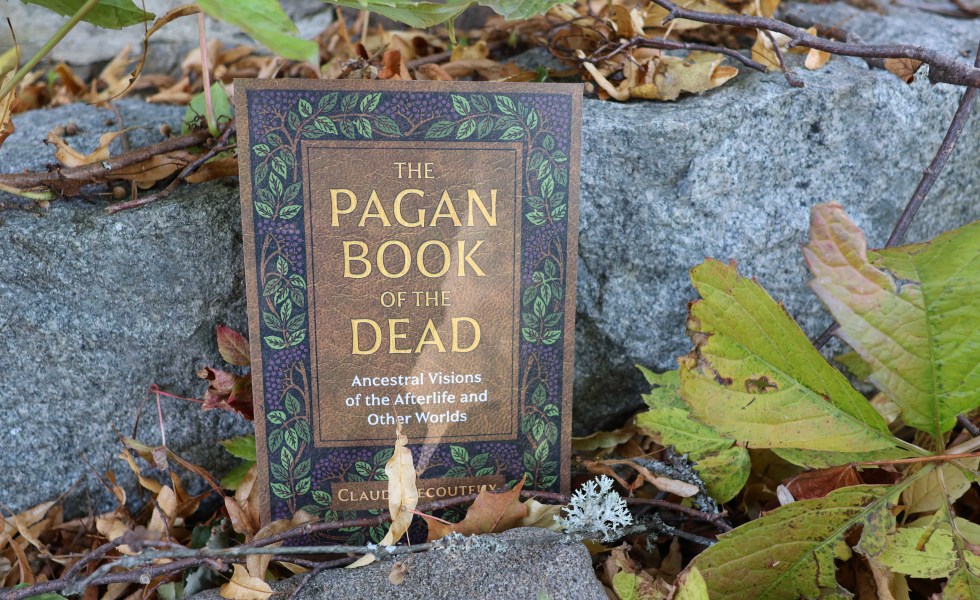
Since I enjoyed the other books by Claude Lecouteux that I have reviewed, I thought it would be interesting to read his The Pagan Book of the Dead – and it is indeed an interesting book. Contrary to what the title might suggest, the book does not only concern Pagan views of the afterlife – the author also draws upon stories and testimonies from the (nominally) Christian times.
European Conception of Angels
Astute enjoyers of my content will know that I often point to angels as a good example of how Christianity was greatly altered to fit the European psyche. This is why we know angels as beautiful and good. The author refers to a text titled Revelation of Moses, in which Moses left his body and travelled through the seven heavens.
‘He saw hell and the men there “tortured by the angels of destruction.” Some were hung up by their eyelids, others by their ears, hands, tongue, sexual organs, or feet, or covered in black worms.’
Claude Lecouteux – The Pagan Book of the Dead. Page 33.
Quite the contrast against said beautiful and good angels!
A Guide in the Afterlife
In the chapter titled Hell, Purgatory, and Paradise, the author shares the following insightful passage:
‘Common to all of the accounts, from antiquity to the Middle Ages, is the presence of a guide accompanying the traveler who has made his way into the beyond: the Yazatas for the Persians, the Uthras for the Mandaeans, Virgil for Dante, and a saint or an angel in the visions. Every time, the guide protects the soul from attacks by demons who want to carry it off.’
Claude Lecouteux – The Pagan Book of the Dead. Page 64.
I always find these perennial themes highly compelling and interesting.
Angels, Demons, and an Irish Saint
The author shares the following epic story from Vita Sancti Fursei (Life of Saint Fursey), written by an anonymous author around 656, in regard to the soul being guided and protected:
‘Falling ill and enveloped in darkness, he gave his last sigh and saw himself picked up by two angels with a third preceding them, armed with a shield and a sword to protect the visionary from attacks by demons. His spirit then rejoined his body because they could not take him with them until he had completed an action. Fursey took communion, and the next day his feet grew cold again, and he fell into a deep sleep on his bed. It is understood that the angels expected him to receive communion. In the course of his journey throughout the beyond, he met two bishops who gave him instructions and advice. During his return trip to earth, Fursey was burned on the jaw and shoulder by demons. When his soul rejoined his body, he saw his chest open.’
Claude Lecouteux – The Pagan Book of the Dead. Page 54.
The author goes on to note that this last detail is missing from an account titled The Golden Legend, but that it says something similar – ‘the devil struck Forsey so hard that after he returned to life, the mark from those blows remained forever.’ And moreover that ‘In a surprising manner, what the soul had suffered had manifested in the flesh.’ This is not the first account of a resurrection – the most famous one is the resurrection of Jesus. I cannot comment further upon these matters for now, but we will revisit the subject as I become wiser and attain more insights.
Virgil and Dante’s Inferno
The author notes that Virgil’s Aeneid served as inspiration for Dante’s Inferno – which in turn was the inspiration for the iconic artwork Chart of Hell by Sandro Botticelli (pictured below). The book is full of examples on how the Pagan conception of the afterlife influenced later Christian views of the afterlife.

Icelandic Syncretism
Readers of my book reviews will be familiar with Icelandic Magic by Stephen E. Flowers (review), in that book the author describes the syncretism that characterised mediaeval Iceland. In The Pagan Book of the Dead, the author notes that mixing Pagan and Christian elements was common in Icelandic literature. He shares an Icelandic poem – Sólarljóð (Song of the Sun) – written around 1200 (so a good bit after the introduction of Christianity). In the poem, the Norns appear. The Norns are the weavers of fate in Germanic tradition.
In a chapter titled The Otherworld in Medieval Scandinavian Literature, the author discusses the works of both Iceland‘s Snorri Sturlasson (1179–1241) and Denmark‘s Saxo Grammaticus (1150–1220). The latter will be familiar to astute listeners of The Greatest Podcast. Here is a short excerpt regarding Saxo from a recent episode: https://www.instagram.com/p/CyDO8AGqUlC/. The author notes that the afterlife in both Snorri‘s and Saxo‘s accounts are syncretic in their nature (i.e. the Pagan view survived into the nominally Christian era).
On a personal note, I must admit that I do indeed appreciate a bit of religious syncretism! That said, the main Gods and Goddesses in my pantheon are Germanic ones – Odin, Balder, and Freya, primarily.

A Celtic Story With an Indian Counterpart
Many of my readers are (I can only suppose) interested in comparative mythology. Perhaps I will discuss the myth at hand at a later stage, but what I can share now (for those who want to read up on it) is the following:
‘Philippe Walter has demonstrated the Celtic origin of the lay of Yonec, whose parallel can be found in the story of Conaire, the legendary king of Tara. But he cites another story taken from the collection of Somadeva, written between 1063 and 1081, in which the supernatural being corresponding to Muldumarec is a rakshasa, an ogre of Indian mythology. The similarities between this story and Yonec are too numerous for them not to represent a shared fragment of our Indo-European heritage.’
Claude Lecouteux – The Pagan Book of the Dead. Page 95.
Said Indo-European heritage can be traced to the Corded Ware Culture – which I discussed briefly in my review of Adrian Goldsworthy’s Rome and Persia (review).
Celtic Afterlife and Dogs
On another note regarding comparative mythology, I thought to share the following valuable insight by the author:
‘The sea voyages of Conn and his son thus illustrate that the otherworld for the Celts was composed of islands. Among the recurring themes we have apples, crystal, and ice. One detail is striking: the names Coinchenn, Coinchend, and coincuilind are all derived from cú (genitive form: con), meaning “dog” (cf. Ancient Greek κύων). This gives me license to venture the hypothesis that we are seeing a vestige of totemism here, although this is not the only possible interpretation, as we shall see.’
Claude Lecouteux – The Pagan Book of the Dead. Pages 140-141.
Men of culture will perhaps think of Cú Chulainn when reading this passage – indeed, his name is usually translated to ‘Culann’s hound.’ What is interesting about dogs in relation to the afterlife is that we see the great dogs Garmr in Germanic myth and Cerberus in Greek myth. For more information about dogs and wolves in Indo-European religion, see my review of Kris Kershaw‘s The One-eyed God and the (Indo)-Germanic Männerbünde.

Conclusion
The Pagan Book of the Dead is 250 pages and contains a wealth of information about the view of the afterlife – both in Pagan and Christian times. I can definitely recommend the book for anyone interested in these matters.



 The Golden One
You must be logged in to post a comment.