Samurai of the West by Dominique Venner
Posted on November 11, 2025
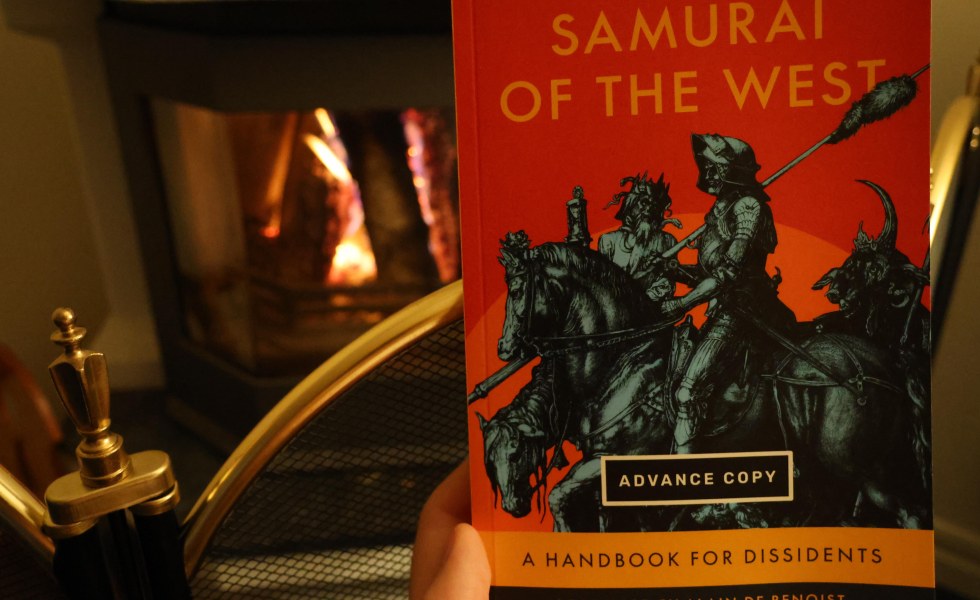
I have had the pleasure of reading Samurai of the West by the eminent Dominique Venner. I first encountered the teachings of Venner around ten years ago upon reading The Shock of History. Then, like now, his writings resonated deeply with me. Just as The Shock of History, Samurai of the West contains many beautiful passages and valuable insights. This review could have been much longer as there is much from the book I would like to share!
Dürer’s Knight
Cultured gentlemen will recognise the artwork adorning the cover of the book. Namely, Albrecht Dürer’s masterpiece Knight, Death and the Devil (Ritter, Tod und Teufel) from 1513. The author notes that he feels in harmony with this great rebel – a role model par excellence. The author describes our Knight in the following manner:
‘In those times, it was not good to ironize about Death and the Devil, the terror of good people and others, maintained byt those who profited from it. But he, Dürer’s solitary Knight, with an ironic smile on his lips, rides on, indifferent and calm. To the Devil, he does not even cast a glance. Yet this scarecrow is reputed to be formidable. The terror of the era, as so many dances of death and purchases of indulgences remind us, the Devil lies waiting in ambush to seize the deceased and throw them into the eternal braziers of Hell. The Knight mocks this and disdains this specter.’
Dominique Venner. Samurai of the West. Pages 4-5.
The beautiful passage goes on to describe the Knight’s fearless attitude towards Death. Inspiring stuff! On a personal note, I have always appreciated Dürer’s artwork. Our fine Legio Gloria t-shirt celebrating the Knight is currently out of stock – I will view this as a sign to bring it back!

Politics First – Mystique First
In an interesting and relevant passage that is worth contemplating, the author notes the following:
‘I will say for my part: “Mystique first.” Political action is inconceivable without the prerequisite of a mystique capable of directing it and responding to the “we are nothing.”
Dominique Venner. Samurai of the West. Page 11.
What mystique? That of the clan, of course, of sources and origins, in other words, of our traditions and our identity.’
Gentlemen involved in the metapolitical struggle for European civilisation will be intimately familiar with discussions regarding political involvement. My take is that both are needed, both an awakening of the European Soul as well as concrete political action. As I have noted many times, our political enemies (i.e. those who are against European civilisation) constantly attack our history. They do this because they know it is an effective way of weakening us. Thus, we have to become strong by understanding our history.
A Lover of Europa
On a personal note, I feel a kinship with Dominique Venner. I understand his love for European civilisation, because I share it. This is a love that becomes clear when enjoying his insights. A good test which can determine whether someone is a true lover of Europa is his or her perspective on the origins of European civilisation. The correct answer is that Athens, not Jerusalem, is the ancient city that has played the most important role for our civilisation. Under the title of Athens of Jerusalem, the author shares the following interesting insight.
‘This is not a conflict between reason and faith, but a conflict between two different faiths, one in the rules of the ordered cosmos (the tradition of Athens), the other in the sole will of God (the tradition of Jerusalem).
Dominique Venner. Samurai of the West. Page 53.
For the family of thought to which Homer, Heraclitus, Plato, and Aristotle belong, the laws that govern the world are eternal (day returns after night, etc.) For that of Moses, Tertullian, and later Mohammed, they come from an eternal God who created the world arbitrarily, by pure will.’
He elaborates more on this dichotomy throughout the book.

The Celtic Spirit of the Middle Ages
As has become increasingly clear for many of us in recent years, the Middle Ages were not Christian; the dominant religion was rather a syncretic one which blended elements of Paganism with Christianity. The author notes the following Celtic spirituality during the Middle Ages:
‘In the Middle Ages, the animal is still frequently represented in religious statuary, where in principle it should have had no business. Romanesque art and then Gothic art still accorded it a non-negligible place. It is often transposed into a fabulous creature by Celtic imagination. Celtic legends indeed show that the faculty of communicating with sacred animality had not been lost. Overflowing with Celtic spirituality, the literature of the Middle Ages embroiders from the 12th century on the theme of the forest, a perilous universe, but also a source of purification for the soul of the knight, whether he be named Lancelot, Perceval, Tristan, or Yvain. By capturing a stag or a boar, the noble hunter appropriates its force and spirit.’
Dominique Venner. Samurai of the West. Page 46.
Later in the book, he shares the following related insight:
‘It has been said that the Renaissance had placed at the heart of Christendom a pagan civilisation that was its negation. In reality, this civilization, born in Greece on the Hellenic branch of the Western Indo-Europeans, then surviving in Rome, was never really uprooted. In the West, the Church poured itself into the imperial mold from which it drew its strength, the philosophy of Plato and Aristotle offering it its rational justifications. Its moral teaching was partly modeled on that of the Stoics. And to incorporate the immense people of the countryside, it tok over the ancient ritual festivals, the cult of sacred springs, and that of familiar divinities to which it gave the names of saints.’
Dominique Venner. Samurai of the West. Page 74.

Mediaeval Homeric Heroes
Reinforcing the point of a Pagano-Christian Middle Ages is the following example of a young knight named Jacques de Lalaing, who was killed during the Battle of Poucques in 1453. The epitaph written for him said:
‘He was the flower of knights; he was beautiful like Paris the Trojan; he was pious like Aeneas; he was wise like Odysseus the Greek. When he found himself in battle against his enemies, he had the wrath of Hector the Trojan.’
Dominique Venner. Samurai of the West. Page 137.
The standard of heroism was Homeric – not Biblical.
Boreans
The author says the following about the Iliad and the Odyssey:
‘These sacred poems are the Greek expression of a heritage common to all our European or Borean ancestors, whether Celtic, Germanic, Slavic, or Latin.’
Dominique Venner. Samurai of the West. Page 113.
The quote goes on:
‘I have just used the neologism Borean, which requires an explanation. I use it to avoid equivocations about the word “European,” sometimes put to dubious uses. “Boreans” designates Europeans of ancient stock. This term has a broader meaning than “Indo-Europeans,” which is used mainly in linguistics. It proceeds from the Greek myth of origins reported by Herodotus, Plutarch, and Diodorus of Sicily. For the Greeks, the mythical people of the Hyperboreans (those who live beyond the breath of Boreas, the North Wind) lived a blessed existence in the North.’
Dominique Venner. Samurai of the West. Pages 113-114.
The author goes on to note that the Boreans worshipped Apollo, and that they came with offerings each year at Apollo’s sanctuary in Delos. I must make a pilgrimage there; hopefully an opportunity will present itself in the years to come.

The Germanic Heirs of Rome
As I note myself in Demigod Mentality, the Germanic peoples did not destroy the Roman Empire; rather, they saved its essence and transformed it. Venner states it in the following way:
‘According to the statements of school history, Antiquity was undoubtably dead when Odoacer deposed the last emperor of the West in 476. But at the same instant was born medieval Europe, which implicitly took up the heritage of the Greco-Roman world.’
Dominique Venner. Samurai of the West. Page 83.
Conclusion
The overarching theme of the book is that European civilisation has a long and uninterrupted history – a great story that must go on!
Samurai of the West was an absolute joy to read, and I can recommend it to everyone. It is 200 pages long. I will reread it and discuss it at length in a future podcast episode. Onwards!
Statement on Active Club Sweden
Posted on October 23, 2025
Unfortunately, a few young men associated with Active Club Sweden have committed some acts of unprovoked violence. At first, I thought it was just a case of lies from the Left-wing extremist media. It seems to be true, however. Hence, I am making this statement.
First and foremost, what is at stake?
The very survival of Sweden itself.
This is not an exaggeration; this is just a statement of facts.
Furthermore, we are in a very bad situation. I always tell others that they are wrong when they say that it is over for Sweden. It is not over, but it is almost over. We have a chance to turn things around, but it is a slim chance.
This means that we are not in any position whatsoever where we can afford mistakes.
A mistake in this situation would be to not call out unnecessary and unprovoked violence against random people.
Again, this is, from my understanding, not a case of self-defence. I have always been clear in that you have a moral and a legal right to fight back if you are attacked.
I have also always been clear about the fact that violence that can be interpreted as having ideological motives will only ever benefit the Left-wing extremist regime.
I am fairly certain that they (journalists, among others) are celebrating at the moment. They have painted a picture of the violent Right-wing thugs for so long. Finally! They have an example to point to.
This example will be used for decades to come in order to discredit pro-Swedish forces in Sweden.
I can only hope that Active Club Sweden makes it clear that attacking random individuals in the middle of the night in Stockholm is not something they (i.e. the majority of activists and members) endorse.
I must also say that it pains me to see this type of irrational behaviour. Not disciplined. Not productive. Not intelligent. Not honourable.
Honourable is putting your name and face on a belief that you refuse to back down from. Honourable is having been a highly recognisable public figure for ten years who has been ready for any type of fight at any time. That is discipline.
Lastly, whilst denouncing anti-social behaviours, we must also continue to expose the Left-wing extremist regime (the media in particular) for their double-standards.
They make a big deal out of this whilst completely ignoring (or excusing, at least) the lethal violence that is destroying Sweden (not to mention the number of Swedish girls who are raped as a result of the multicultural hell-project they are so fond of).
Legio Gloria Merino Wool Autumn 2025
Posted on September 21, 2025

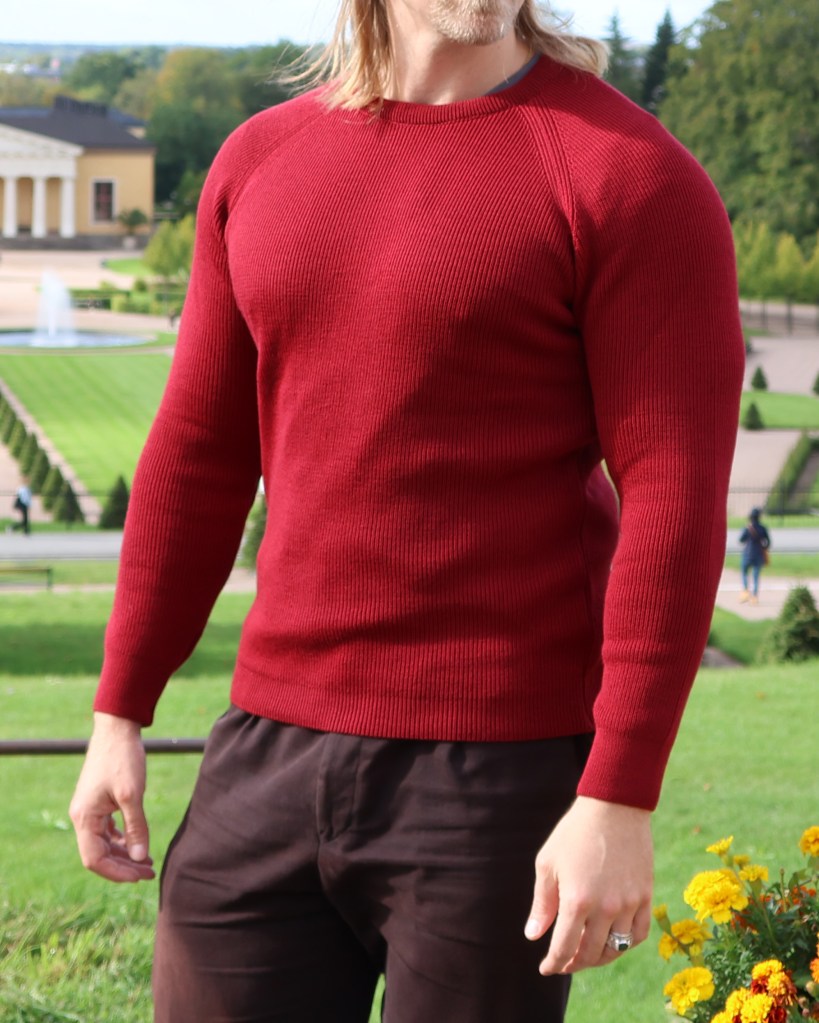
We are happy and proud to present four new merino wool garments. From Lithuania with love! The garment in the picture above is the Grey Gigachad Merino Wool Sweater, it is the same model as the popular Green Gigachad Merino Wool Sweater – ribbed and fitted! Below is the Burgundy Gigachad Merino Wool Sweater (which is also the same model) – I am especially happy with this one.
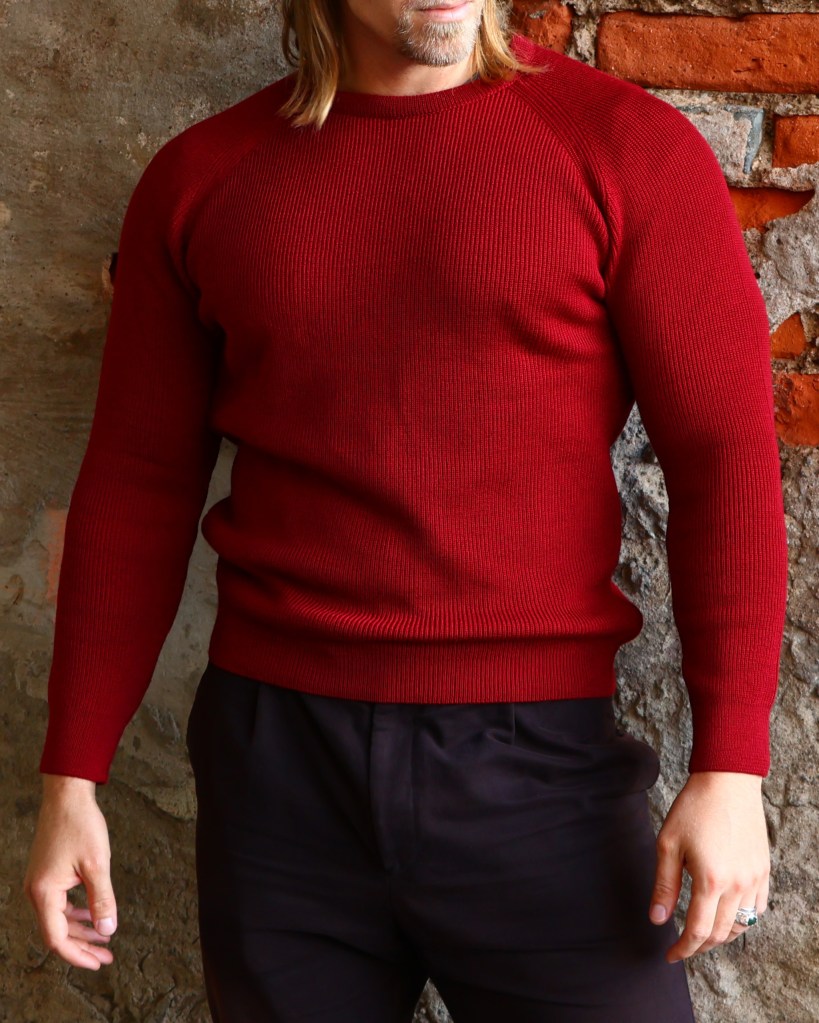
Below is the Tyrian Handsome Merino Wool Sweater, it is the same model as the Handsome Merino Wool Sweater. Quite the eye-catching colour! Very beautiful, if I may be so bold.


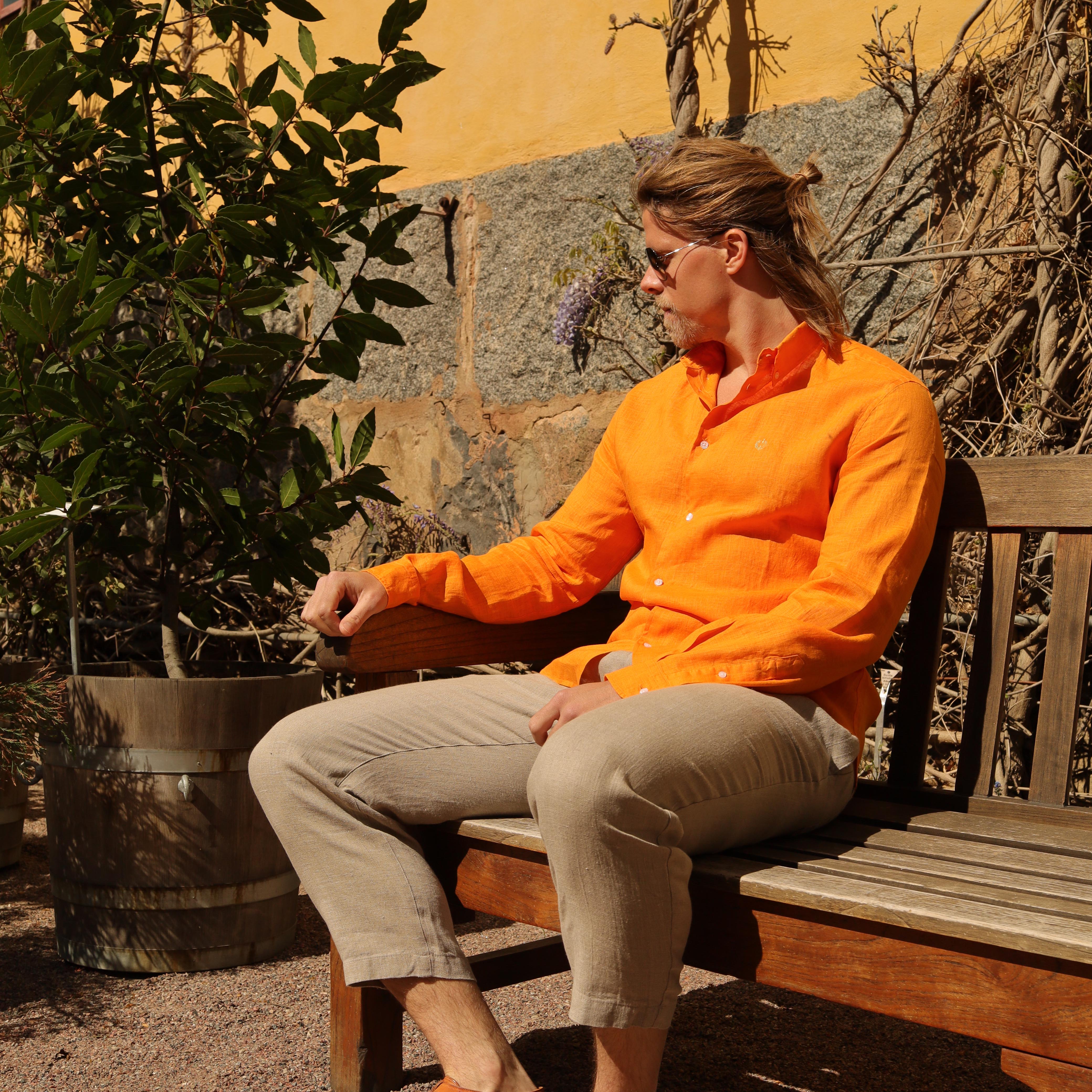
Below are the Wool Trousers of the Ages. I have used the prototype for these basically every day since March this year (except the warmest days of summer). Thus, I am happy to release the final product. Truly great stuff!
You can wear these for a wide variety of activities – composing poetry in your study, a harmonious forest walk, meditation, yoga, for example. Comfortable and aesthetically pleasing.
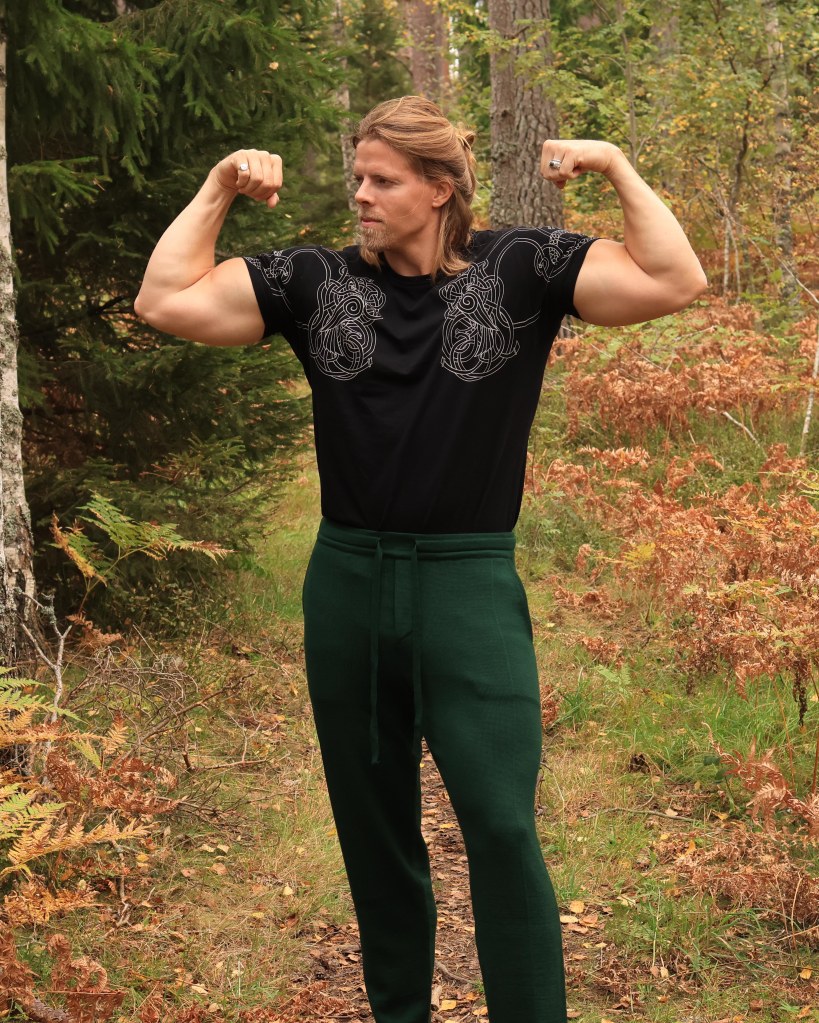

Head over to LegioGloria.com to check out the new releases. Onwards!
Fascism Viewed From the Right by Julius Evola
Posted on August 20, 2025
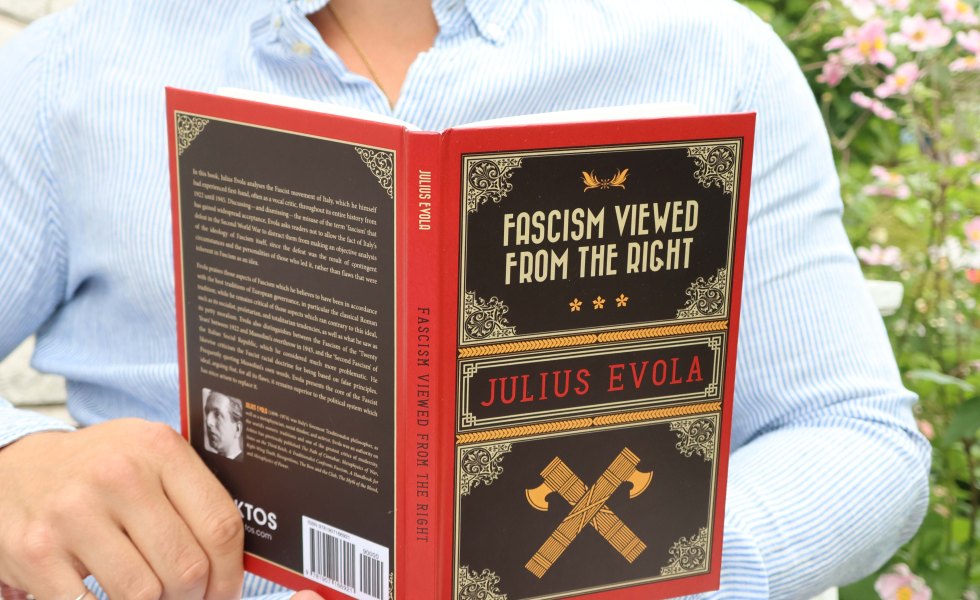
I have read Fascism Viewed From the Right by Julius Evola. As I have noted before, I prefer the good baron’s esoterico-magical writings, but his socio-political ones are also worth reading for a connoisseur such as myself! The book is quite concise (121 pages), and many of the insights presented are found in his other books. In this book, he aims to present a nuanced view of Fascism (looking at both the good and the bad). We have discussed Evola’s relationship with Mussolini and Fascism elsewhere (in summary: he was never a member of the party and had his disagreements with the Fascist regime).
An Animating Myth
Among the positive aspects he notes the following:
‘In the period that immediately followed the First World War, Italy presented itself as a secular state, in which the influence of Freemasonry was considerable, with a weak and mediocre liberal democratic government and a monarchy without real power; in other words, constitutional and parliamentary, a state that on the whole lacked a ‘myth’ in the positive sense, that is, a superior animating and formative idea that could have made of it something more than a mere structure of public administration.’
Julius Evola – Fascism Viewed From the Right. Page 30.
This related to what I talk about in Demigod Mentality (The Story of Who We Are). He goes on to say the following:
‘Thus, the merit of Fascism was, above all, to have revived in Italy the idea of the state and to have created the basis for an active government, by affirming the pure principle of authority and political sovereignty.’
Julius Evola – Fascism Viewed From the Right. Page 30.
One-Party State
As the late and great Jonathan Bowden once noted, Evola criticised Fascism for not being Right-wing enough, not hierarchical enough. Evola did not like the mass-movement aspect of it all. Evola says the following of the one-party system.
‘The true state – it is hardly necessary to say this – does not admit the rule of parties (partitocrazia) of democratic regimes. Parliamentary reform, which we shall talk about in a little while, undoubtedly represented one of the positive aspects of Fascism. However, the conception of a ‘one-party state’ is absurd. Because it belongs exclusively to the world of parliamentary democracy, it is only irrationally that the idea of a ‘party’ can be preserved in a regime opposed to everything that is democratic.’
Julius Evola – Fascism Viewed From the Right. Page 57.
He goes on to note that a ‘party‘ means to be only a part – a state within a state. The true state, in contrast, is a whole. In the same chapter he states the following:
‘Even after the conquest of power the Fascist party was committed to being a mass party. It opened itself up, instead of purifying itself. Instead of making membership in the Party appear a difficult privilege, the regime practically imposed it on everyone.’
Julius Evola – Fascism Viewed From the Right. Page 59.
Again, Evola did not appreciate the mass-movement aspect of Fascism and preferred the rule by a small elite. On a similar note related to the party – as we have noted elsewhere, Evola wanted to enlist as an officer to fight against the Soviets, but his applications were rejected since he was not a member of the party. So his aversion can be seen from both an intellectual as well as a personal perspective.
Monarchy
The following quote summarises his position on monarchy quite well.
‘We can reasonably affirm that a true Right without the monarchy ends up deprived of its natural centre of gravity and crystallisation, because in almost all traditional states the principal reference point for realizing the independent and stable principle of pure political authority has been the crown.’
Julius Evola – Fascism Viewed From the Right. Page 50.
Well stated! He elaborates further on the relationship between the Fascist regime and the monarchy in the book. I have discussed my own views on monarchy elsewhere, and will return to the topic later on as well.

Traditional State vs Totalitarian State
Evola shares the following profound and inspiring insight:
‘The traditional state is organic, but not totalitarian. It is differentiated and articulated, and admits zones of partial autonomy. It coordinates forces and causes them to participate in a superior unity, while recognising their liberty. Exactly because it is strong, is does not need to resort to mechanical centralising, which is required only when it is necessary to rein in in a shapeless and atomistic mass of individuals and wills, from which, however, disorder can never be truly eliminated, but only temporarily contained.’
Julius Evola – Fascism Viewed From the Right. Page 42.
He goes on to note that the true state is all powerful, but is not doing all – meaning that it holds absolute power (beyond the ‘rule-of-law’), but does not meddle in everything. So, quite the opposite of today’s European regimes where the state does not hold absolute power (but has to contend with other forces within society), yet at the same time meddles in every aspect of the lives of its citizens.
Pro-Natalist Campaign
Evola labels the Fascist pro-natalist campaign ‘odious’, and the notion that ‘number is power’ is a principle contradicted by history since ‘numbers’ have always been subjugated by small, dominating groups. This criticism of the Fascist regime by Evola comes as no surprise for those who are familiar with his views. He notes:
‘Empires have been created by these groups, and not by a demographic overflow of masses of the dispossessed and pariahs flooding over the lands of the rich with no other right but their poverty and procreative incontinence.’
Julius Evola – Fascism Viewed From the Right. Page 46.
He goes on to note that the population of Italy at the time was already excessive. I will discuss this matter at length later on. For now, I can say that it is an unworthy and unloving attitude to view children (which are a divine blessing) as numbers to bolster a demographic situation. To speak of our issues today, it is clear that our own birth-rates will not change our destiny – only remigration will. It is also not desirable to uphold a system that requires a constantly growing population.
A Statement by Sulla
Evola recalls a statement by Sulla which I thought was insightful – said ambition was not to possess gold, but to hold power over those who possess it. This is an interesting statement which deserves further attention (I will discuss it at length in a coming podcast episode).
Conclusion
The book has 121 pages. It is not one of Evola’s more captivating books, and I would not necessarily recommend anyone start with this title. Metaphysics of Power is a better starting point (and contains more valuable socio-political insights). For the Evola connoisseur, however, it is, again, well worth a read!



 The Golden One
You must be logged in to post a comment.