Samurai of the West by Dominique Venner
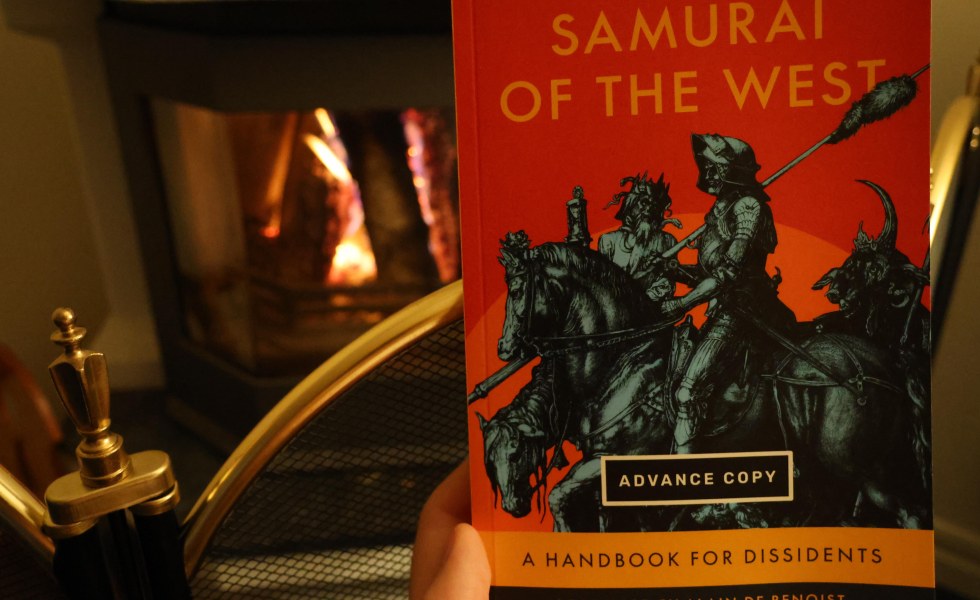
I have had the pleasure of reading Samurai of the West by the eminent Dominique Venner. I first encountered the teachings of Venner around ten years ago upon reading The Shock of History. Then, like now, his writings resonated deeply with me. Just as The Shock of History, Samurai of the West contains many beautiful passages and valuable insights. This review could have been much longer as there is much from the book I would like to share!
Dürer’s Knight
Cultured gentlemen will recognise the artwork adorning the cover of the book. Namely, Albrecht Dürer’s masterpiece Knight, Death and the Devil (Ritter, Tod und Teufel) from 1513. The author notes that he feels in harmony with this great rebel – a role model par excellence. The author describes our Knight in the following manner:
‘In those times, it was not good to ironize about Death and the Devil, the terror of good people and others, maintained byt those who profited from it. But he, Dürer’s solitary Knight, with an ironic smile on his lips, rides on, indifferent and calm. To the Devil, he does not even cast a glance. Yet this scarecrow is reputed to be formidable. The terror of the era, as so many dances of death and purchases of indulgences remind us, the Devil lies waiting in ambush to seize the deceased and throw them into the eternal braziers of Hell. The Knight mocks this and disdains this specter.’
Dominique Venner. Samurai of the West. Pages 4-5.
The beautiful passage goes on to describe the Knight’s fearless attitude towards Death. Inspiring stuff! On a personal note, I have always appreciated Dürer’s artwork. Our fine Legio Gloria t-shirt celebrating the Knight is currently out of stock – I will view this as a sign to bring it back!
Politics First – Mystique First
In an interesting and relevant passage that is worth contemplating, the author notes the following:
‘I will say for my part: “Mystique first.” Political action is inconceivable without the prerequisite of a mystique capable of directing it and responding to the “we are nothing.”
Dominique Venner. Samurai of the West. Page 11.
What mystique? That of the clan, of course, of sources and origins, in other words, of our traditions and our identity.’
Gentlemen involved in the metapolitical struggle for European civilisation will be intimately familiar with discussions regarding political involvement. My take is that both are needed, both an awakening of the European Soul as well as concrete political action. As I have noted many times, our political enemies (i.e. those who are against European civilisation) constantly attack our history. They do this because they know it is an effective way of weakening us. Thus, we have to become strong by understanding our history.
A Lover of Europa
On a personal note, I feel a kinship with Dominique Venner. I understand his love for European civilisation, because I share it. This is a love that becomes clear when enjoying his insights. A good test which can determine whether someone is a true lover of Europa is his or her perspective on the origins of European civilisation. The correct answer is that Athens, not Jerusalem, is the ancient city that has played the most important role for our civilisation. Under the title of Athens of Jerusalem, the author shares the following interesting insight.
‘This is not a conflict between reason and faith, but a conflict between two different faiths, one in the rules of the ordered cosmos (the tradition of Athens), the other in the sole will of God (the tradition of Jerusalem).
Dominique Venner. Samurai of the West. Page 53.
For the family of thought to which Homer, Heraclitus, Plato, and Aristotle belong, the laws that govern the world are eternal (day returns after night, etc.) For that of Moses, Tertullian, and later Mohammed, they come from an eternal God who created the world arbitrarily, by pure will.’
He elaborates more on this dichotomy throughout the book.
The Celtic Spirit of the Middle Ages
As has become increasingly clear for many of us in recent years, the Middle Ages were not Christian; the dominant religion was rather a syncretic one which blended elements of Paganism with Christianity. The author notes the following Celtic spirituality during the Middle Ages:
‘In the Middle Ages, the animal is still frequently represented in religious statuary, where in principle it should have had no business. Romanesque art and then Gothic art still accorded it a non-negligible place. It is often transposed into a fabulous creature by Celtic imagination. Celtic legends indeed show that the faculty of communicating with sacred animality had not been lost. Overflowing with Celtic spirituality, the literature of the Middle Ages embroiders from the 12th century on the theme of the forest, a perilous universe, but also a source of purification for the soul of the knight, whether he be named Lancelot, Perceval, Tristan, or Yvain. By capturing a stag or a boar, the noble hunter appropriates its force and spirit.’
Dominique Venner. Samurai of the West. Page 46.
Later in the book, he shares the following related insight:
‘It has been said that the Renaissance had placed at the heart of Christendom a pagan civilisation that was its negation. In reality, this civilization, born in Greece on the Hellenic branch of the Western Indo-Europeans, then surviving in Rome, was never really uprooted. In the West, the Church poured itself into the imperial mold from which it drew its strength, the philosophy of Plato and Aristotle offering it its rational justifications. Its moral teaching was partly modeled on that of the Stoics. And to incorporate the immense people of the countryside, it tok over the ancient ritual festivals, the cult of sacred springs, and that of familiar divinities to which it gave the names of saints.’
Dominique Venner. Samurai of the West. Page 74.

Mediaeval Homeric Heroes
Reinforcing the point of a Pagano-Christian Middle Ages is the following example of a young knight named Jacques de Lalaing, who was killed during the Battle of Poucques in 1453. The epitaph written for him said:
‘He was the flower of knights; he was beautiful like Paris the Trojan; he was pious like Aeneas; he was wise like Odysseus the Greek. When he found himself in battle against his enemies, he had the wrath of Hector the Trojan.’
Dominique Venner. Samurai of the West. Page 137.
The standard of heroism was Homeric – not Biblical.
Boreans
The author says the following about the Iliad and the Odyssey:
‘These sacred poems are the Greek expression of a heritage common to all our European or Borean ancestors, whether Celtic, Germanic, Slavic, or Latin.’
Dominique Venner. Samurai of the West. Page 113.
The quote goes on:
‘I have just used the neologism Borean, which requires an explanation. I use it to avoid equivocations about the word “European,” sometimes put to dubious uses. “Boreans” designates Europeans of ancient stock. This term has a broader meaning than “Indo-Europeans,” which is used mainly in linguistics. It proceeds from the Greek myth of origins reported by Herodotus, Plutarch, and Diodorus of Sicily. For the Greeks, the mythical people of the Hyperboreans (those who live beyond the breath of Boreas, the North Wind) lived a blessed existence in the North.’
Dominique Venner. Samurai of the West. Pages 113-114.
The author goes on to note that the Boreans worshipped Apollo, and that they came with offerings each year at Apollo’s sanctuary in Delos. I must make a pilgrimage there; hopefully an opportunity will present itself in the years to come.
The Germanic Heirs of Rome
As I note myself in Demigod Mentality, the Germanic peoples did not destroy the Roman Empire; rather, they saved its essence and transformed it. Venner states it in the following way:
‘According to the statements of school history, Antiquity was undoubtably dead when Odoacer deposed the last emperor of the West in 476. But at the same instant was born medieval Europe, which implicitly took up the heritage of the Greco-Roman world.’
Dominique Venner. Samurai of the West. Page 83.
Conclusion
The overarching theme of the book is that European civilisation has a long and uninterrupted history – a great story that must go on!
Samurai of the West was an absolute joy to read, and I can recommend it to everyone. It is 200 pages long. I will reread it and discuss it at length in a future podcast episode. Onwards!





You must be logged in to post a comment.