Germanic Theology: Volume I by Tristan Powers
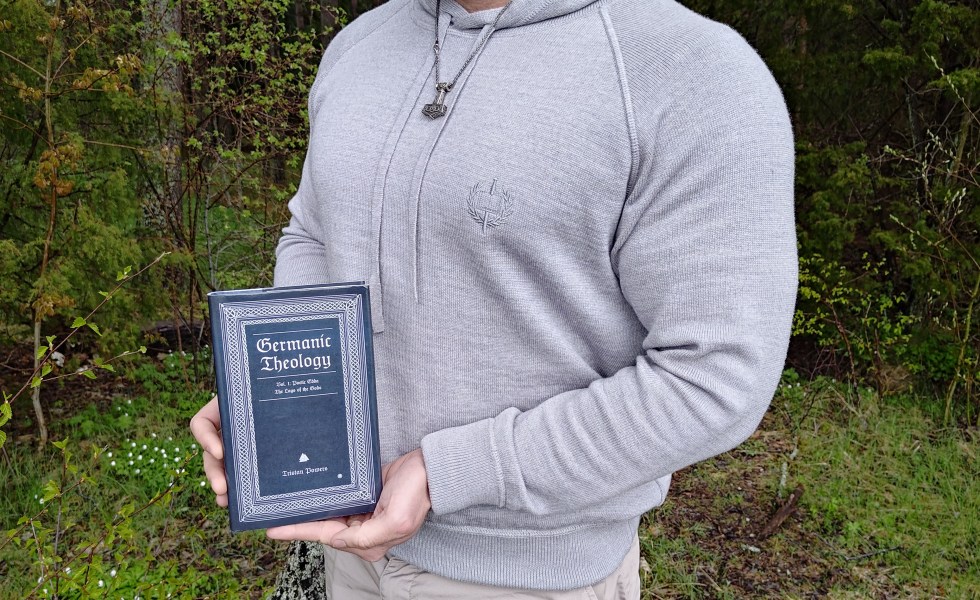
I have had the pleasure of reading Germanic Theology Volume I: Poetic Edda – The Lays of the Gods by Tristan Powers. The book is, contrary to its title, not about Germanic theology per se, but would be better described as a commentary on the Poetic Edda. Astute Enjoyers of my content will remember that I reviewed the Imperium Press edition of the Poetic Edda (translation by Henry Adams Bellows) a while back. Powers’ commentary is excellent and insightful. So, if you plan on reading the Poetic Edda, Germanic Theology is a good companion!
Sexual Morality
In several places, the author correctly emphasises the strict sexual morality of the Vikings. The faulty notion that the pre-Christian Germanic peoples were anything but virtuous comes from two sources: Christians and modern liberals (I use the term liberal in the broad sense). The Christians had an incentive in portraying the old Gods and their worshippers as immoral, thereby presenting the introduction of a new faith as something that brought with it an increase in societal virtue. The modern liberal perspective is one that seeks to juxtapose the attractive Vikings against the repressive Christians – in the sense that they wish to portray pre-Christian sexual attitudes as “tolerant” and Christian ones as “intolerant”.
‘It must be noted that our ancestors did not permit the open seduction of women and considered such a thing to be illegal and subject to immediate physical violence – up to death – in order to avenge the attempt or intent to do so, such was their concern and care for the chastity of their wives, sisters, and daughters.’
Tristan Powers – Germanic Theology. Page 65.
Moreover, the author notes that Ergi – behaviour unbefitting of a man – was seen as a religious crime. The Vikings were anything by “tolerant” in the modern sense of the word. As I noted in Podcast Episode 45. Viking Worldview, honour was central and paramount for our ancestors.
Our Lady Freya
Freya, perhaps more than any Pagan deity (with the possible exception of Odin), has been the target of malicious attacks – both in the past and today. The author perfectly states the following:
‘Secondly we may note that, in a strictly sociological sense, it would be usual or illogical to find that a people such as the Germanic should consider their primary female divinity to be unchaste and representative of all baseness they despised and outlawed amongst their own wives and daughters.’
Tristan Powers – Germanic Theology. Page 281.
The author goes on to note that any notion that the Goddess Freya would be unchaste must be seen as lies and slander. With this, I wholeheartedly agree. It makes perfect sense for rivals and enemies to portray an important Goddess in a negative light, and it makes absolutely zero sense that her worshippers would believe this about her.

Gothic Order
On the same topic of sexual morality, the author shares an insightful quote from the 5th century priest Salvian of Marseilles:
‘Wherever the Goths become masters we see no longer any disorders among the old inhabitants. Our manners are reformed under the dominion of the Vandals. Behold and incredible event! Barbarians have, by the severity of their discipline, rendered chaste the Romans themselves; and the Goths have purified those places which the others have defiled by their debaucheries. A cruel warlike nation, but worthy to be admired for their continence.’
As I have noted elsewhere, the Goths have often been misrepresented as destroyers. In fact, they – and the other Germanic tribes of the Migration Era – created a new Europe out of the greatly degenerated remains of the Roman Empire. Enthusiasts of The Greatest Podcast will recall that I discussed Theodoric the Great and the Ostrogothic Kingdom in Episode 30. The Gothic Heirs of Rome.
Magically Gifted Norse Queens
In the chapter commenting on Hávamál, the author notes that the wives of Norse kings would (stereotypically) be sorceresses or wise in magical foresight and healing – thus bolstering the rule and skills of their lordly husbands. As anyone interested in spiritual matters will know, certain women do indeed possess powers of foresight and intuition. Pre-Christian Europeans had a place for women in their religious practices. In fact, this did not completely end with the introduction of Christianity. During the Catholic period (i.e. the period of Pagan-Christian Syncretism) women could still find ways to express this divine connection – notable examples are Hildegard of Bingen, Joan of Arc, and Bridget of Sweden. It must be noted that this was in spite of the Christianity of the time – after all, Joan of Arc was burnt at the stake!
Pictured below: A Sensitive Poet seeking the mystic insights of Heliga Birgitta (Saint Bridget of Sweden).

Rígsþula, Odin, Heimdall
In the chapter commenting on Rígsþula, the author notes that white linen was considered suitable wear for kings and jarls. I fully endorse this statement! Rígsþula is the myth in which Rig – who is Heimdall according to some sources and Odin according to some – visits three families and creates the three castes (mirrored in Vedic tradition): Thrall (black/dark), Karl (red/ruddy), Jarl (white/fair). The author notes that he is more inclined to agree with the theory that posits Odin as Rig and makes a compelling case for this. On a personal note, I must meditate further upon it to give a conclusive statement, but for now I can say that I, too, view it as reasonable to believe that Rig is Odin.
Pictured below: An Aspiring Enlightened Despot contemplating the nature of Rig whilst wearing the finest linen.

Conclusion
As already noted, I can definitely recommend Germanic Theology for those who have or will read the Poetic Edda. I would recommend it even if you do not intend to read the poems themselves, as the book contains plenty of valuable insights. Good stuff!




 The Golden One
You must be logged in to post a comment.