The Runes by Alain de Benoist

I have read The Runes and the Origins of Writing by Alain de Benoist. As Enjoyers of my content will be aware, I am always on the search for more knowledge about the Runes. It might be worth pointing out that my interest in the Runes is mainly in regard to the psycho-magical – viewing them as just an alphabet is missing the point completely. Alain de Benoist is, alongside Guillaume Faye, the most important thinker of the French New Right. I have read some other works by de Benoist and always find his insights valuable. This book was no exception!
Religion & Magic
I must also point out that I am not alone in viewing the Runes as being primarily magical in their nature. The author discusses this in the book. In the chapter titled The Debate on ”Magic”, the author shares the following related insight:
‘The opposition between magic and religion, which is a characteristic of Judeo-Christian monotheism, isn’t present in European Paganism, and they were even said to have an “essential similarity.”’
Alain de Benoist – The Runes. Page 69.
On the same page, he goes on to share an insight from François-Xavier Dillmann. Dillman notes that, in most Indo-European civilisations, magic cannot be disassociated from all of the beliefs, representations, and religious rites – on the contrary, it is a prevalent component. Dillman also notes that Runic writing and Germanic writing is often one and the same. Pictured below: Birches and the Berkana Rune (related to Freya).

Discovered – Not Invented
In the chapter titled Odin and the “Divine Origins” of the Runes, the author shares the supremely beautiful passage from the Havamal in which Odin tells of how he took up the Runes. Recited by Yours Truly here:
He correctly identifies that the Runes were not invented, but discovered.
‘So, it is in that famous text that Scandinavian tradition attributes the discovery of the Runes to Odin. It should be emphasized that it’s a discovery, not an invention, because the text implies that the Runes existed prior to the story being told.’
Alain de Benoist – The Runes. Page 89.
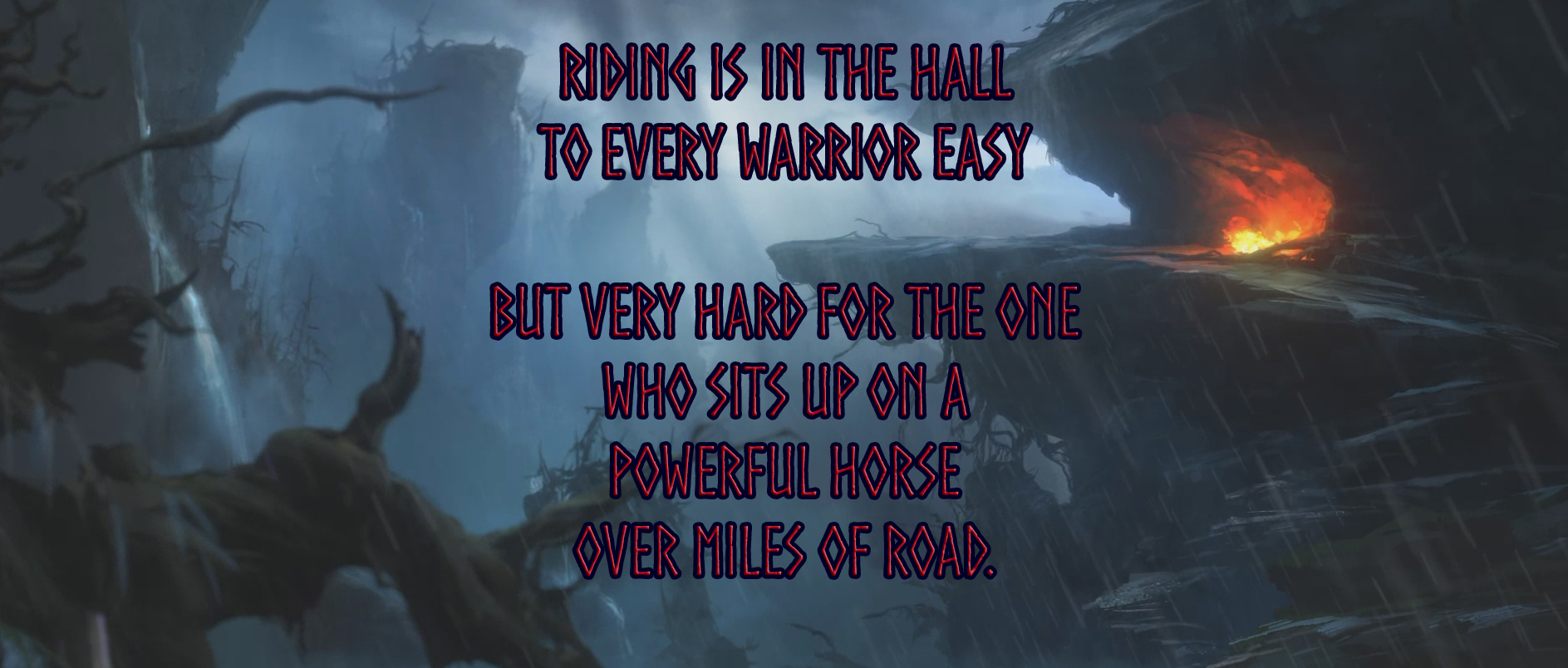
Pictured below: The Raido Rune Poem.
Night & New
The author presents an interesting observation relating to numbers and the words for night and new in Indo-European languages. Examples for eight and night below:
- French: huit/nuit.
- German: acht/Nacht.
- English: eight/night.
- Italian: otto/notte.
- Spanish: ocho/noche.
And for nine and new:
- French: neuf/neuf.
- German: neun/neu.
- English: nine/new.
- Italian: nove/nuovo.
- Spanish: nueve/nuevo.
Odin hung for nights full nine on the tree before taking up the Runes. The number nine comes up in many other religious contexts as well. I do not usually find numerology particularly interesting, but I thought this numerologico-etymological observation was worth sharing. In regard to the Runes of the Elder Futhark, they are sorted into three aetts (ätter, clans, in Swedish) of eight. 3×8 = 24 Runes in total.
Jera & Janus
The author refers to Jean Haundry, who notes that the Jera Rune (Jera as in year) has the shape of Janus – the dual-faced Roman God who oversees the transitions between years. The name Janus also appears in the name of the month January.
The Sea Peoples
The Sea Peoples (the ones connected to the Bronze Age Collapse) are always interesting! Thus, I was delighted to find a few pages dedicated to them (they were discussed in relation to the origins of the alphabet). The author says the following:
‘The bas-reliefs of Medinet Haby describe with some degree of precision the attackers. They make them out to be tall, with a straight nose, often tattooed, but clean shaved and not circumcised.’
Alain de Benoist – The Runes. Page 149.
I can only speculate as to the origins of the mysterious Sea Peoples, but if I were to guess, I would say that they were a confederation of tribes high in Steppe Ancestry (i.e. Aryan/Indo-European blood). We will return to the Sea Peoples later on! Pictured below: The Spirit of a Sea People Chieftain has materialised.

Conclusion
The Runes and the Origins of Writing has 164 pages and is well worth reading for those interested in the Runes. It does not discuss the individual Runes, nor the magical nature of them. The book is more about the relation of the Runes to other writing systems. That said, the author (as shown above) emphasises the fact that the Runes are indeed magical.
I would also recommend Demigod Mentality (where I present each Rune and how to use their teachings and mysteries) as well as Rune Might (review) and Revival of the Runes (review) by Stephen E. Flowers.
Onwards!



 The Golden One
You must be logged in to post a comment.