The Fall of Spirituality by Julius Evola
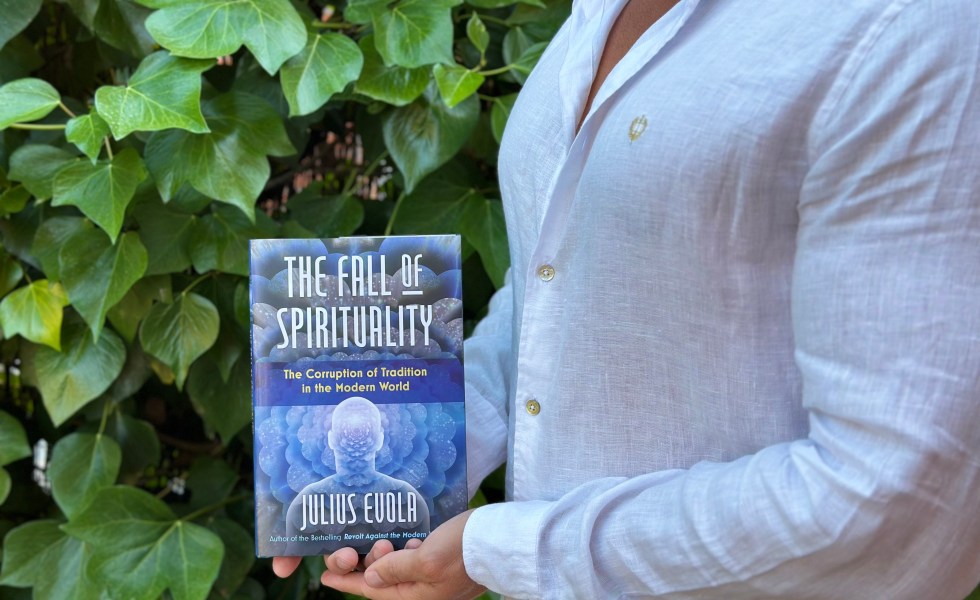
I have read The Fall of Spirituality – The Corruption of Tradition in the Modern World by Julius Evola.
Evola’s Warning – Dark Forces
If I were to summarise the main point of the book in the most concise fashion possible, I would describe it as a warning. Evola’s critique of many of the spiritual trends of the time (the early 1900s, primarily) is that they concern themselves with the Lower regions of the metaphysical. Or, worse, that they ‘open the doors’ to the Lower regions and to the entities dwelling therein.
‘Neither the common man nor the “optimists” of today have any idea of the dark and impersonal forces that linger at the borders of the reality from which they have been excluded.’
Julius Evola – The Fall of Spirituality. Page 15.
I am paraphrasing a poster on X when I say that it is often the most spiritually inept who seek supernatural thrills – i.e. the Hippie who takes Ayahuasca (who knows what sort of entity might possess the unprepared?). I am in full agreement with Evola here. In fact, I have had a video planned for a while now in which I will also warn people to not engage with the occult without having adequate preparation.
To summarise another point Evola makes in the book, we could say that one can go either upward or downward (spiritually speaking) – his warning goes out to those who seek to go downward. In most of his other works, he elaborates on the path upward (the path of initiation – the Mithraic Mysteries, to name an example). This is at least how I interpreted Evola’s views on the matter. I will elaborate on this at length later on (most likely in a coming book).

Evola’s Praise of the Catholic Church
The Lower regions do indeed present dangers to the uninitiated. Evola actually praises the Catholic Church for having served as a protector in this regard – i.e. protecting people from themselves (from their own Lower regions). Evola criticises the Church in his other books – often for the fact that they close the doors to higher initiation. To conclude, the Catholic Church closes the doors leading downward as well as upward (I am simplifying here) – which is good because it hinders spiritually inept people from hurting themselves (i.e. engaging in the occult and becoming the target for demons, to use that terminology) and is bad because it hinders spiritually gifted people from pursuing magical aims. This is, again, my interpretation of Evola’s teachings.
‘Moreover, every saturation with “lower” influences, which is produced in life through these or other means, acting between the weft and weave of consciousness, is today more worrying than it has ever been, because our day almost entirely lacks the counterparts to those influences in an opposite sense; that is, effectively supernatural influences, which the great traditions knew how to invisibly attract and graft onto our intentions, thoughts, and actions.’
Julius Evola – The Fall of Spirituality. Page 16.
The passage above could be explained in the following way: too many demons, not enough angels to counteract the influence of the demons (to use that terminology). Again, the door must be opened upward but must be closed downward.

Critique of Psychoanalysis – Freud & Jung
In the chapter titled Critique of Psychoanalysis, Evola shares his views on Freud. He essentially critiques Freud for focusing on sex in its lowest and darkest aspects. Evola discusses sex in a higher sense elsewhere (I will review Evola’s Eros and the Mysteries of Love soon). On a personal note, I have always found the teachings of Freud to be uninteresting, I will not discredit his entire work as the thoughts of a degenerate, but I do not believe his work should hold the position it does today. Of greater interest is the work of Jung (which I must get further acquainted with). A while back, I asked my friend John Morgan, an authority on matters of Tradition, about Evola’s views on Jung, and he responded thus:
‘He rejected psychology as a modern, scientifically-based movement, first of all. But additionally, he rejected Jung since he attributed the gods and the myths to being archetypes of human consciousness, rather than something that exists outside of and superior to human consciousness — i.e., being real in their own right.’
John Morgan
Evola shares the following insight:
‘It is certain, in any case, that if we were to psychoanalyze psychoanalysis as a general phenomenon, at its bottom we would find a Schadenfreude, a malicious pleasure in demoralizing and contaminating, applied not only to others and to the spiritual world but also, in the general vision of life, to oneself – almost as if one of those autosadistic complexes of which we have already spoken was acting here under the guise of “science”. It could also be called the counterpart of the Darwinian myth: it manifests the same tendency, the same unconscious joy in being able to reduce the higher to the lower, the human to the animal and the primitive-savage, which manifests in the so-called theory of evolution.’
Julius Evola – The Fall of Spirituality. Page 59.
On a personal note, I do believe in evolution. I thought this quote was worth sharing because of how accurate it describes the attitude of many low-thumos individuals today – i.e. the ones finding joy in reducing the Higher to the Lower. Plenty of examples can be found – said low-thumos individuals often have matching political views (Liberal-Leftist).

Definition of Magic & Crowley First Principle
Evola presents the following definition of magic (or rather one type of magic):
‘It is the art of consciously activating and directing certain subtle energies, whose place and field of action is the domain that exists behind “form” – that which has both form in the psychic field and in an external reality governed by the laws of nature.’
Julius Evola – The Fall of Spirituality. Page 169.
This can be compared to Aleister Crowley’s definition ‘Magick is the science and art of causing change to occur in conformity with the Will.’ Speaking of which, Evola discusses Crowley in the book (actually in quite favourable terms). Most notably he discusses Crowley’s principle: ‘Do what thou wilt shall be the whole of the Law’. This principle does not mean that one should do whatever one wants, but rather that one’s purpose must be discovered and realised. I believe the confusion about his principle is due to the fact that he took a lot of drugs.
Evola on Theosophy
There is a joke about “Evola’s book on Theosophy” – stemming from the fact that a Leftist content creator was asked if he had read it, whereupon he responded in the affirmative. The one who asked the question then noted that Evola did, in fact, not write a book about Theosophy. Evola does, however, include a chapter on Theosophy in The Fall of Spirituality. As one might expect, Evola does not have much good to say about Theosophy (i.e. Madame Blavatsky’s spiritual school) – being too “New Agey” (my term and interpretation). I am not yet familiar enough with Blavatsky to comment further on the matter.
Conclusion
The Fall of Spirituality 194 pages. I must admit that it was quite hard to read – hard but interesting. It is probably easier to read for those who are better acquainted with the spiritual schools he is critiquing. I will most likely reread the book later on. I would not necessarily recommend the book for anyone new to Evola; I would rather recommend Meditations on the Peaks (review) in those cases. I can recommend the book for Evola Enjoyers, however!



 The Golden One
You must be logged in to post a comment.