Fascism Viewed From the Right by Julius Evola
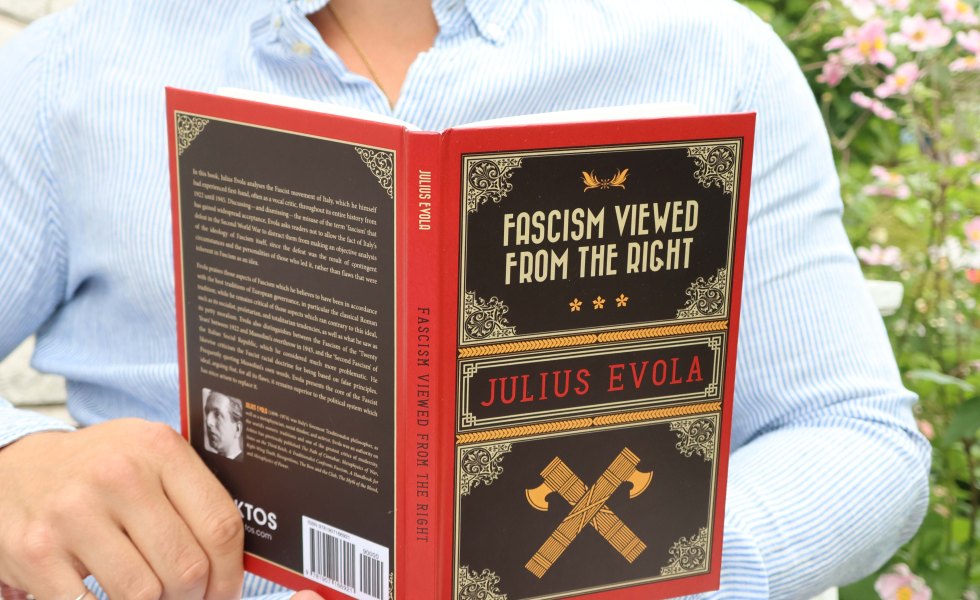
I have read Fascism Viewed From the Right by Julius Evola. As I have noted before, I prefer the good baron’s esoterico-magical writings, but his socio-political ones are also worth reading for a connoisseur such as myself! The book is quite concise (121 pages), and many of the insights presented are found in his other books. In this book, he aims to present a nuanced view of Fascism (looking at both the good and the bad). We have discussed Evola’s relationship with Mussolini and Fascism elsewhere (in summary: he was never a member of the party and had his disagreements with the Fascist regime).
An Animating Myth
Among the positive aspects he notes the following:
‘In the period that immediately followed the First World War, Italy presented itself as a secular state, in which the influence of Freemasonry was considerable, with a weak and mediocre liberal democratic government and a monarchy without real power; in other words, constitutional and parliamentary, a state that on the whole lacked a ‘myth’ in the positive sense, that is, a superior animating and formative idea that could have made of it something more than a mere structure of public administration.’
Julius Evola – Fascism Viewed From the Right. Page 30.
This related to what I talk about in Demigod Mentality (The Story of Who We Are). He goes on to say the following:
‘Thus, the merit of Fascism was, above all, to have revived in Italy the idea of the state and to have created the basis for an active government, by affirming the pure principle of authority and political sovereignty.’
Julius Evola – Fascism Viewed From the Right. Page 30.

One-Party State
As the late and great Jonathan Bowden once noted, Evola criticised Fascism for not being Right-wing enough, not hierarchical enough. Evola did not like the mass-movement aspect of it all. Evola says the following of the one-party system.
‘The true state – it is hardly necessary to say this – does not admit the rule of parties (partitocrazia) of democratic regimes. Parliamentary reform, which we shall talk about in a little while, undoubtedly represented one of the positive aspects of Fascism. However, the conception of a ‘one-party state’ is absurd. Because it belongs exclusively to the world of parliamentary democracy, it is only irrationally that the idea of a ‘party’ can be preserved in a regime opposed to everything that is democratic.’
Julius Evola – Fascism Viewed From the Right. Page 57.
He goes on to note that a ‘party‘ means to be only a part – a state within a state. The true state, in contrast, is a whole. In the same chapter he states the following:
‘Even after the conquest of power the Fascist party was committed to being a mass party. It opened itself up, instead of purifying itself. Instead of making membership in the Party appear a difficult privilege, the regime practically imposed it on everyone.’
Julius Evola – Fascism Viewed From the Right. Page 59.
Again, Evola did not appreciate the mass-movement aspect of Fascism and preferred the rule by a small elite. On a similar note related to the party – as we have noted elsewhere, Evola wanted to enlist as an officer to fight against the Soviets, but his applications were rejected since he was not a member of the party. So his aversion can be seen from both an intellectual as well as a personal perspective.

Monarchy
The following quote summarises his position on monarchy quite well.
‘We can reasonably affirm that a true Right without the monarchy ends up deprived of its natural centre of gravity and crystallisation, because in almost all traditional states the principal reference point for realizing the independent and stable principle of pure political authority has been the crown.’
Julius Evola – Fascism Viewed From the Right. Page 50.
Well stated! He elaborates further on the relationship between the Fascist regime and the monarchy in the book. I have discussed my own views on monarchy elsewhere, and will return to the topic later on as well.

Traditional State vs Totalitarian State
Evola shares the following profound and inspiring insight:
‘The traditional state is organic, but not totalitarian. It is differentiated and articulated, and admits zones of partial autonomy. It coordinates forces and causes them to participate in a superior unity, while recognising their liberty. Exactly because it is strong, is does not need to resort to mechanical centralising, which is required only when it is necessary to rein in in a shapeless and atomistic mass of individuals and wills, from which, however, disorder can never be truly eliminated, but only temporarily contained.’
Julius Evola – Fascism Viewed From the Right. Page 42.
He goes on to note that the true state is all powerful, but is not doing all – meaning that it holds absolute power (beyond the ‘rule-of-law’), but does not meddle in everything. So, quite the opposite of today’s European regimes where the state does not hold absolute power (but has to contend with other forces within society), yet at the same time meddles in every aspect of the lives of its citizens.
Pro-Natalist Campaign
Evola labels the Fascist pro-natalist campaign ‘odious’, and the notion that ‘number is power’ is a principle contradicted by history since ‘numbers’ have always been subjugated by small, dominating groups. This criticism of the Fascist regime by Evola comes as no surprise for those who are familiar with his views. He notes:
‘Empires have been created by these groups, and not by a demographic overflow of masses of the dispossessed and pariahs flooding over the lands of the rich with no other right but their poverty and procreative incontinence.’
Julius Evola – Fascism Viewed From the Right. Page 46.
He goes on to note that the population of Italy at the time was already excessive. I will discuss this matter at length later on. For now, I can say that it is an unworthy and unloving attitude to view children (which are a divine blessing) as numbers to bolster a demographic situation. To speak of our issues today, it is clear that our own birth-rates will not change our destiny – only remigration will. It is also not desirable to uphold a system that requires a constantly growing population.
A Statement by Sulla
Evola recalls a statement by Sulla which I thought was insightful – said ambition was not to possess gold, but to hold power over those who possess it. This is an interesting statement which deserves further attention (I will discuss it at length in a coming podcast episode).
Conclusion
The book has 121 pages. It is not one of Evola’s more captivating books, and I would not necessarily recommend anyone start with this title. Metaphysics of Power is a better starting point (and contains more valuable socio-political insights). For the Evola connoisseur, however, it is, again, well worth a read!





 The Golden One
You must be logged in to post a comment.