The Legio Gloria September Release
Posted on October 1, 2022

I am happy to present five new releases. I am also happy to say that several garments have been restocked! First and foremost, two new polo shirts are available – a verdant green one and a much-requested black one. Both have the same cut and material as the previous polo shirts – 100% organic cotton and with an athletic fit. The model fits rather tightly, so if you are in between sizes, go with a size up.

Two new stringers are available. The Mithraic Gym Stringer was, as regular readers of my book reviews will perhaps have surmised, a design I had a special desire to release. Wearing the motif of Mithras and the Bull will serve as a reminder to dominate your inner chaos, and to make the most use of the divine energies that are yours to harness. This design is also meant as an esoteric salute to others who will recognise its message.


The second motif is inspired by the Vendel-era Torslunda helmet, which was found on the Swedish island Öland (located in the sacred Baltic Sea). The runes say Legio Gloria. The garment itself is a better version of the previous tanktop the motif appeared on last year. I was not perfectly happy with the said tanktop, so I made some changes (for better comfort and durability). I wear this stringer in large (I wear most other garments in extra large), so you can go with a size smaller than your usual (a medium actually fits me well too).

Alongside a restock of most bottoms, new Questing Shorts in grey are available. Based on customer feedback, these have deeper pockets than previous Questing Shorts.

Related to the polo shirts – it is sometimes necessary to even out the shoulder seam (simply iron it). The cut of the polos is designed to accommodate muscular arms and shoulders, hence spacious shoulder seams.

Lastly, we still have some issues with DHL. Our logistics team has been in contact with DHL and DHL is currently making some changes and improvements, so the matter should be resolved within a foreseeable future. The orders are arriving in good fashion, even if some tracking numbers are not working. Thank you for your patience in this regard!
Next up for Legio Gloria is a wool release, which will consist of a new garment in addition to a restock of the beloved Lir’s Merino Wool Sweater. Onwards and upwards!

Creation and Completion – Essential Points of Tantric Meditation by Jamgön Kongtrul
Posted on September 28, 2022
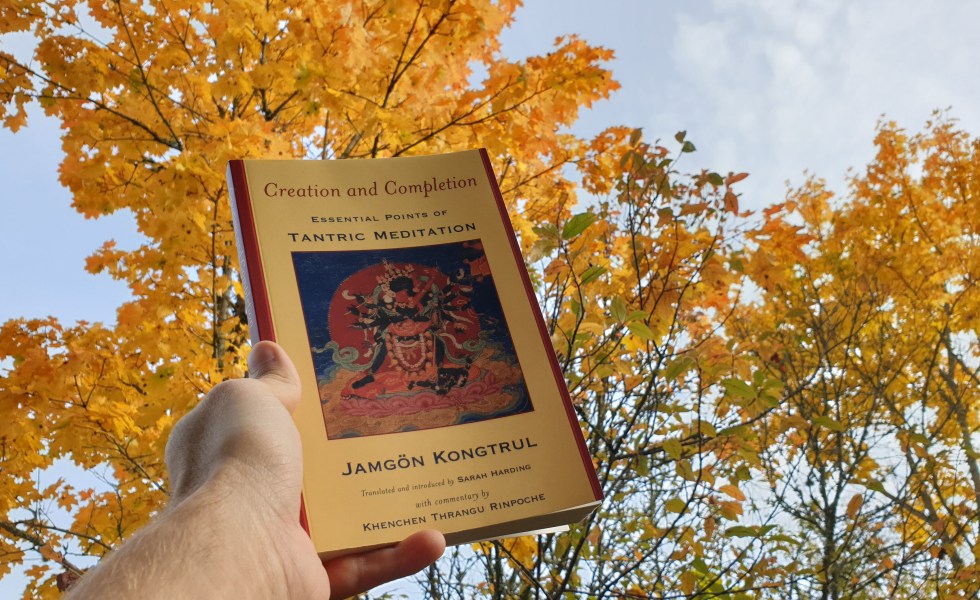
I have read Creation and Completion – Essential Points of Tantric Meditation by Jamgön Kongtrul, also known as Jamgön Kongtrul the Great, who lived between 1813 and 1899 CE. The best part of the book, at least from my perspective, is the valuable commentary by Khenchen Thrangu Rinpoche. Many older esoteric texts can be a bit hard to comprehend, especially since certain aspects of the them might be lost in translation. This is why the commentary is so appreciated.
Tibetan Buddhism and Deities
In the introduction, Sarah Harding notes that many Tibetan Buddhist spiritual practices center around various deities. This may come as a surprise to those who view Buddhism as a nontheistic religion. This is also why some other Buddhist schools have considered Tibetan Buddhism as corrupt and untrue to its original form. However, as Sarah Harding notes, these deity practices are deeply rooted in the very foundations of Buddhist thought. In my own humble opinion, a spirituality with a pantheon of Gods and Goddesses will always be more appealing than one without deities.

Transformation of Desire
Jamgön Kongtrul shares the following accessible technique for dealing with desire. I do not believe that any of my esteemed book-review readers are still under the yoke of pornography, but if you are – try to transform that desire into a deity (i.e. visualise a deity) the next time it comes to you!
‘The uncommon approach of mantra is to transform afflictive emotions.
Jamgön Kongtrul – Creation and Completion . Page 37.
When the desire arises, you meditate on Amitabha
or a deity such as Heruka in union.
The desirous thought is transformed into the deity.
The other deluded emotions are treated in the same way.’
In the notes, the following is mentioned regarding the two deities mentioned above:
Amitabha: Boundless Light, the name of a buddha – the head of the lotus family – that is associated with the transformation of desire into the pristine wisdom of discernment.
Heruka: a general name for wrathful meditational deities, and also a name for Cakrasamvara or ‘Wheel of Sublime Bliss,’ one of the Tantric deities particularly associated with desire.

Virtue! Virtue!
At the end of the text, Jamgön Kongtrul states the following. I thought it was a beautiful passage worth sharing:
‘At the request of the spiritual friend Karma Palden, an attendant of the fourteenth Omniscient Lord of the Victorious Ones (Karmapa), and whose mind is totally devoted to the definite meaning, I, Karma Ngawang Yönten Gyamtso, bearing merely the signs of a Buddhist monk, at the age of twenty-seven, gradually dictated this text, and he transcribed it. May it send forth glorious healing qualities for the doctrine and for beings. In all times and directions may glory prevail. May the glorious blaze of good fortune adorn the world. Virtue! Virtue!
Jamgön Kongtrul – Creation and Completion . Page 81.

Confronting Fear – A Note on Batman
In the commentary section, Khenchen Thrangu Rinpoche talks about the teachings of Machig Labdron – a female Buddhist monk who lived between 1055 and 1149 CE. He notes that her approach is one of severance rather than pacification.
‘Rather than pacifying thoughts, you actually provoke the most difficult ones. In severance practice, you work especially with fear. You go to places where you feel unsafe, typically to charnel grounds. You trigger intense fear, and you cut through it.’
Khenchen Thrangu Rinpoche
Reading this made me think of Christopher Nolan’s masterwork Batman – Batman Begins in particular, where Bruce Wayne is presented with his fears (bats) in a monastery in the Himalayas. I wonder if Nolan took inspiration from the teachings of Machig Labdron. Epic stuff in either case!

Tantras and Sutras
In the commentary, the following passage appears in regard to the Tantras and Sutras:
‘First of all, all of the Buddha’s teachings are included within two paths. They are the stable and gradual path of the sutras and the quick and especially effective path of the Vajrayana, or the tantras. Both of these take as their root the taming of the mind, or pacifying the thoughts and kleshas that afflict out minds’
Khenchen Thrangu Rinpoche
He goes on to note that the Sutras teach rejection or abandonment of the kleshas – you must relinquish attachments. The Tantra approach, on the other hand, is one of transformation – transformation of desire into something pure. This is also the meaning of the title of the previous book I reviewed, Introduction to Tantra: The Transformation of Desire by Lama Yeshe (review).
Conclusion
At 153 pages and written in an accessible language, the book serves as a good further introduction to the topic. The book was a good follow-up to the aforementioned Introduction to Tantra: The Transformation of Desire by Lama Yeshe. I can recommend the book to anyone interested in Buddhism in general and Tantra in particular.
Onwards and upwards!
Introduction to Tantra by Lama Yeshe
Posted on September 22, 2022 1 Comment
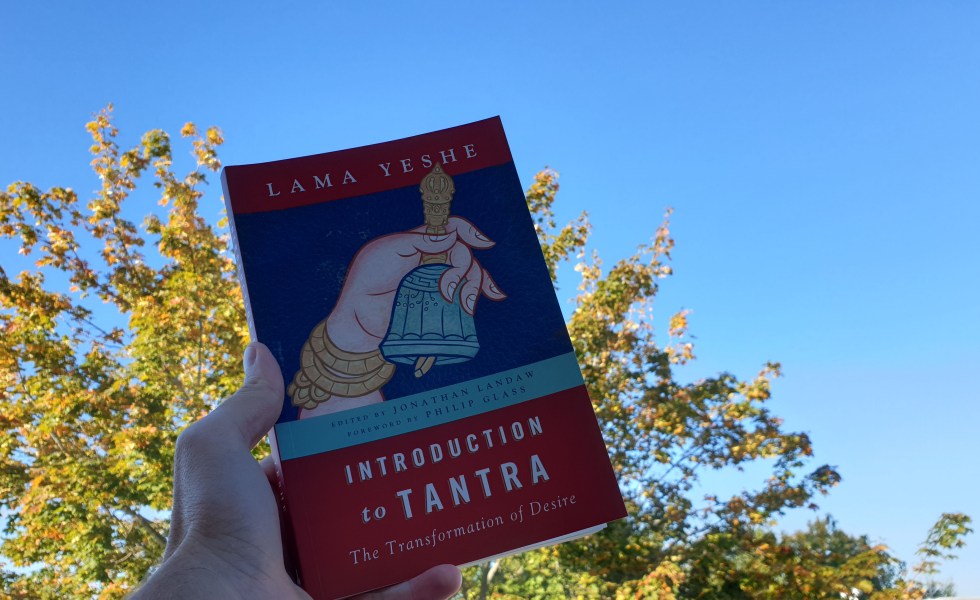
I have read Introduction to Tantra: The Transformation of Desire by Lama Yeshe. As the title suggests, the book is an introduction to Tantra – which is an often misunderstood path of Buddhism. The book is concise and easy to understand, which makes it a good starting point for those interested in the topic.
The Tantric Approach to Pleasure
Tantra has a different approach to pleasure than some other religious traditions. Lama Yeshe states it beautifully in the following passage:
‘Tantra’s approach is very different. Instead of viewing pleasure and desire as something to be avoided at all costs, tantra recognizes the powerful energy aroused by our desires to be an indispensable resource for the spiritual path. Because the goal is nothing less than the realization of our highest human potential, tantra seeks to transform every experience – no matter how “unreligious” it may appear – into the path of fulfillment. It is precisely because our present life is so inseparably linked with desire that we must make use of desire’s tremendous energy if we wish to transform our life into something transcendental.’
Lama Yeshe – Introduction to Tantra. Page 9.
The Tantric View of Mind and Body
In the chapter Arising as a Deity, Lama Yeshe shares the following valuable insight:
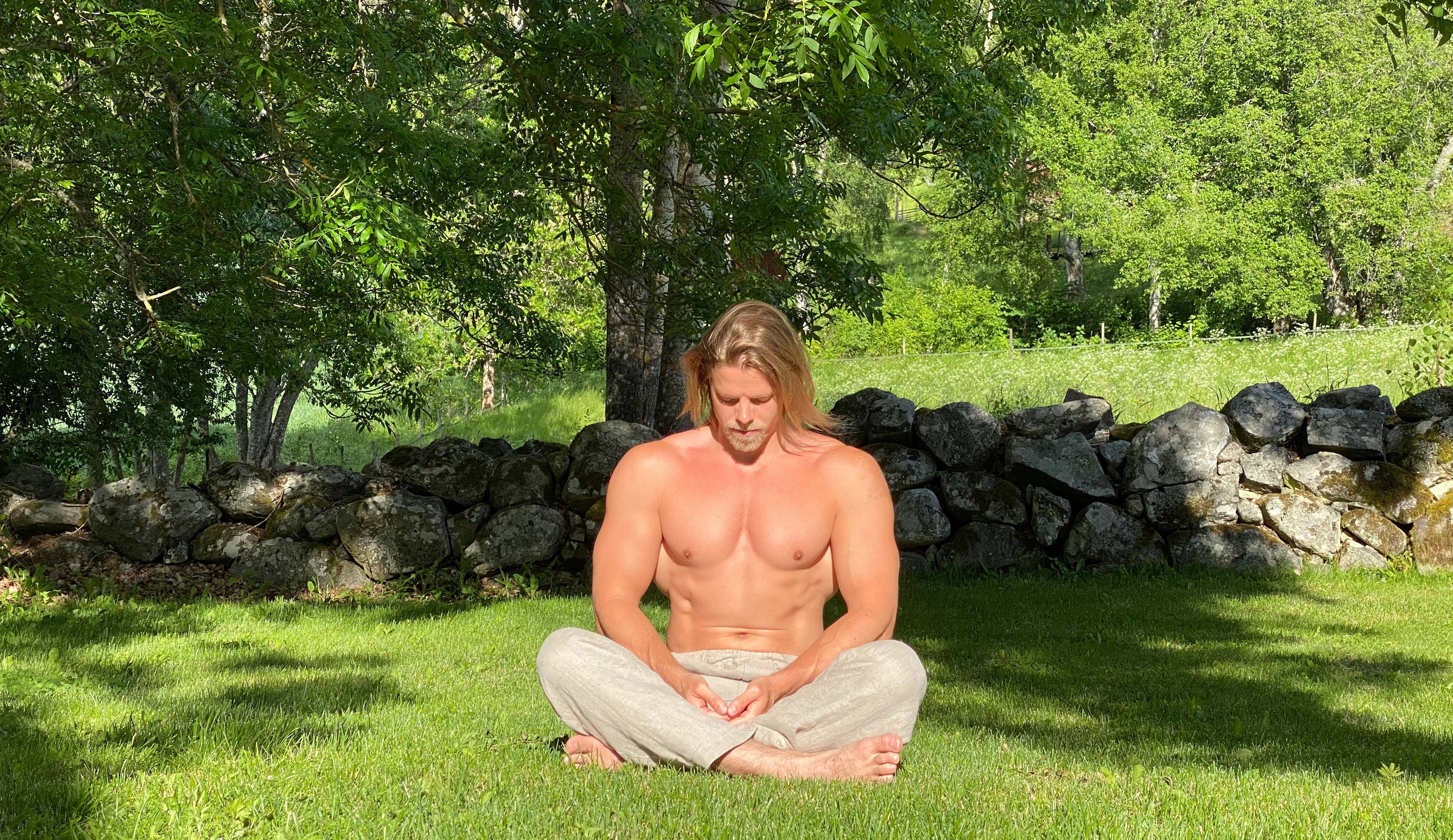
‘According to tantra we cannot say that the mind is more important than the body or that the body is more important than the mind. They are of equal importance. In tantric practice the body is understood to be like a plot of ground containing untold mineral wealth. This body of ours, for all its suffering nature, contains the most valuable of natural resources: kundalini gold, kundalini oil!’
Lama Yeshe – Introduction to Tantra. Page 127.
This attitude to the body makes, in my humble opinion, a spiritual teaching worth listening to. I am always very sceptical of any spiritual teaching that neglects the importance of the body.
Against the Modern View of the Human
The author shares the following profound take on the modern scientistic view of humanity:
‘Many people feel that humans are little more than monkeys and that the human mind is nothing but a series of chemical reactions and electrical impulses in the brain. Such a view reduces us to lumps of matter and dismisses any notion of a higher dimension to human existence. For people who truly believe in such a narrow view of what it means to be human, what is the purpose of remaining alive? Perhaps it is merely to experience as many sensations of pleasure as possible before we decay back to our basic nature: dust. Such a depressing outlook may account for much of the alienation in modern society.’
Lama Yeshe – Introduction to Tantra. Pages 29-30.
As we know, depression and all manner of ills ail humans in the age of atheism. A good first step is to rid ourselves of said scientistic attitude. Reject atheism, embrace the metaphysics!
The Heart Chakra and Bodisattva
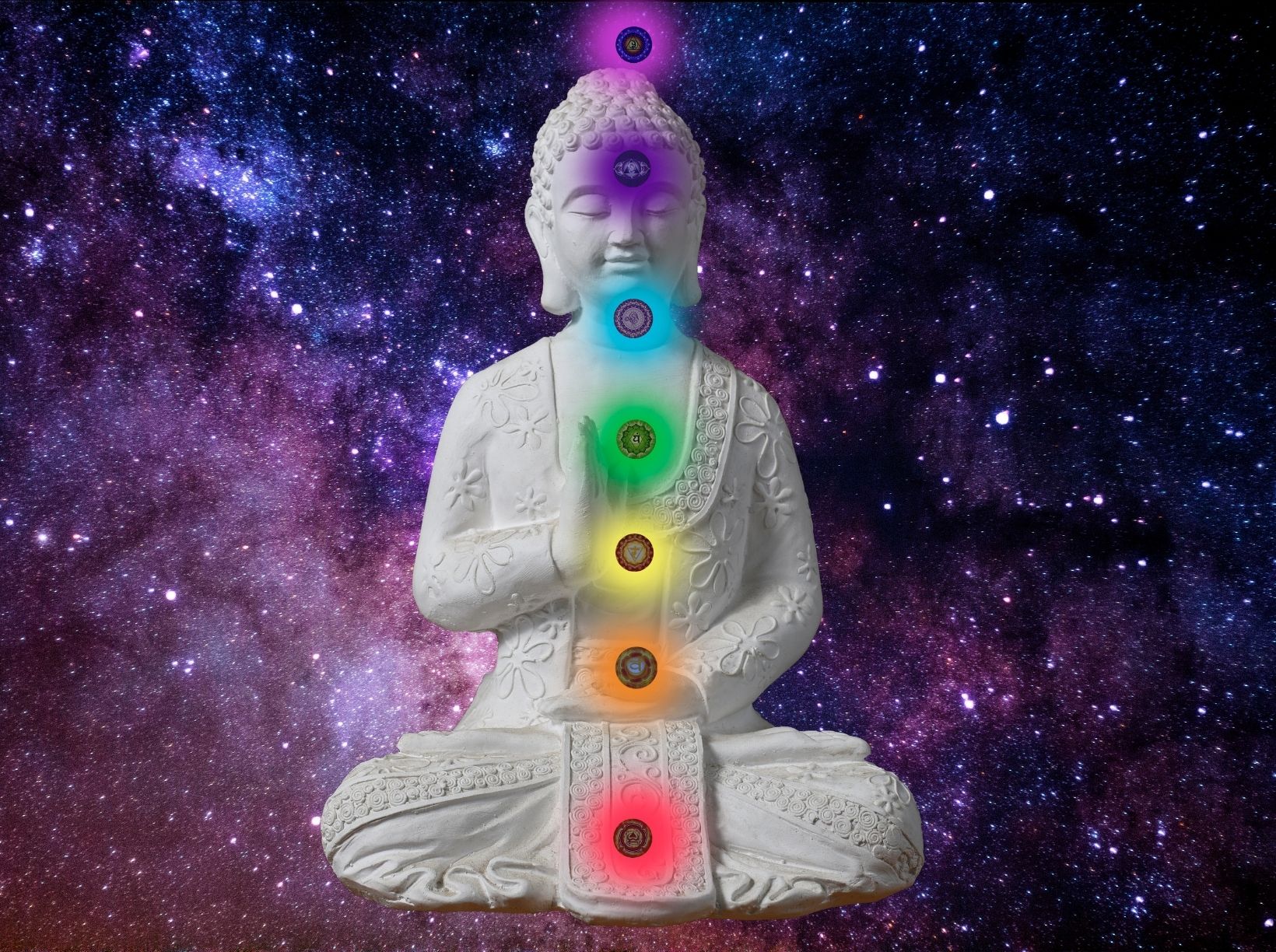
Although the author does not discuss the Chakras at length, he does note that the Heart Chakra (the green one) is the most important one for the Tantric path. The Heart Chakra is associated with compassion and love. The author also notes that the Heart Chakra is the home of our subtle mind: the priceless treasure of all tantric practitioners. A point that is emphasised throughout the importance of being driven by compassion and the desire to help others. In the glossary the following concepts are clarified:
Bodhichitta: the altruistic motive of a bodhisattva; the wish to attain enlightenment in order to benefit others; the fully open and dedicated heart.
Bodisattva: someone whose spiritual practice is directed toward the achievement of enlightenment; one who possesses the compassionate motive of bodhichitta.
I could, if I may be so bold, perhaps refer to myself as a Bodisattva – my great work is certainly motivated by great compassion!
Visualisation Exercises
Visualisation meditation exercises are presented and emphasised as an integral part of Tantra. The author notes the following in the chapter titled Inspiration and the Guru:
‘When we visualize our spiritual guide as the meditational deity we should think especially about his or her great kindness and concern for us.’
Lama Yeshe – Introduction to Tantra. Page 93.
Reading this made me think of the following quote by Emperor Julian:
‘I feel awe of the gods, I love, I revere, I venerate them, and in short have precisely the same feelings towards them as one would have towards kind masters or teachers or fathers or guardians or any beings of that sort.’
Emperor Julian the Blessed
Conclusion
At 141 pages, the book is of a good length for an introduction. Sometimes, I wish certain books would be shorter; this time, however, I wished that it had been longer. I mention this as a compliment to the book; it simply means that I found it interesting! I look forward to reading more about Buddhism and Tantra.
Onwards and upwards!
The Path of Cinnabar by Julius Evola
Posted on August 21, 2022
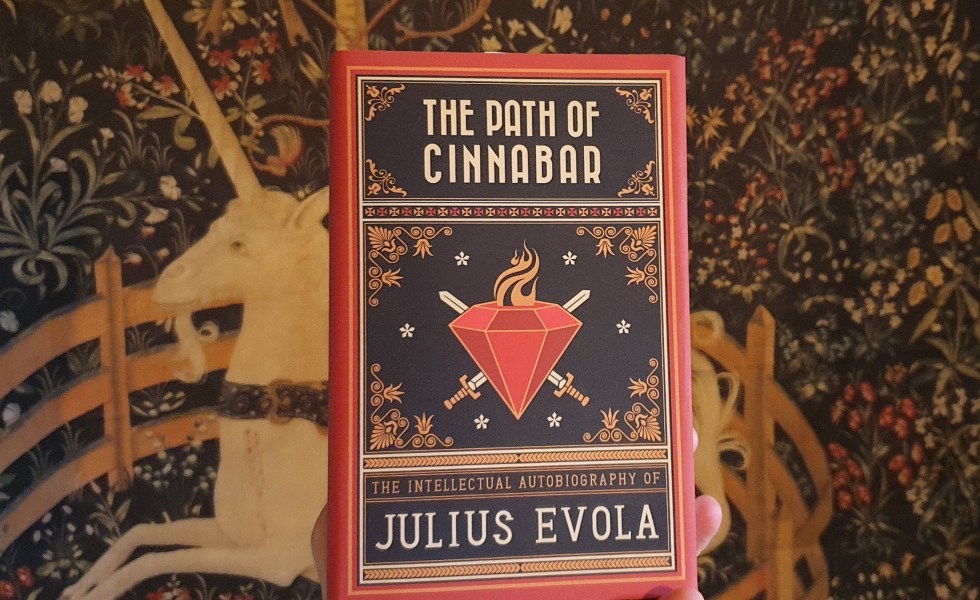
I have read The Path of Cinnabar by Julius Evola, which is his autobiography. In the book, he discusses some of his ideas and the events surrounding the publications of his books. He lived during tumultuous times, to say the least, and even if the book does not contain overly many personal stories, it is still interesting from that perspective. Most of the thoughts presented in the book will be familiar to those who have read his other works. I have discussed these books and thoughts in other reviews – which can be found here: Book Reviews.
Evola’s Background
Evola shares precious few notes regarding his personal life; the book follows his intellectual and spiritual journey and the corresponding works. However, he shares the following interesting insight:
‘As for my character, it is chiefly defined by two dispositions. The first is an impulse towards transcendence, which manifested itself from my early youth./…/ A spontaneous detachment from what is merely human, from what is generally regarded as normal.’
Julius Evola – The Path of Cinnabar. Page 6.
‘The second significant trait of my character might be described, in Hindu terms, as my kshatriya bent. In India, the word kshatriya was used to describe the human type inclined to action and performance: the ‘warrior’ type, as opposed to the religious, priestly and contemplative type of the brahma.’
Julius Evola – The Path of Cinnabar. Page 7.
As I noted in my review of Men Among the Ruins, Evola served as an artillery officer during World War 1, and applied to join the war effort on the Eastern Front during World War 2, but since he was not a member of the Fascist Party those wishes did not come to pass. As we have noted in several of the previous reviews, a reoccurring point in Evola’s thought is the distinction between the kshatriya and the brahman.
In the introduction, Evola also mentions that Nietzsche served as an inspiration with regard to his anti-Christian sentiments. He also notes that he grew up Catholic but always felt an ‘utter indifference’ for Christianity.
Another thing to note about Evola’s personality is that he ‘made a point of not receiving any degrees’ since he could not stand to be called Doctor or Professor (he would still be called thus later on though). This was due to his anti-bourgeois sentiments.

Evola’s Dadaist Phase
Evola had, and this may be surprising to some, a Dadaist phase. Dadaist ‘art’ is anything but beautiful and should, in my view, not be called art. I asked my friend Tom (Survive the Jive) how it was that Evola, at any stage of his life, would find an appreciation of degenerate art. Tom answered me thus: ‘Because he hated bourgeois sensibilities and Dada was a deliberate affront to them.’ This makes perfect sense when taking his world view into account.
‘What attracted me to Dadaism was its radicalism: Dadaism was not merely conceived as a new avant-garde artistic tendency; rather, it stood for an outlook on life which expressed a tendency towards total liberation, conjoined with the upsetting of all logic, ethic and aesthetic categories, in the most paradoxical and baffling ways.’
Julius Evola – The Path of Cinnabar. Page 19.
Evola would eventually move past this state, however:
‘The movement I had joined out of my high esteem for Tristan Tzara was destined to accomplish few of the things I had sought to find within it. While Dadaism certainly embodied the extreme, unsurpassed limit of all avant-garde artistic currents, it never consumed itself in the fire of a ‘leap of boundaries’ beyond all art forms and similar forms of expression. Dadaism was soon followed by Surrealism, which, in my opinion, gave proof of its regressive character.’
Julius Evola – The Path of Cinnabar. Page 22.
Evola’s Book Recommendations
The book contains an appendix in which a few interviews are included. In a question regarding his books, Evola responds with the following:
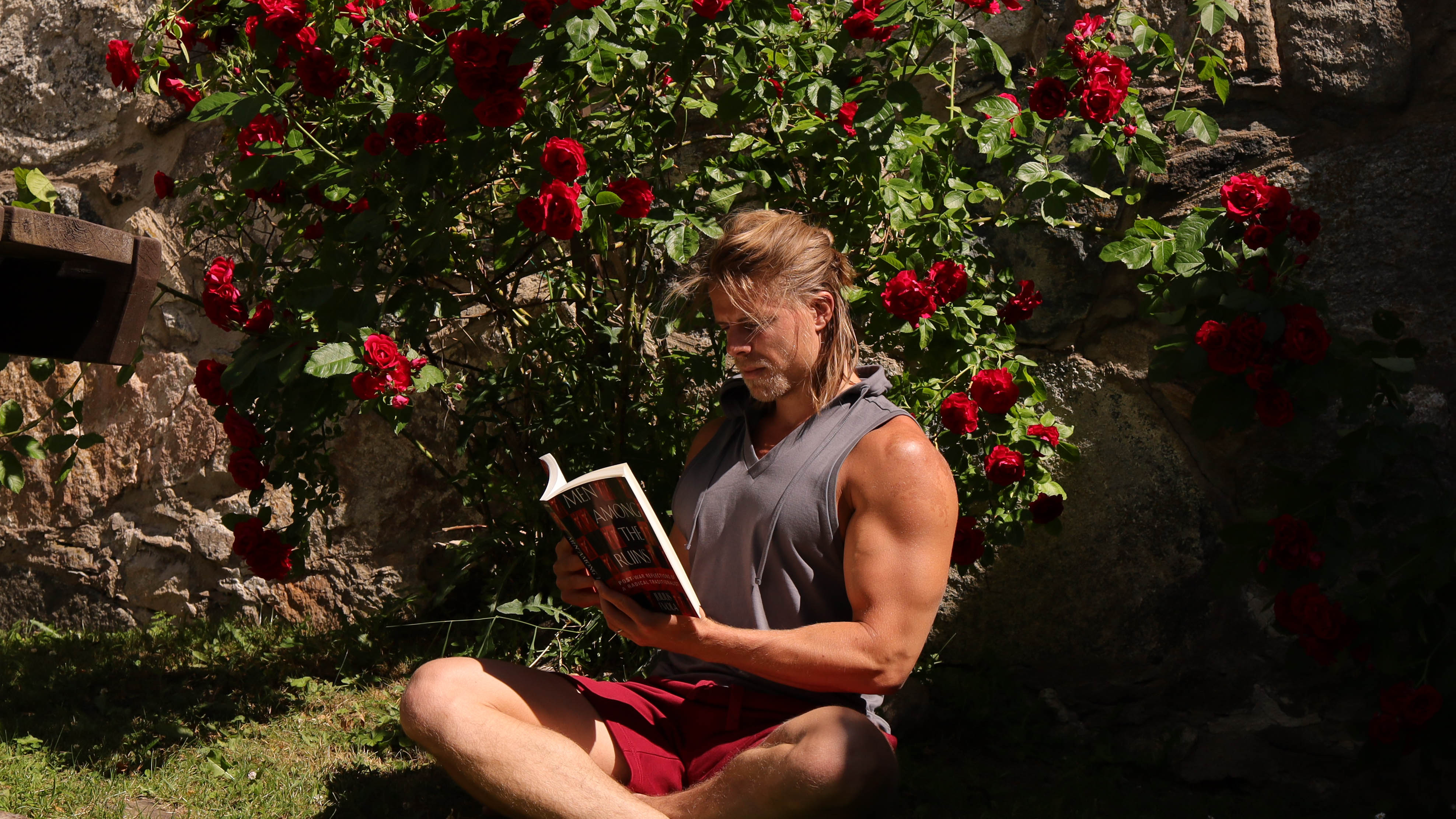
‘Young people chiefly interested in my work for political reasons should stick to Revolt Against the Modern World, as it provides both a general overview of the world of Tradition and the modern world, and gives the reader an idea of a ‘metaphysics of history’ in contrast to mainstream historiography. One might also turn to The Mystery of the Grail and Men Among the Ruins.’
Julius Evola – The Path of Cinnabar. Page 257.
This was quite interesting to note since I gave the same top three recommendations in my review of Revolt Against the Modern World. I talk more about where to start with Evola in the following video: Starting With Julius Evola.
Conclusion
I would recommend The Path of Cinnabar to those who have read a good number of Evola books. I found it interesting to get to know more about the context in which the books were written. However, may the spirit of Evola forgive me for saying so, the chapter titled The Speculative Period of Magical Idealism is quite uninteresting in my humble opinion – the subsequent chapters are much more interesting, so if you decide to read it, do not be disheartened by that chapter. Evola’s philosophical writings are not nearly as interesting as his other writings (esoteric, historical, societal etc.).
Thank you for reading this book review; it will actually be the last one for a while. I will now focus all of my writing on my upcoming book – which will be out sometime next year. Onwards and upwards!



 The Golden One
You must be logged in to post a comment.