The Golden One – Videoplatform
Posted on February 24, 2021

Greetings,
Thank you for being here. I am not sure for how long I will be on YouTube, so if you appreciate my videos, I encourage you to sign up to Odysee using my invite link below:
https://odysee.com/$/invite/@thegoldenone:a
Moreover, I will start making exclusive Odysee videos (even when I am still on YouTube). Also, be sure to sign up on these platforms:
Mandatory:
👑Telegram: https://t.me/thegoldenone
Optional:
🐸Gab: https://gab.com/TheGoldenOne
💡Minds: https://www.minds.com/TheGloriousLion/
The best way to stay updated on Legio Gloria releases is to sign up for the newsletter: https://legiogloria.com/ (on the right sidebar on the front page).
Lucifer’s Court – Book Review and Inspiring Quotes
Posted on February 17, 2021

I have read Lucifer’s Court, originally in German Luzifers Hofgesind, eine Reise zu den guten Geistern Europas, by Otto Rahn. I have always had an interest in the legend of the Holy Grail, and as of late, I have decided to delve a bit deeper into the occult.
Lucifer’s Court is a book that is best enjoyed when it is felt, rather than read. Taking everything in it literally and viewing it as a historically accurate document might lead to some misconceptions. However, when reading books like this, one can always be inspired to explore new ideas. The book, published in 1937, is written like a travel journal and he visits various European destinations in his search for the Grail. Perhaps the fictional character Indiana Jones was inspired by Rahn. Speaking of which, I greatly enjoyed the Indiana Jones films in my childhood.
The author, Otto Rahn, became a member of the German SS after Heinrich Himmler took an interest in him and his search for the Grail after the publication of his first book Crusade Against the Grail: The Struggle between the Cathars, the Templars, and the Church of Rome (my review can be read here). Rahn eventually became disillusioned with the Third Reich and resigned from his position in the SS in 1939. Later the same year, he, allegedly, committed suicide. His death is still subject to speculation. Rahn was openly homosexual and he positioned the intolerance of the Catholic Church against what he saw as a more tolerant pre-Christian Europe. Perhaps his disillusionment with the Third Reich came as a result of the increasing totalitarianism he perceived there.
His thesis in regard to the Grail was that it was a stone fallen from Lucifer’s crown, spirited away by four Cathar pure ones when their stronghold came under threat from the Catholic forces:
“And perhaps the treasure of the church, which four chivalrous pure ones had taken from the threatened castle of Montségur to the caves of the Sabarthès, was the Grail – not the Church’s distortion known as the chalice of Jesus of Nazareth, but a stone fallen from Lucifer’s crown that bestows food and drink and immortality to those who are worthy of his display.”
Since the author is hostile to the Catholic Church, he is sympathetic to the Cathars. The Cathar movement was a heresy that flourished in southern France between the 12th and 14th centuries. The Pope eventually called a crusade to subjugate them. Rahn points to the region’s Gothic past, connecting the Cathars to the noble Goths.
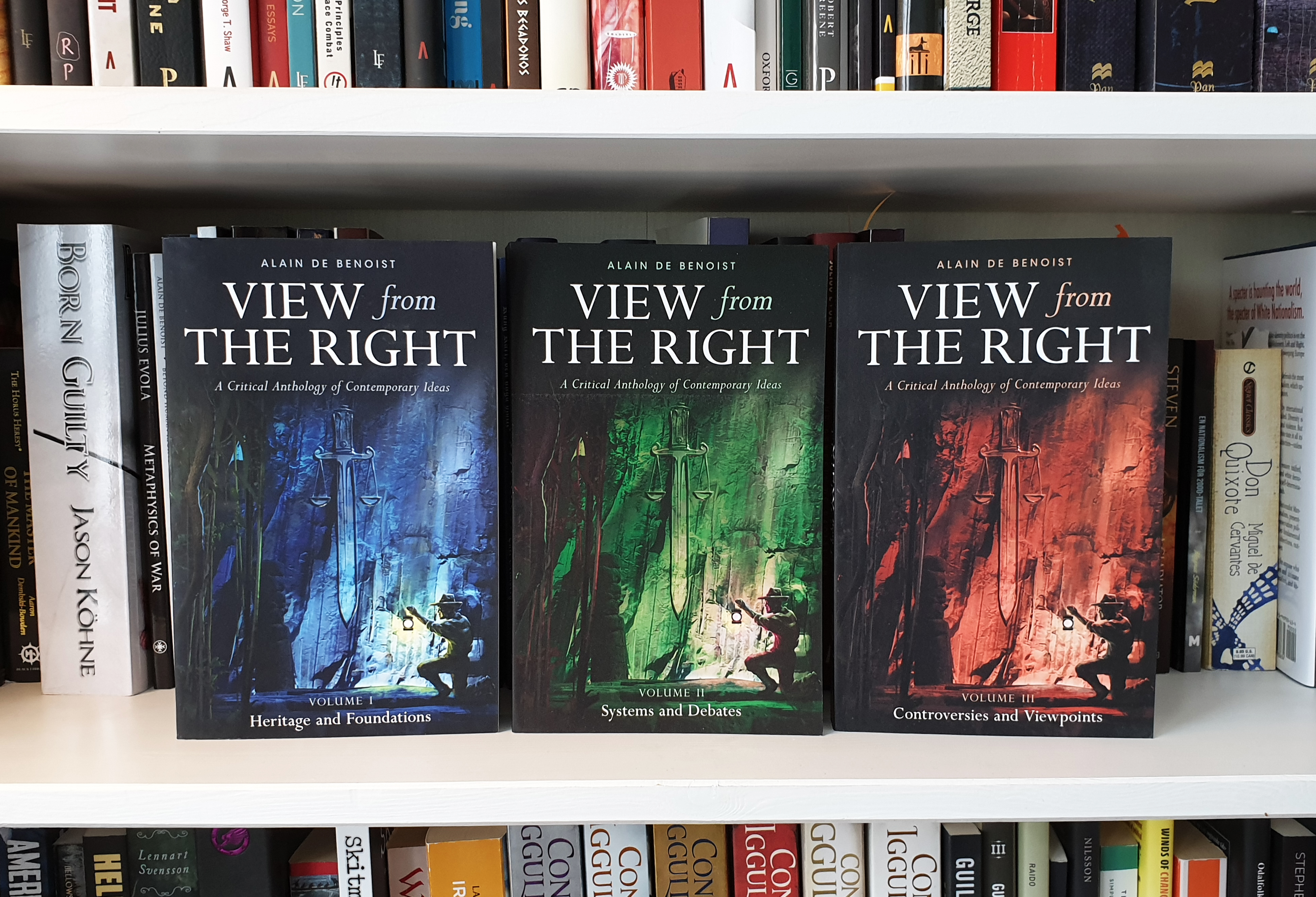
The crusade against the Cathars was not only religious in its nature. It was a way for the Pope to quell an emerging threat to the authority of Rome (the Catholic Church), it was also a way for the French king to bring the southern counties under firmer control. France during the Middle Ages was a quite heterogenous country, and many of the Cathars also differed from the rest of the country in that they spoke Old Occitan. Alain de Benoist of the French New Right, writes at length about the Occitan separatist movement in View from the Right (see picture further down).
Rahn argues that Lucifer is the equivalent of Balder among the Norsemen and Apollo among the ancient Greeks. Some scholars, such as my friend, the historian Thomas Rowsell, disagree with this claim. Rowsell runs a popular YouTube channel, Survive the Jive, which focuses on Indo-European religion, among other topics. A channel I can highly recommend subscribing to.
Whenever reading books like this, I take great joy in finding epic and inspiring quotes that I can return to whenever I need additional motivation to set a high pace, in the Temple of Iron, or in other endeavours. One such quote is the following:
“This God looks like a knight: He has blond hair and rides on a light horse that is black like the night on one half and dazzling white on the other. A garnet on the reins shines like the sun. In this knight’s attendance is a paladin whose name is Loyalty.”
The god appears in a later sequence in the book as well:
“I believe that I just saw God on this road! He came riding like a knight, beautiful and strong. His blond hair fell around his bronzed face and his bright eyes shone. […] ‘Peire Vidal, you have met Lucifer, whom you call Lucibel!’”
Peire Vidal was a poet, who was, most likely, born in Toulouse in the mid-12th century.
If you have an interest in the legend of the Grail, or the Cathar Heresy I can recommend this book. If not, there are plenty of other good books to read.
I read the following edition: Lucifer’s Court. Rahn, Otto. Translated by Christopher Jones. Inner Traditions. Rochester, Vermont.
The quotes above are translated from the German original, Luzifers Hofgesind, eine Reise zu den guten Geistern Europas.
A book review in video format is incoming at my Odysee channel. Sign up using my invite link to support the video making: https://odysee.com/$/invite/@thegoldenone:a
The Essential Amino Acids seen in the picture are available for Swedish customers at Jotunheimnutrition.se and for European customers at Jotunheimnutrition.de
Epic Quote from Horus Heresy – Galaxy in Flames
Posted on February 15, 2021

“She saw such power in his broad over-muscled torso and such intense focus in his sharp grey eyes she wondered she was not repelled by Loken. He was a killing machine, created and trained to deal death, but she couldn’t stop watching and blink-clicking images of his heroic physique.”
Galaxy in Flames: Horus Heresy Book 3 – Ben Counter
The Great Game by Peter Hopkirk
Posted on February 6, 2021

I have read The Great Game by Peter Hopkirk.
The Great Game refers to the geopolitical power struggle between Great Britain and Russia in Central Asia (with Afghanistan as the focal point) during the 1800s.
This Anglo-Russian rivalry began with the defeat of Napoleon (their common enemy) and ended in the early 1900s with the emergence of two glorious nations; Germany and Japan.
What were the motivating factors for interference and struggle for control of Central Asia?
For Russia 🇷🇺
– Revenge after centuries of aggression from the peoples of the steppes. Russia was occupied by the Mongol Golden Horde for a long time.
– Conquest to stop slave raiders (similar to what the French did in North Africa).
Russians were routinely enslaved by the khans of Central Asia.
For the British 🇬🇧
– Keeping India safe. Using Afghanistan and other tribes and nations as a buffer against Russian expansion. The British authorities in India feared a Russian invasion of their imperial crown jewel.
For both 🇷🇺🇬🇧
– Imperial prestige.
– Access to new markets for their products.
– Spreading Christian civilisation, which got even moreover important after reports of Central Asian lack of morals reached London and St. Petersburg.
For explorers, adventurers and military men ⚔️
– Glory, fame and riches.
– Military promotion and awards, from Royal Geographic Society in the British case to give an example.
An interesting book for sure. At 524 pages it might be a bit long unless you are interested in the topic, if you are, I can definitely recommend it. If not, there are plenty of other good books to read.




 The Golden One
You must be logged in to post a comment.