Döden spelar schack by Albertus Pictor
Posted on August 25, 2023

The famous Döden spelar schack (Death plays chess) by the great Albertus Pictor (Albert Målare, Albert the Painter). This epic work of art dates from the 1480s and can be found in Täby kyrka, Sweden.
The meaning behind the motif of playing chess with Death can be seen a reminder to think about how one’s actions in life determine which rewards or punishments one can expect after death.
In a mediaeval Christian context, this takes the shape of Heaven and Hell. In a Pagan context, one’s deeds also impact what comes after death. In addition to realms of the afterlife (i.e. Valhall, Hel, Fólkvangr, etc.), there is also the Hamingja (the collective luck or fortune of a bloodline).
Good deeds strengthen the Hamingja and thereby also one’s Fylgja (guardian spirit). I elaborate more on these concepts in my upcoming book Demigod Mentality (September, 2023).
Therefore, make sure to make good and virtuous moves in your chess game with Death!
Traditional Magic Spells by Claude Lecouteux
Posted on August 23, 2023
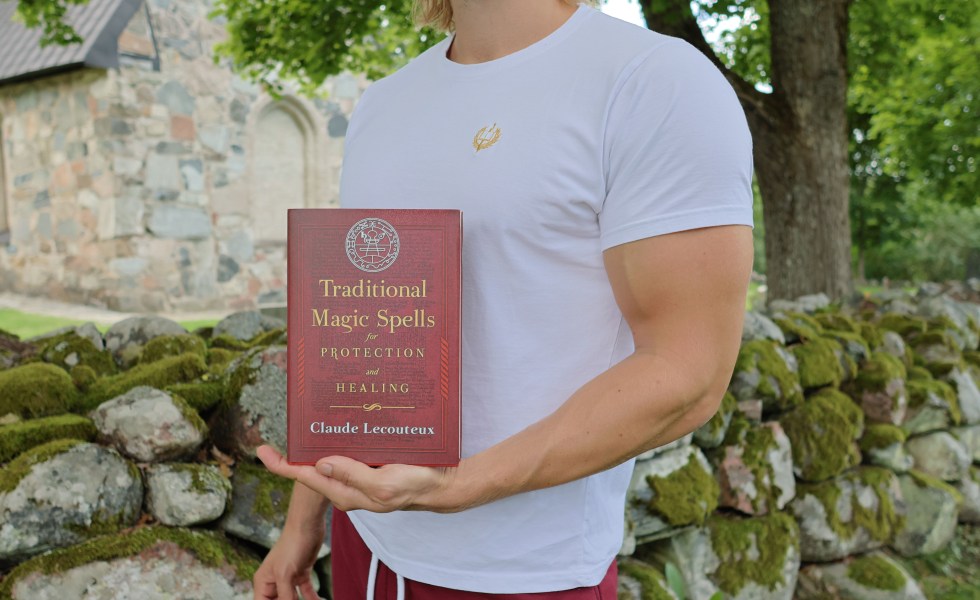
I have read Traditional Magic Spells for Protection and Healing by Claude Lecouteux. The book should not necessarily be read as a practical book about magic (i.e. with practical instructions for meditation techniques, etc.), but rather as a study of folklore and myth. The book contains a great number of spells from various European countries. As the title of the book suggests, most of them concern healing and protection.
Christian Magic – No Religion Without Magic
Perhaps the greatest insight from the book is the prevalence of Christian magic. Many of the spells and incantations revolve around characters from the Christian mythos. As we have discussed on numerous occasions, the Christianity that dominated Europe for most of its existence was a syncretic Paganism and Christianity – these spells support this notion. Related to this it becomes apparent that this type of Christianity certainly was not averse to magic. This is, of course, a complicated topic, especially taking into consideration the witch hunts but it is interesting to point out.
The author shares a quote from another author which I found illuminating. This is also, in my own humble opinion based on my esoteric journey of the last one and a half years, accurate.
‘There is no religion without magic any more than than there is any magic without at least a trace of religion.’
Claude Lèvy-Strauss – The Savage Mind
Pictured below: a picture I took in Enköping kyrka.

Norwegian Spell Involving Jesus and a Troll
One spell which I found particularly interesting is the following from Norway. In order to free animals of all ills, one can read the following over salt and malt and give them to one’s animals:
‘Jesus and the Virgin Mary were traveling along the shore when they saw the good valerian planted in the ground. Jesus began to dig up the root. The troll in the mountain began shouting about the uselessness of the root. Saint Peter arrived and answered the troll of the mountain this way: “It is good against many ills. It is good against exhaustion and anemia! It is good against the fang of the wolf and the claw of the bear and the tooth of Satan and the hand [the contact] of sorcerers and against all ill that flies between heaven and earth.” By the three Names and [speak] the Our Father three times before and three times after.’
Claude Lecouteux – Traditional Magic Spells. Page 263.
The source is the Svartbok frå Gudbrandsdalen. Svartbok (svart = black in Norwegian and Swedish, bok = book). Svartbok refers to a book of sorcery.
What is interesting about this is how Jesus is incorporated in myth (in this case, a spell). Since we have discussed how Christianity was formed to fit into the European psyche, I thought this example of a spell was a good way to illustrate this. Thus, one can say that much of the mythos (i.e. folklore) remains the same, but with the addition of some new Gods or characters (Jesus, Mary, Saint Peter).
Moreover, regarding valerian itself, it can be used to improve sleep quality and reduce depression (study: https://www.ncbi.nlm.nih.gov/pmc/articles/PMC8077445/). Perhaps valerian would make a good addition to Jotunheim Nutrition?

Astrology and Body Parts
Many of the spells presented in the book concern healing. The author notes that Bernard de Gordon (a physician of the thirteenth to fourteenth century) established a connection between the zodiac and the human body: Aries ruled the head and neck; Taurus, the neck and shoulders; Cancer, the chest; Gemini, the lungs and arms; Leo, the heart and stomach; Virgo, the navel and its neighbouring parts; Libra, the hips and kidneys; Scorpio, the womb, penis, testicles, and peritoneum; Sagittarius, the muscles of the thigh; Capricorn, the knees; Aquarius, the legs; and Pisces, the feet.
The author also shares some wisdom from our old friend Paracelsus, who was, undoubtably, a genius:
‘For Paracelsus (1493-1541), when using plants for remedies, it is necessary to take into consideration their harmony on the one hand with the constellations, and on the other hand with the parts of the body and the diseases, each star attracting, by a kind of magic virtue, the plant with which it shares an affinity and which forms part of its activity in such a way that plants are, strictly speaking, so many sublunary stars. A bleeding should never be performed on just any day, as the astral conjunctions can have a helpful or harmful influence over this operation.’
Claude Lecouteux – Traditional Magic Spells. Page 20.
The author also notes that barbers had almanacs indicating which days are favourable (and which are less favourable) when it comes to bleedings. Astrology is always interesting!

European Union Regulations
The author notes that there is an EU regulation (no. 1924/2006) from 2012 that stipulates the following:
‘Healers, faith healers, naturopaths… and other professions of alternative medicine do not have the authority to claim that their natural products, or treatments, provide relief, benefit, powers, positive properties to health nor make any allusion to a potential cure.’
I present this without further comment at the moment, but I have thought about making a video on medicine and belief – so if I refer to this passage in that video and you recognise it from this book review, I salute you! Those who read my book reviews are my most esteemed supporters.
Conclusion
The author has done good work in compiling folklore from all over Europe into this volume of 293 pages. I would recommend the book to enthusiasts of folklore or history. For the enjoyer of magic and the more practical application of esoteric knowledge, I would rather recommend a book such as Icelandic Magic by Stephen E. Flowers (review).
Is The Golden One on Steroids?
Posted on April 8, 2023

Let us deal with this once and for all.
I swear upon my honour that I have never taken steroids. For men of honour, this is enough. Alas, men of honour are few and far between. Degenerates, however, are common.
Thus, let me share some information:
Never judge someone on pictures – pictures can be highly deceiving. I can go and take a picture right now in which I look like a slouch; then I will change the lighting, angle, and flex a bit – et voila! I look great. If you know how to work angles, you can appear much more massive.
Moreover, my model pictures are taken during a few hours of a few days during the summer; this is not how my standard form has looked like. If you want to know what I look like, watch my videos. Fortunately, I have 75 training videos on my YouTube channel (the oldest is from 2013). So, you can admire my physique from all stages of my journey – and what you will see is a natural physique.
Now, some stats:
I am 187 cm tall and my standard weight is 95 kg. Standard summer-form is 93 kg. Photoshoot form is closer to 90 kg.
My testosterone levels throughout the years:
2015: 18,3.
2017: 21.
2019: 21.
2020: 23.
2022: 20.
Personal records throughout the years:
2015: 180 kg Benchpress.
2015: 130 kg Pushpress.
2016: 235 kg Squat.
2020: 260 kg Deadlift.
2023: 95 kg Strictpress.
I was at my most physically imposing in either 2015 or 2020 (I was a bit leaner in 2013 and 2014, but smaller). The picture below is from 2020.

“But others have taken steroids.”
I am not others; my superior – flawless – moral conduct over all of these years should have made that abundantly clear. Humans are different, both in terms of genetic and spiritual qualities – I know school teaches egalitarianism, so I do not blame anyone for being blue-pilled on the matter.
“You cannot look like that as a natural.”
You cannot, but I can – due to my unique genetic make-up. Regarding this, I have always made it quite clear that no one can look like me by training like me – I have only said that you can put on mass as a natural by following my advice (which other natural lifters will vouch for). Genetics > Steroids. You cannot look like me, but you can look better than me, Gods willing.
Lastly, this is not about steroids. This is about the fact that there is such a thing as an objective truth. It is about the fact that if I give my word, that means it is true. If you do not take my word as a gold standard, there is absolutely no reason for you to listen to anything I say. Therefore, you can decide; either you trust me when I give my word, or you do not. If you do not, I invite you to unfollow me on all platforms. If you acknowledge the truth – I salute you and humbly thank you for your continued support.

Quote by Giovanni Pico della Mirandola
Posted on February 13, 2023
‘You can lower yourselves to the level of the beast, but you can also be reborn as a divine creature by the free will of your spirit. Man can become what he likes – subhuman or superman, as he wishes.’
Giovanni Pico della Mirandola


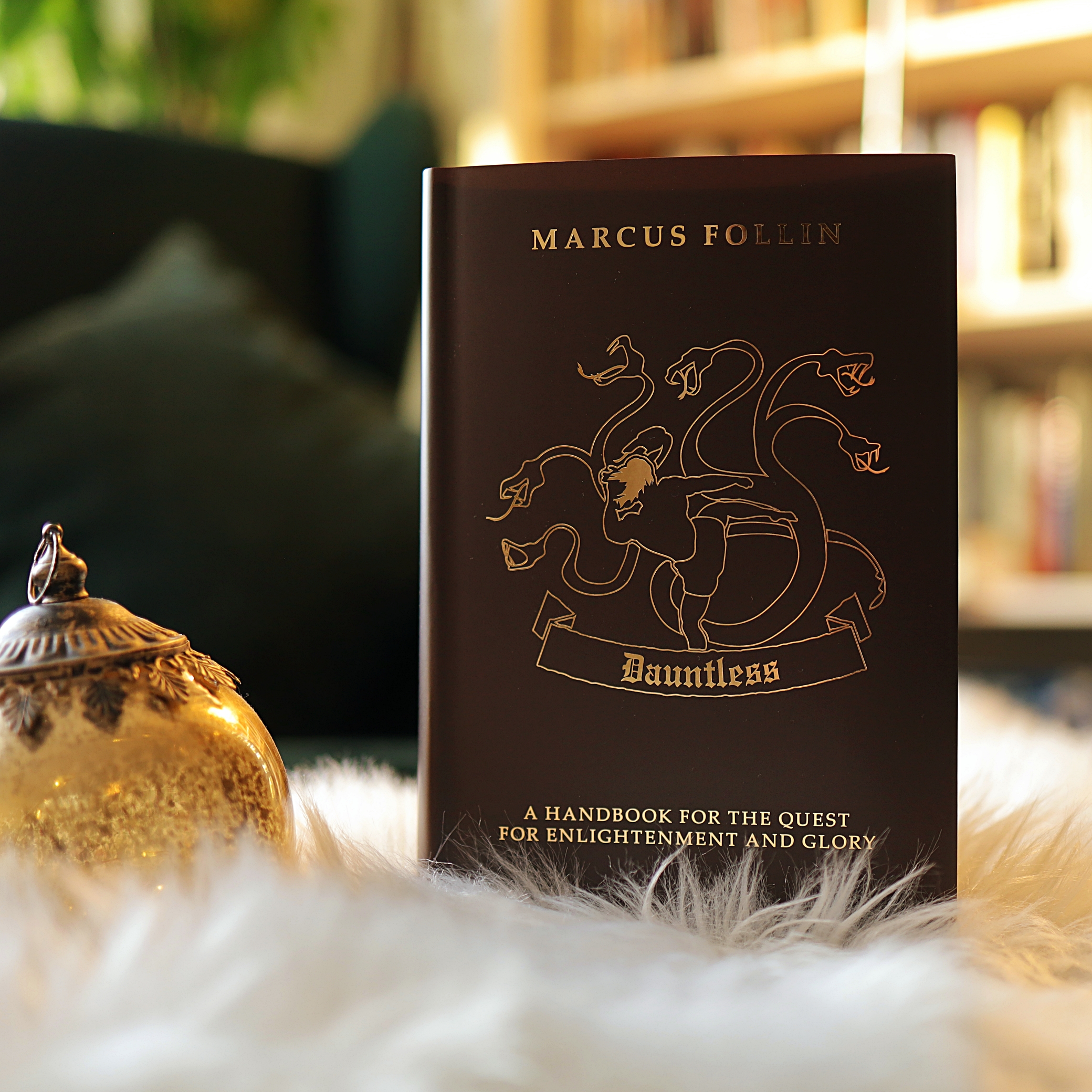


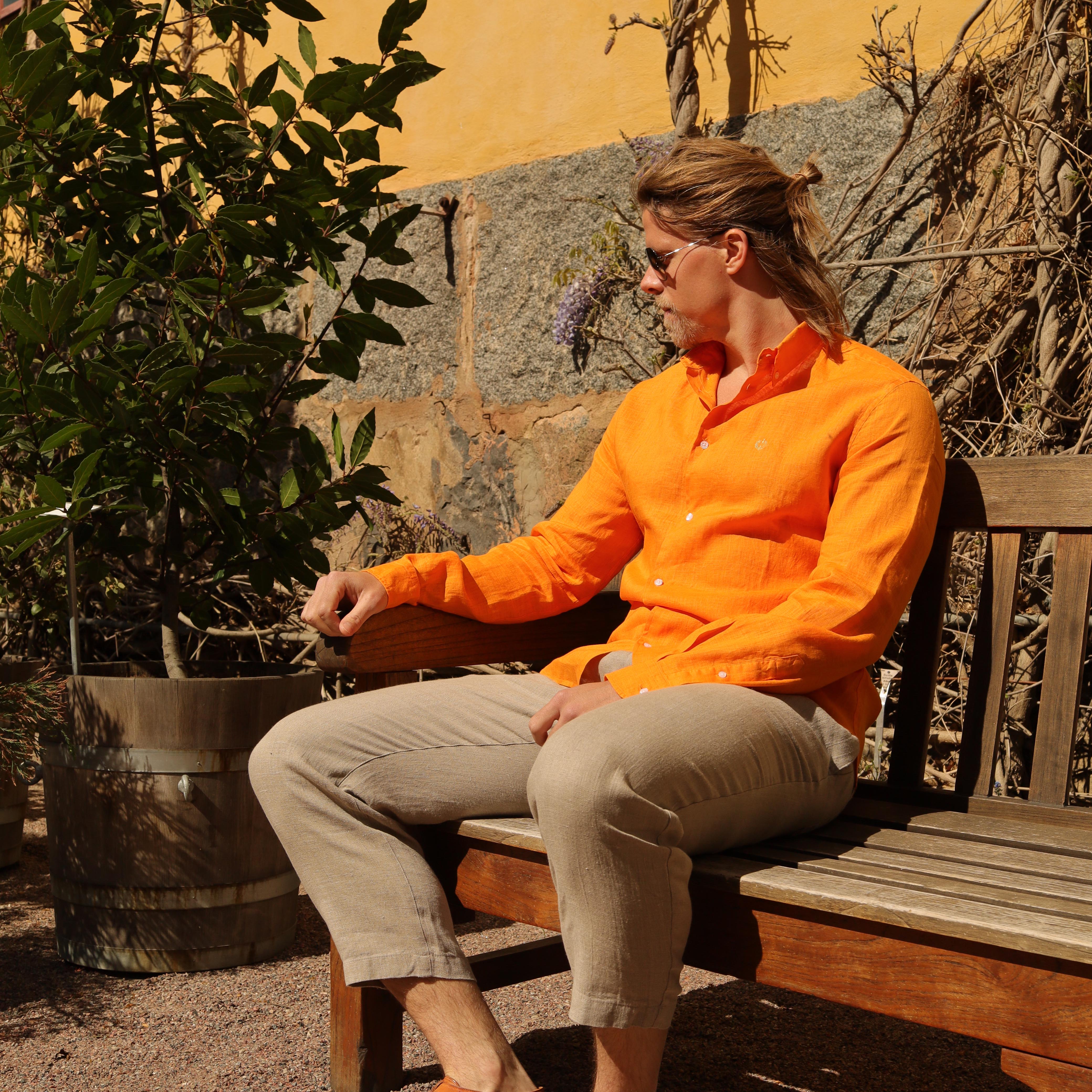
 The Golden One
You must be logged in to post a comment.