Tales & Legends of the Devil by Claude & Corinne Lecouteux
Posted on September 5, 2023

Our study of folklore continues! Thus, I have read Tales & Legends of the Devil – The Many Guises of the Primal Shapeshifter by Claude & Corinne Lecouteux. The book contains stories involving the Devil, from all over Europe. The book is structured into seven chapters, which are the following:
Chapter I: The Devil as a Suitor
Chapter II: The Devil and His Family
Chapter III: The Swindled and Battered Devil
Chapter IV: In the Devil’s Service
Chapter V: A Visit to Hell
Chapter VI: The Devil and the Church
Chapter VII: Singular Tales
The stories are, as suggested by the titles of the chapters, sorted in themes.
The most interesting insights gained from reading all of the stories is that the Devil is not quite the fearsome Prince of Evil that one would except. Rather, he is usually presented as an archetypal Trickster God. Upon reading many of the stories, I was reminded of Gaunter O’Dimm, whom men of culture will have encountered when playing the masterpiece The Witcher 3: Hearts of Stone. So, a powerful individual that tempts individuals into diabolic pacts – but still an entity that can be defeated by the wit or goodness of humans.
Many of the stories – especially those presented in Chapter III: The Swindled and Battered Devil – conclude with the human getting the better of the Devil.
A common theme in many of the stories is, as one may expect, that one who enters a pact with the Devil will benefit in the short terms but at a great cost later on.
At 209 pages, the book is a concise read and gives a good overview of the Devil in European folklore.
Phantom Armies of the Night by Claude Lecouteux
Posted on August 26, 2023

I have read Phantom Armies of the Night: The Wild Hunt and the Ghostly Processions of the Undead by Claude Lecouteux. As the title suggests, the book explores the legend of the Wild Hunt and similar folklore stories about the restless dead. The author introduces various tropes found in primarily French and German mediaeval myth and discusses them throughout the book. Just as with the Traditional Magic Spells for Protection and Healing (review), the book should be read as a study of European folklore.
The Golden One’s Wild Hunt
Those who have been with me for some time know that I sometimes make videos titled The Wild Hunt Challenge, where I present a number of challenges to complete (often related to training and reading). By using the name of the Wild Hunt, I seek to evoke a sense of enthusiasm, a sense of divine energy, and a hunger for life. Envision yourself as being swept up by the energies of Odin and the Wild Hunt as you embark upon an endeavour! I elaborate more on this in my upcoming book Demigod Mentality (September, 2023).
The Mediaeval Church and Folklore
As we have noted in several other book reviews and in a few Podcast episodes, the Christianity of the Middle Ages was rather a syncretic Paganism and Christianity. One could even say that the Christian mythos of the Middle Ages was a continuation of the existing one (with the addition of new characters and places):
‘The medieval church invented nothing. It picked up preexisting elements so that it could remodel them. It therefore created its own mythology from an older substratum, and this mythology soon fell into the public domain, where it continued to nourish beliefs and legends.’
Claude Lecouteux – Phantom Armies of the Night. Page 3.
Most of the stories presented in the book date from the (nominally) Christian period. The reason for this is that there are more sources to draw upon from that period than from earlier periods. On a personal note, I would have preferred a deeper investigation of the earliest roots of the legend, but I understand that such a discussion lies outside the scope of this book. Moreover, Claude Lecouteux is a scholar and presents evidence as he finds it, so I respect his choice to not speculate too much.
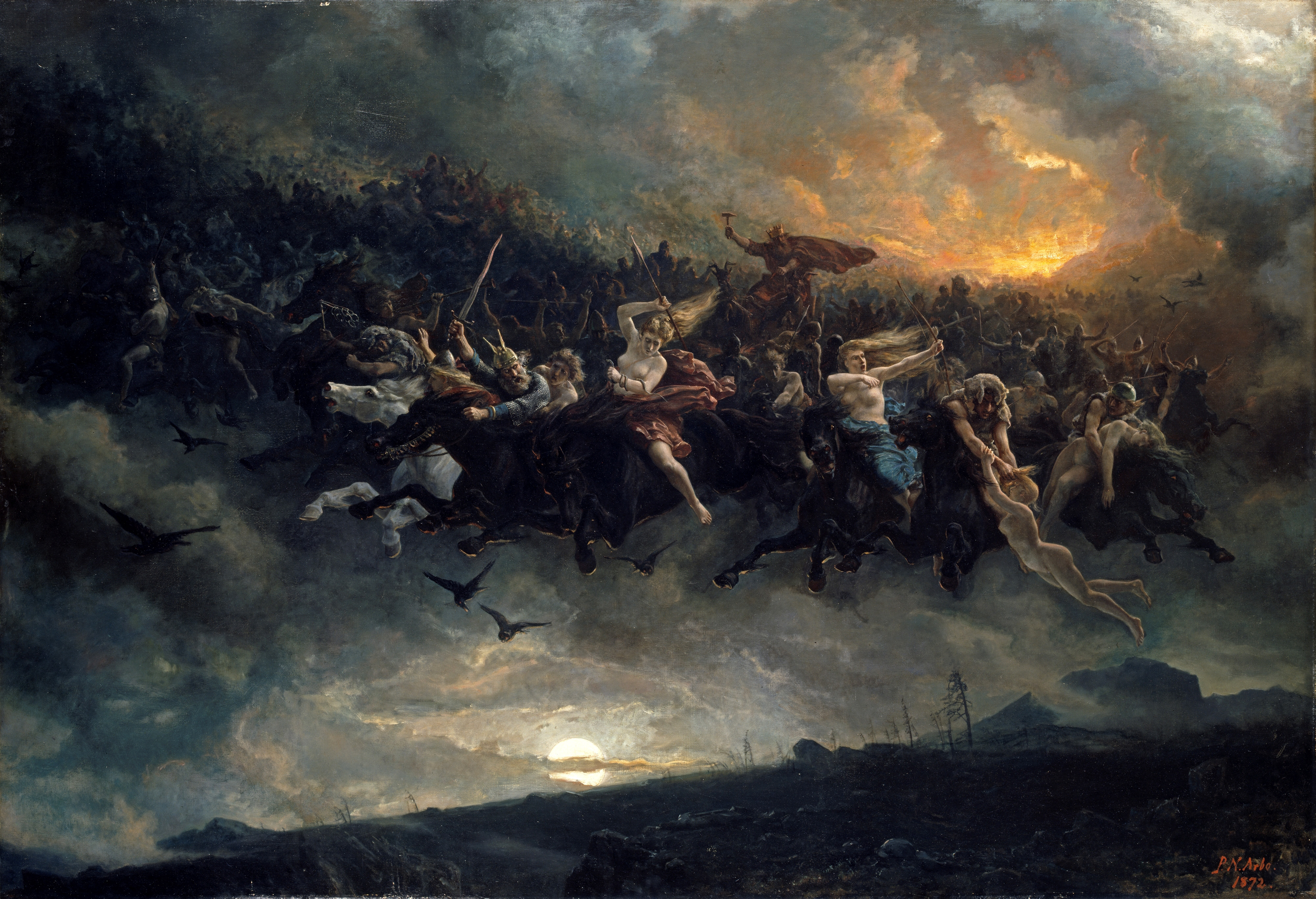
Pictured below: The Wild Hunt of Odin (1872) by the Norwegian artist Peter Nicolai Arbo.
The Wild Hunt in Indo-European Myth
The author concludes that it is hard to find a direct common source for the Wild Hunt. He does, however, note that some researchers have compared the Wild Hunt to the Vedic God Indra’s companions – which indicates an Indo-European origin of the myth. The author shares the following quote by Jan Gonda, who describes Indra’s companions thus:
‘Large and powerfully strong and dreadful in appearance, they cleave the air over mountain and hill, armed with their glittering spears. Admirable and irresistible, they travel in their sparkling golden chariots pulled by red-roan horses or gazelles. All tremble before them, even the earth and the mountains.’
Jan Gonda – Les Religions de l’Inde I: Védisme et Hindouisme anciens
This does indeed sound quite Indo-European. Important to note here is that the Indo-European influence in Iran and India came from the Corded Ware culture of central Europe. The modern population that is the closest genetically to the Corded Ware culture is the Swedish one. Thus, one should not be confused by the term Indo-European – which is why some prefer the term Aryan. Vedic spirituality was a result of the Aryan Invasion (for more information, watch this video: Aryan Invasion of India: Myth or Reality?).
Odin and Shamanic Doubles
In an interesting passage in the chapter titled Odin and the Wild Hunt, the author notes the following:
‘In 1980 a disciple of Höfler, Christine N. F. Eike, published an extensive study on the Oskoreia, the name for the Mesnie Hellequin in Norwegian folk traditions that picked up on the trance theory, noting that the manifestations of the winter-nights troop seem to reflect phenomena, such as forming Doubles, well known in shamanic traditions. This finally explains why it is logical for Odin to have been made the leader of the troop: he was considered the “god of ecstasy” (ekstasegud).’
Claude Lecouteux – Phantom Armies of the Night. Page 205.
The Oskoreia and the Mesnie Hellequin refer to the Wild Hunt. In the same chapter, the author refers to the great Jacob Grimm:
‘In quest of a German mythology, Jacob Grimm studied the theme of the cursed huntsman, which he compares to the Mesnie Hellequin, known as the Furious Army and the Wild Army in the regions east of the Rhine River. Starting in 1835 he sees in its leader a form of Odin that had been downgraded by Christianity to the rank of a ghostly figure.’
Claude Lecouteux – Phantom Armies of the Night. Page 203.
I present these quotes without further comment at the moment, but we will return to this topic in coming reviews, videos, and Podcast episodes.

Epic German Verse
The following verse appears on the first page of the chapter titled The Troops of the Dead. I found it particularly epic:
‘Es stehn die Stern am Himmel,
Es scheint der Mond so hell,
Die Toten reiten schnell…’
This is translated in the book as follows:
The stars sparkle in the firmament
The moon shines clear
the dead ride fast…
Hell (bright in German) rhymes with schnell (fast). The verse comes from the folk song Lenore. The poem was written by German author Gottfried August Bürger in 1773. Aside from the beauty of the verse, it is interesting to observe that this procession takes place when the moon shines bright (full moon) since we have discussed the influence of the full moon on previous occasions.
Pictured below: Sturm und Drang moment in Marburg, Germany.

Theodoric the Great and the Huntsman
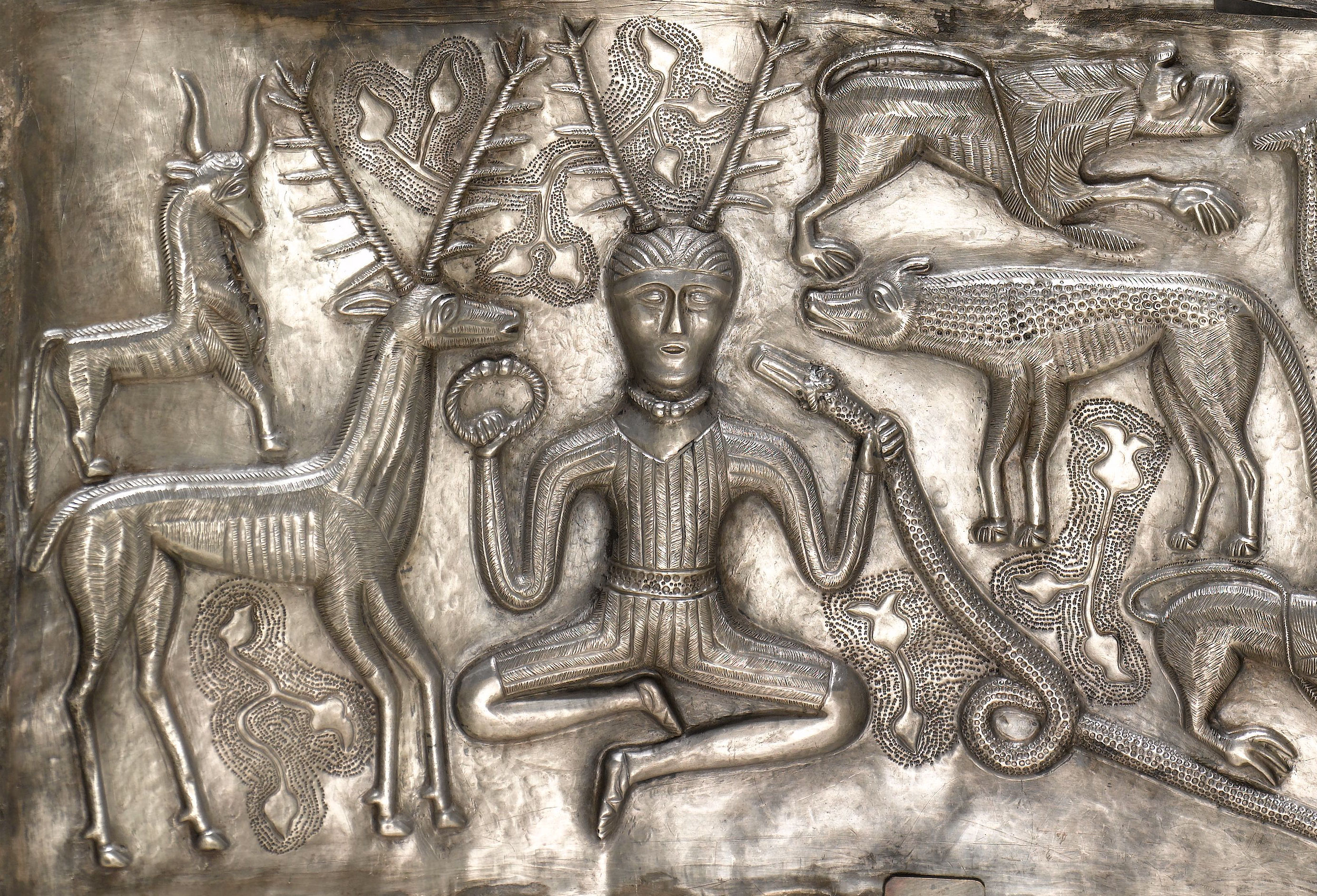
In the Eckenlied (an anonymous 13th-century Middle High German poem), Theodoric the Great (Dietrich von Bern in German mediaeval literature) encounters a giant figure named Fasolt. Fasolt is clad in armour and has his hair braided and carries a hunting horn; he is accompanied by a pack of hounds. In the story, he pursues a wild maiden named Babehilt, who seeks the protection of Dietrich. Fasolt enters a rage and demands to know why Dietrich would deny him his prey. Since Dietrich is wounded, Fasolt does not engage him in combat. My initial thought upon reading this was to think of Orion of Warhammer – who is a figure based on these themes as well as on the Celtic God Cernunnos (pictured below). Cernunnos is associated with beasts, fertility, hunting, and nature. Although the author of the book does not make this statement, I am personally of the opinion that Cernunnos surely must have inspired later tales of the Wild Hunt.
The Cursed Hunter and Michael Beheim
One common trope associated with the Wild Hunt and the restless dead is the cursed hunter. The author shares one such example from a Meistersang (master + song) by Michael Beheim. In that story, Count Ebenhart of Wirtenberg encounters an apparition during a hunt. The apparition tells the count that he was so passionate about hunting that he asked God if he would permit him to hunt until Judgement Day. The apparition then says that to his great misfortune the wish was granted, and that he had now hunted for five hundred years.
The author notes that the apparition was punished for hunting on a Sunday, for damaging crops, and for slaying a stag in a church.
On a related note, the name Michael Beheim may be familar for appreciators of Vlad Dracula. Beheim was Dracula’s contemporary and composed a poem about him. I first encountered the name of Michael Beheim in Dracula, Prince Of Many Faces by Florescu Radu R. and Raymond T. McNally (the book I relied on for my Podcast Episode 20. Vlad Dracula).
Hellequin
The English word Harlequin stems from the French word Hellequin. The author says the following about the word:
‘In France, the name Mesnie Hellequin gradually came to mean people who assembled to commit acts contrary to good character and morality…’
Claude Lecouteux – Phantom Armies of the Night. Page 206.
The Mesnie Hellequin is, as already mentioned, a word used in mediaeval French literature and myth to describe Wild Hunt-like ghostly processions.
Conclusion
Phantom Armies of the Night is a good book and serves as a good starting point for anyone who wishes to learn more about mediaeval folklore. On a personal note, I would have liked a more thorough discussion about the Odinic and ecstatic aspect of the legend. However, as already mentioned, the book should be read as a study of folklore as opposed to a study of pre-Christian religion.
Onwards and upwards!
Döden spelar schack by Albertus Pictor
Posted on August 25, 2023

The famous Döden spelar schack (Death plays chess) by the great Albertus Pictor (Albert Målare, Albert the Painter). This epic work of art dates from the 1480s and can be found in Täby kyrka, Sweden.
The meaning behind the motif of playing chess with Death can be seen a reminder to think about how one’s actions in life determine which rewards or punishments one can expect after death.
In a mediaeval Christian context, this takes the shape of Heaven and Hell. In a Pagan context, one’s deeds also impact what comes after death. In addition to realms of the afterlife (i.e. Valhall, Hel, Fólkvangr, etc.), there is also the Hamingja (the collective luck or fortune of a bloodline).
Good deeds strengthen the Hamingja and thereby also one’s Fylgja (guardian spirit). I elaborate more on these concepts in my upcoming book Demigod Mentality (September, 2023).
Therefore, make sure to make good and virtuous moves in your chess game with Death!
Traditional Magic Spells by Claude Lecouteux
Posted on August 23, 2023
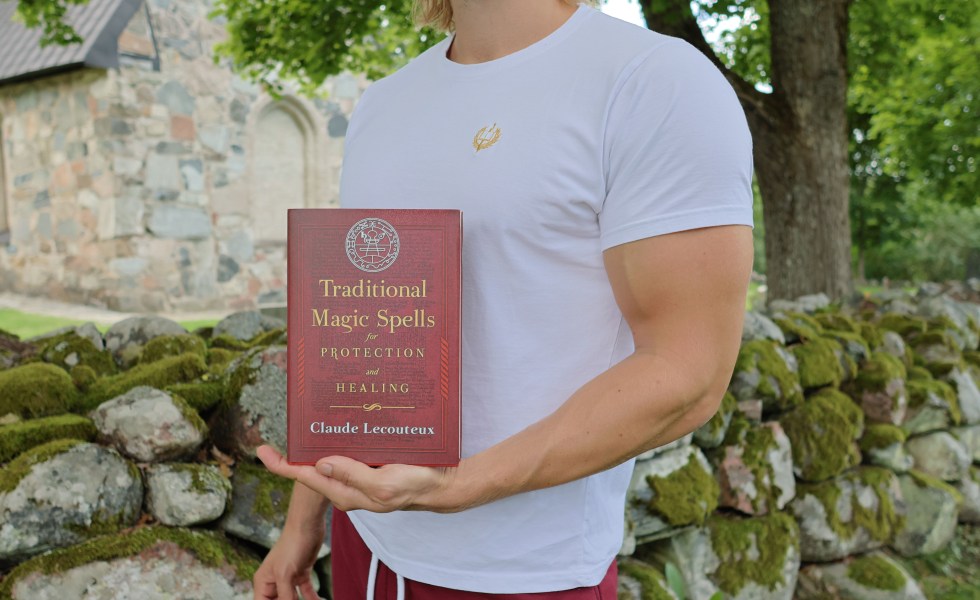
I have read Traditional Magic Spells for Protection and Healing by Claude Lecouteux. The book should not necessarily be read as a practical book about magic (i.e. with practical instructions for meditation techniques, etc.), but rather as a study of folklore and myth. The book contains a great number of spells from various European countries. As the title of the book suggests, most of them concern healing and protection.
Christian Magic – No Religion Without Magic
Perhaps the greatest insight from the book is the prevalence of Christian magic. Many of the spells and incantations revolve around characters from the Christian mythos. As we have discussed on numerous occasions, the Christianity that dominated Europe for most of its existence was a syncretic Paganism and Christianity – these spells support this notion. Related to this it becomes apparent that this type of Christianity certainly was not averse to magic. This is, of course, a complicated topic, especially taking into consideration the witch hunts but it is interesting to point out.
The author shares a quote from another author which I found illuminating. This is also, in my own humble opinion based on my esoteric journey of the last one and a half years, accurate.
‘There is no religion without magic any more than than there is any magic without at least a trace of religion.’
Claude Lèvy-Strauss – The Savage Mind
Pictured below: a picture I took in Enköping kyrka.

Norwegian Spell Involving Jesus and a Troll
One spell which I found particularly interesting is the following from Norway. In order to free animals of all ills, one can read the following over salt and malt and give them to one’s animals:
‘Jesus and the Virgin Mary were traveling along the shore when they saw the good valerian planted in the ground. Jesus began to dig up the root. The troll in the mountain began shouting about the uselessness of the root. Saint Peter arrived and answered the troll of the mountain this way: “It is good against many ills. It is good against exhaustion and anemia! It is good against the fang of the wolf and the claw of the bear and the tooth of Satan and the hand [the contact] of sorcerers and against all ill that flies between heaven and earth.” By the three Names and [speak] the Our Father three times before and three times after.’
Claude Lecouteux – Traditional Magic Spells. Page 263.
The source is the Svartbok frå Gudbrandsdalen. Svartbok (svart = black in Norwegian and Swedish, bok = book). Svartbok refers to a book of sorcery.
What is interesting about this is how Jesus is incorporated in myth (in this case, a spell). Since we have discussed how Christianity was formed to fit into the European psyche, I thought this example of a spell was a good way to illustrate this. Thus, one can say that much of the mythos (i.e. folklore) remains the same, but with the addition of some new Gods or characters (Jesus, Mary, Saint Peter).
Moreover, regarding valerian itself, it can be used to improve sleep quality and reduce depression (study: https://www.ncbi.nlm.nih.gov/pmc/articles/PMC8077445/). Perhaps valerian would make a good addition to Jotunheim Nutrition?

Astrology and Body Parts
Many of the spells presented in the book concern healing. The author notes that Bernard de Gordon (a physician of the thirteenth to fourteenth century) established a connection between the zodiac and the human body: Aries ruled the head and neck; Taurus, the neck and shoulders; Cancer, the chest; Gemini, the lungs and arms; Leo, the heart and stomach; Virgo, the navel and its neighbouring parts; Libra, the hips and kidneys; Scorpio, the womb, penis, testicles, and peritoneum; Sagittarius, the muscles of the thigh; Capricorn, the knees; Aquarius, the legs; and Pisces, the feet.
The author also shares some wisdom from our old friend Paracelsus, who was, undoubtably, a genius:
‘For Paracelsus (1493-1541), when using plants for remedies, it is necessary to take into consideration their harmony on the one hand with the constellations, and on the other hand with the parts of the body and the diseases, each star attracting, by a kind of magic virtue, the plant with which it shares an affinity and which forms part of its activity in such a way that plants are, strictly speaking, so many sublunary stars. A bleeding should never be performed on just any day, as the astral conjunctions can have a helpful or harmful influence over this operation.’
Claude Lecouteux – Traditional Magic Spells. Page 20.
The author also notes that barbers had almanacs indicating which days are favourable (and which are less favourable) when it comes to bleedings. Astrology is always interesting!

European Union Regulations
The author notes that there is an EU regulation (no. 1924/2006) from 2012 that stipulates the following:
‘Healers, faith healers, naturopaths… and other professions of alternative medicine do not have the authority to claim that their natural products, or treatments, provide relief, benefit, powers, positive properties to health nor make any allusion to a potential cure.’
I present this without further comment at the moment, but I have thought about making a video on medicine and belief – so if I refer to this passage in that video and you recognise it from this book review, I salute you! Those who read my book reviews are my most esteemed supporters.
Conclusion
The author has done good work in compiling folklore from all over Europe into this volume of 293 pages. I would recommend the book to enthusiasts of folklore or history. For the enjoyer of magic and the more practical application of esoteric knowledge, I would rather recommend a book such as Icelandic Magic by Stephen E. Flowers (review).



 The Golden One
You must be logged in to post a comment.