The Fraternitas Saturni by Stephen E. Flowers
Posted on November 12, 2022 1 Comment
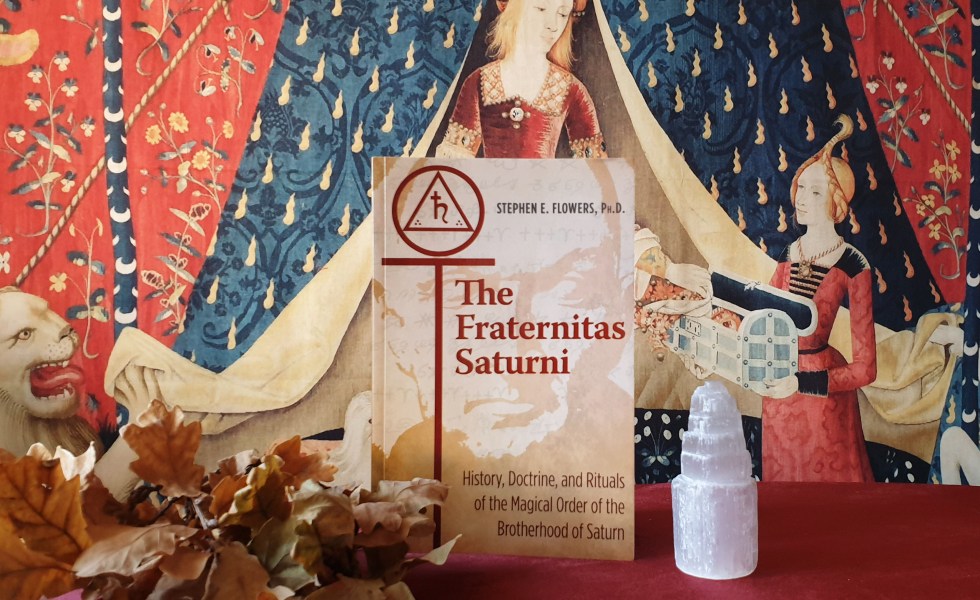
I have read The Fraternitas Saturni – History, Doctrine, and Rituals of the Magical Order of the Brotherhood of Saturn by Stephen E. Flowers. The book is, as the subtitle suggests, about the history, doctrine, and rituals of the Fraternitas Saturni. The brotherhood was founded in 1926 by Eugen Grosche (1888–1964), also known by his occult name of Gregor A. Gregorius, and exists to this day. In my humble opinion, the most interesting part of the book concerns the brotherhood’s view of Lucifer.
Saturn, Lucifer, Satan
‘The elements that make the FS unique are its focus on the Saturn archetype, the Satunian mythos of a new aeon based on an astrological process, and an unabashed Luciferianism.’
Stephen E. Flowers – The Fraternitas Saturni. Page 41.
The author notes that in the Saturn Gnosis, the planet and archetype of Saturnus is the focal point for the manifestation of the Demiurge (Demiurge = Creator God). This Demiurge is identified with Lucifer as the ‘higher octave’ of Saturn, whereas Satan is the ‘lower octave’ – the Saturnian brother should focus on the higher octave to remain fully conscious and independent. According to secret teachings of the Fraternitas Saturni, Saturnus is the ‘Great Judge’ that manifests justice, as well as being a bringer of reason and intelligence. Saturnus is, moreover, the ‘breaker of cosmic order and unity.’ He instituted death, thus causing regeneration and change to come into being. One of the ways he broke the cosmic order was in the revelation of divine secrets to mankind. Therefore, in the view of the Fraternitas Saturni, Lucifer is the ‘Good God’ who brought the Divine Light to mankind – he is the embodiment of enlightenment and reason. Lucifer in this context takes on a similar shape as Prometheus of Greek myth (who brought the divine fire, or higher consciousness, to mankind).
‘Gregorius was always anxious to point out that this Lucifer mythology was in fact older than the ignorant misunderstandings and willful distortions of the Judeo-Christian tradition.’
Stephen E. Flowers – The Fraternitas Saturni. Page 62.
Perhaps Otto Rahn was inspired by this view of Lucifer; it is not an impossibility since he was active during the same tumultuous time in Germany. As we saw in Lucifer’s Court, Rahn believed Lucifer to be an ancient Indo-European God (equivalent of Balder among the Norsemen and Apollo among the ancient Greeks).
‘I believe that I just saw God on this road! He came riding like a knight, beautiful and strong. His blond hair fell around his bronzed face and his bright eyes shone. […] “Peire Vidal, you have met Lucifer, whom you call Lucibel!”’
Otto Rahn – Lucifer’s Court

Weimar Degeneracy
In the appendix of the book, a chapter titled An Outline of Adonism is included. Adonism was connected to, although not in any official capacity, the Fraternitas Saturni. In essence, the adherents of ‘Adonism’ were degenerates (i.e. similar to modern-day Leftists). They profaned the sacred name of Adonis by connecting it to ‘sexual liberation’ and radical Left-wing policies (abolishing of marriage as the societal norm, for example).
An Epic Poem
As an aspiring poet, I am always on the look-out for beautiful and epic poems to serve as inspiration. Here is the first part of a poem by Gregor A. Gregorius.
‘Thou must affirm the God in Thee,
– Gregor A. Gregorius
for every doubt takes power from Thee.
Every hour of Thy divine knowledge brings
Thee a step higher in Thy journey.
Thou canst unfold the spark,
that God bestowed on Thee, to a pure flame
that makes worlds fall and rise again,
God is in Thee! – Thou art Thyself God!’
As any loyal reader of these book reviews will know by now, I do not endorse the teachings of every person I quote. The passage above is merely a part of a beautiful poem – it does not mean that I endorse Gregorious as a person.

Illuminati and the Rosicrucians
Also included in the appendix of the book is a chapter on the Bavarian Illuminati (founded 1776) and the Rosicrucians (founded ca. 1604). The reason for including a chapter on these two different organisations is due to their importance to the later occult revival to which the Fraternitas Saturni was heir. The quote below summarises the difference between the two quite well:
‘Rosicrucians are spiritual and mystical, whereas the Illuminati were purely materialistic and rational. The Rosicrucians are children of the Renaissance and Reformation while the Illuminati are the offspring of the Enlightenment.’
Stephen E. Flowers – The Fraternitas Saturni. Page 171.
A longer discussion of the two organisations is beyond the scope of this review, but we will most likely return to the topic in coming articles.
Conclusion
Since I have read quite a few of his books by now, I am confident in recommending everything by Stephen E. Flowers – including this fine book. It is 181 pages and written in accessible language. Good stuff!
Aleister Crowley’s Four Books of Magick – Liber ABA
Posted on October 10, 2022

I have read Aleister Crowley’s Four Books of Magick – Liber ABA. Having encountered him in several other esoteric books, I decided that it would be reasonable to read his own words. The edition I read is edited by Stephen Skinner and contains an interesting foreword as well as many helpful footnotes. The footnotes are especially helpful since most of the book is rather unstructured.
As is selbstverständlich (roughly translated from German as ‘self understanding’; another translation would be obvious) for my loyal readers, I do not endorse Aleister Crowley as a person (i.e. his degeneracy and drug use). I, a humble seeker of esoteric knowledge, merely seek to present the grimoire at hand.
Mysticism vs Magic
In the introduction, Stephen Skinner shares the following explanation regarding the difference between mysticism and magic:
‘Mysticism relates to improving one’s mind or soul while striving for something like Samadhi or union with god. This can only be experienced internally. Magic, however, is concerned with making changes in the external world, securing the love of someone otherwise unobtainable, or a rapid job promotion, obtaining treasure, or an impossibly elusive book. The two methods are not interchangeable, just as their objectives are very different.’
Stephen Skinner

Spirit or Psyche?
Another interesting insight presented in the introduction is Aleister Crowley’s indecisiveness regarding the nature of magical operations.
- The Spirit View. Up until and during the 19th century, magic was seen as a collaboration between the magician and a god, angel, demon, or spirit.
- The Psyche View. The 20th century view of magic was one influenced by science, albeit a soft science – in the form of psychology. The view is that everything magical takes place in one’s own psyche.
Crowley, being a child of his time – Victorian England – with its love for all things scientific, wanted to present magick (magick being his spelling of the word) as a science. This becomes clear when reading the book. This would present an issue since it was his Holy Guardian Spirit, Aiwass – an entity outside of his own psyche – that presented him with the insights required to start Thelema (his new religion).
‘Magick is the Science and Art of causing Change to occur in conformity with Will.’
Aleister Crowley
My own take is that the Spirit View is more heroic; it also makes more sense. The Psyche View is a bit too atheistic for my taste! We will return to this interesting topic at a later stage.

The Five Glaciers
In part one of the book, Crowley elaborates on meditation and yoga. This is the best and most accessible part of the book. He shares a beautiful image that he learned in India in regard to stilling the mind:
‘That image is that of a lake into which five glaciers move. These glaciers are the senses. While ice (the impressions) is breaking off constantly into the lake, the waters are troubled. If the glaciers are stopped the surface becomes calm; and then, and only then, can it reflect unbroken the disk of the sun. This sun is the “soul” or “God.”’
Aleister Crowley – Four Books of Magick. Page 85.
In the same part, he shares another epic quote from the Dhammapada (a collection of sayings of the Buddha in verse form):
‘An ill-thatched house is open to the mercy of the rain and wind;
Dhammapada
So passion hath the power to break into an unreflecting mind.
A well-thatched house is proof against the fury of the rain and wind;
So passion hath no power to break into a rightly-ordered mind.’
Aleister Crowley’s Description of Himself
Crowley shares the following description of himself. He describes himself in grandiose terms in other sections of the book as well. On a personal note, I like this. Degenerate as he was, he was still accomplished in certain matters (especially mountaineering), and there is no reason to pretend to be humble when one is in fact not.
‘Myself, age 28½. In good health, fond of out-door sports, especially mountaineering and big-game shooting. An Adept Major of the A∴A∴ [Argenteum Astrum, which is Latin for Silver Star] but weary of mysticism and dissatisfied with Magick. A rationalist, Buddhist, agnostic, anti-clerical, anti-moral, Tory and Jacobite. A chess-player, first class amateur, able to play three games simultaneously blindfold. A reading and writing addict.’
Aleister Crowley – Four Books of Magick. Page 687.
Something to note with Aleister Crowley is that his father was a devout member of the (Christian) Plymouth Brethren. As I noted in my conversation with Styxhexenhammer666 (listen to it here), it seems that many with anti-Christian attitudes come from strict Christian households. His anti-Christian sentiments become clear when reading the book.
An Amusing Anecdote
Crowley shares the following amusing anecdote. Frater Perdurabo = Aleister Crowley.
‘His need to check the vampiring of a lady in Paris by a sorceress once led FRATER PERDURABO to the discovery of a very powerful body of black magicians, with whom he was obliged to wage war for nearly 10 years before their ruin was complete and irremediable, as it now is.’
Aleister Crowley – Four Books of Magick. Page 309.
His style of writing, it must be admitted, is entertaining. He is also politically incorrect, which is refreshing and fun. Some other similar anecdotes appear throughout the book.

Conclusion
The tome is quite massive, physically speaking; length-wise it is around 700 pages, depending on how you count (the appendix section is quite extensive). The text is quite spaced out and there are plenty of illustrations, so the book does not contain 700 pages of dense text. Even so, reading it presents quite a time investment. The edition itself is beautiful; it is a nice hardcover with an aesthetically pleasing front.
Can I recommend the book? It depends on whether you view Crowley as an interesting man or not. If not, then I would not recommend reading the book, especially since there are so many other interesting esoteric works out there – I would first and foremost recommend the works of Stephen E. Flowers. Moreover, large parts of the book do not make much sense. For those who are interested in Crowley’s own rituals and philosophies, however, the book is a good addition to one’s arcane library.
Onwards and upwards!
The Legio Gloria September Release
Posted on October 1, 2022

I am happy to present five new releases. I am also happy to say that several garments have been restocked! First and foremost, two new polo shirts are available – a verdant green one and a much-requested black one. Both have the same cut and material as the previous polo shirts – 100% organic cotton and with an athletic fit. The model fits rather tightly, so if you are in between sizes, go with a size up.

Two new stringers are available. The Mithraic Gym Stringer was, as regular readers of my book reviews will perhaps have surmised, a design I had a special desire to release. Wearing the motif of Mithras and the Bull will serve as a reminder to dominate your inner chaos, and to make the most use of the divine energies that are yours to harness. This design is also meant as an esoteric salute to others who will recognise its message.


The second motif is inspired by the Vendel-era Torslunda helmet, which was found on the Swedish island Öland (located in the sacred Baltic Sea). The runes say Legio Gloria. The garment itself is a better version of the previous tanktop the motif appeared on last year. I was not perfectly happy with the said tanktop, so I made some changes (for better comfort and durability). I wear this stringer in large (I wear most other garments in extra large), so you can go with a size smaller than your usual (a medium actually fits me well too).

Alongside a restock of most bottoms, new Questing Shorts in grey are available. Based on customer feedback, these have deeper pockets than previous Questing Shorts.

Related to the polo shirts – it is sometimes necessary to even out the shoulder seam (simply iron it). The cut of the polos is designed to accommodate muscular arms and shoulders, hence spacious shoulder seams.

Lastly, we still have some issues with DHL. Our logistics team has been in contact with DHL and DHL is currently making some changes and improvements, so the matter should be resolved within a foreseeable future. The orders are arriving in good fashion, even if some tracking numbers are not working. Thank you for your patience in this regard!
Next up for Legio Gloria is a wool release, which will consist of a new garment in addition to a restock of the beloved Lir’s Merino Wool Sweater. Onwards and upwards!

Creation and Completion – Essential Points of Tantric Meditation by Jamgön Kongtrul
Posted on September 28, 2022
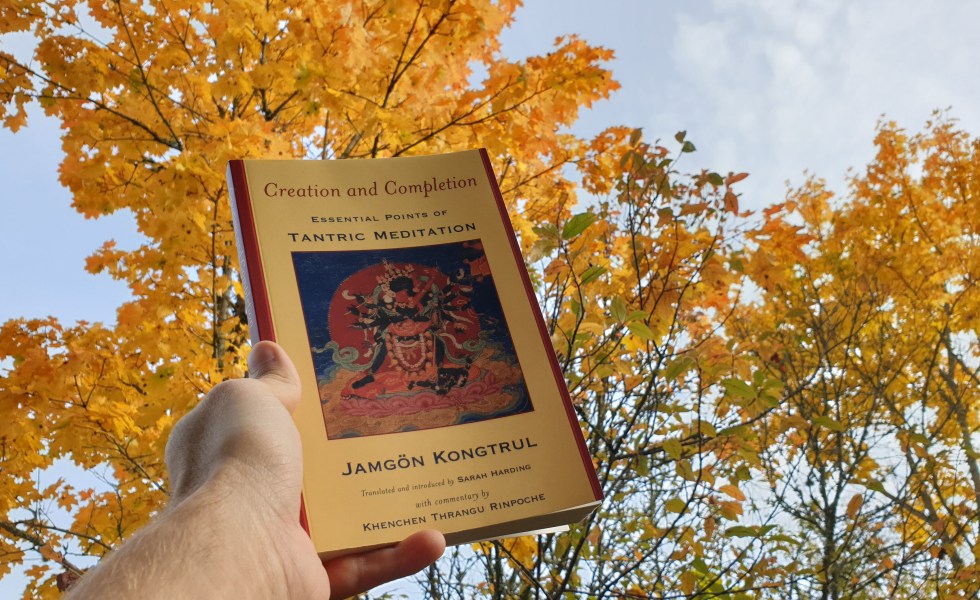
I have read Creation and Completion – Essential Points of Tantric Meditation by Jamgön Kongtrul, also known as Jamgön Kongtrul the Great, who lived between 1813 and 1899 CE. The best part of the book, at least from my perspective, is the valuable commentary by Khenchen Thrangu Rinpoche. Many older esoteric texts can be a bit hard to comprehend, especially since certain aspects of the them might be lost in translation. This is why the commentary is so appreciated.
Tibetan Buddhism and Deities
In the introduction, Sarah Harding notes that many Tibetan Buddhist spiritual practices center around various deities. This may come as a surprise to those who view Buddhism as a nontheistic religion. This is also why some other Buddhist schools have considered Tibetan Buddhism as corrupt and untrue to its original form. However, as Sarah Harding notes, these deity practices are deeply rooted in the very foundations of Buddhist thought. In my own humble opinion, a spirituality with a pantheon of Gods and Goddesses will always be more appealing than one without deities.

Transformation of Desire
Jamgön Kongtrul shares the following accessible technique for dealing with desire. I do not believe that any of my esteemed book-review readers are still under the yoke of pornography, but if you are – try to transform that desire into a deity (i.e. visualise a deity) the next time it comes to you!
‘The uncommon approach of mantra is to transform afflictive emotions.
Jamgön Kongtrul – Creation and Completion . Page 37.
When the desire arises, you meditate on Amitabha
or a deity such as Heruka in union.
The desirous thought is transformed into the deity.
The other deluded emotions are treated in the same way.’
In the notes, the following is mentioned regarding the two deities mentioned above:
Amitabha: Boundless Light, the name of a buddha – the head of the lotus family – that is associated with the transformation of desire into the pristine wisdom of discernment.
Heruka: a general name for wrathful meditational deities, and also a name for Cakrasamvara or ‘Wheel of Sublime Bliss,’ one of the Tantric deities particularly associated with desire.

Virtue! Virtue!
At the end of the text, Jamgön Kongtrul states the following. I thought it was a beautiful passage worth sharing:
‘At the request of the spiritual friend Karma Palden, an attendant of the fourteenth Omniscient Lord of the Victorious Ones (Karmapa), and whose mind is totally devoted to the definite meaning, I, Karma Ngawang Yönten Gyamtso, bearing merely the signs of a Buddhist monk, at the age of twenty-seven, gradually dictated this text, and he transcribed it. May it send forth glorious healing qualities for the doctrine and for beings. In all times and directions may glory prevail. May the glorious blaze of good fortune adorn the world. Virtue! Virtue!
Jamgön Kongtrul – Creation and Completion . Page 81.

Confronting Fear – A Note on Batman
In the commentary section, Khenchen Thrangu Rinpoche talks about the teachings of Machig Labdron – a female Buddhist monk who lived between 1055 and 1149 CE. He notes that her approach is one of severance rather than pacification.
‘Rather than pacifying thoughts, you actually provoke the most difficult ones. In severance practice, you work especially with fear. You go to places where you feel unsafe, typically to charnel grounds. You trigger intense fear, and you cut through it.’
Khenchen Thrangu Rinpoche
Reading this made me think of Christopher Nolan’s masterwork Batman – Batman Begins in particular, where Bruce Wayne is presented with his fears (bats) in a monastery in the Himalayas. I wonder if Nolan took inspiration from the teachings of Machig Labdron. Epic stuff in either case!

Tantras and Sutras
In the commentary, the following passage appears in regard to the Tantras and Sutras:
‘First of all, all of the Buddha’s teachings are included within two paths. They are the stable and gradual path of the sutras and the quick and especially effective path of the Vajrayana, or the tantras. Both of these take as their root the taming of the mind, or pacifying the thoughts and kleshas that afflict out minds’
Khenchen Thrangu Rinpoche
He goes on to note that the Sutras teach rejection or abandonment of the kleshas – you must relinquish attachments. The Tantra approach, on the other hand, is one of transformation – transformation of desire into something pure. This is also the meaning of the title of the previous book I reviewed, Introduction to Tantra: The Transformation of Desire by Lama Yeshe (review).
Conclusion
At 153 pages and written in an accessible language, the book serves as a good further introduction to the topic. The book was a good follow-up to the aforementioned Introduction to Tantra: The Transformation of Desire by Lama Yeshe. I can recommend the book to anyone interested in Buddhism in general and Tantra in particular.
Onwards and upwards!




 The Golden One
You must be logged in to post a comment.