The Knights Templar in the Golden Age of Spain by Juan García Atienza
Posted on June 22, 2024
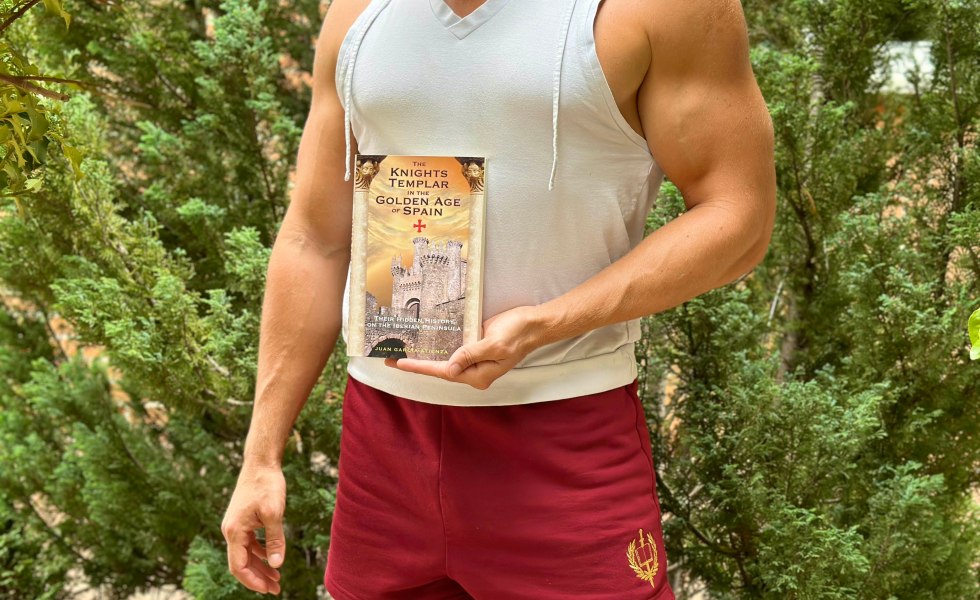
I have read The Knights Templar in the Golden Age of Spain – Their Hidden History on the Iberian Peninsula by Juan García Atienza. As the title of the book suggests, it details the history of the Templar Order in Spain (i.e. the various Spanish kingdoms of the Middle Ages) and Portugal. It can be described as a history book with an esoteric touch.
Disclaimer and Correction
To my great lament, I detected a glaring falsehood in the introduction of the book. The author erroneously claims that the Moors were as Spanish as the Spaniards after a few centuries. This is, needless to say, a politically loaded comment. It is unfortunately not all too uncommon to see this sort of submissive display (to the politically correct establishment – for lack of a better term). The rest of the book is good, and I did not get the sense that the author tried to impose his own views (aside from perhaps when discussing the esoteric aspect of the Order).
Another correction: The author states that Julius Evola was the ‘personal magician’ of Mussolini. This was not the case. It is true, however, that Evola and his companions tried to influence Mussolini to embrace Roman Paganism. They were unsuccessful – Mussolini chose an alliance with the Catholic Church.
As for the Reconquista and identity in mediaeval Spain, it was always a religio-racial war between European (Spanish) Christians and Arab and Berber Muslims. Pictured below: Santiago Matamoros.

Templar Synarchy & Synchretism
The esoteric aspect of the Templar Order is a central theme of the book. The author gives plenty of attention to what he calls the synarchic plan of the Templars. In a footnote he defines synarchic as a government made up by various princes (each one administering a section of the state). Syncretism refers to the practice of incorporating various religious teachings in one’s faith (Templars learning about the Divine from Muslim mystics would be an example of this, for example). The author says the following:
‘It is beyond all doubt that the Templar Order structured its theocratic ideology by studying and assuming unorthodox principles. These included those they extracted from Eastern Christian sects and from the traditional structures that had been repeatedly denounced by the Roman Church as abominations. The spiritual world conceived by the Templars was made up of the very practices and ideas that in many cases served their accusers toward the end of the Order’s existence. They had laid out a blueprint for a universal theocracy in which any unorthodox Christian sects would have a place, as would a substantial part of the religious ideologies defended by Jews and Muslims.’
Juan García Atienza– The Knights Templar in the Golden Age of Spain. Page 94.
That the Templars were spiritual seekers is uncontroversial and something that I am fairly confident in agreeing with. The latter part of the quote, however, is something that I must look into further. Orthodox in the quote above does not refer to Orthodox Christianity (i.e. the Orthodox Church), but rather to what was seen as acceptable in the eyes of the Catholic Church. Another quote on the same topic:
‘They had educated at least one monarch – James I, the Conqueror – according to their values and the image of the political plan they had conceived. With an eye to total control, they partially controlled the strategy that, in theory, would lead to the conquest of the Jerusalemite Axis Mundi, the nucleus of their great synarchic enterprise. They maintained officious but very solid but very solid relations with qualified representatives of the great Mediterranean religions, who came to consider the Templars the firmest speakers to a mutual understanding that constituted the basis for that union on which would be built the dream of a universal theocratic government.’
Juan García Atienza– The Knights Templar in the Golden Age of Spain. Page 192.
The author goes on to note that Cathars could find a place in this vision as well. We will return to the epic story of James the Conqueror later on.

Templars and Cathars
As Lynn Picknett and Clive Prince noted in their The Templar Revelation (review), the Templars gave refuge to the Cathars who flew the onslaught of the French crusaders (of the Albigensian Crusade). The author of this book also emphasises this fact. He notes that the Templars in Iberia did their best to accept and hide Cathars in their strongholds. Moreover, the author notes that Aragorn, Catalonia, and Navarre were almost drawn into war with France over the Cathar situation. Furthermore, he notes that Cathars joined the military efforts of James I in conquering the Balearic Islands (including Mallorca). Much more can be said about this topic – and we will indeed return to this later on! Astute Enjoyers of my content will know that I have a particular interest in both the Templars and the Cathars.
Templar Momentum
You will hear me quote this passage later on, but I will share it now as well since I found it inspiring:
‘For the next nine years, the offensive was unstoppable, as if the Templars were in a hurry to conquer territories before the Almohad machine began advancing like a steamroller. In 1146 the plaza, Santarém, Leiría, and all of the territory surrounding the rivers Mondego and Tajo had been reconquered. In 1149, with the collaboration of English Crusaders (perhaps Templars), Lisbon was conquered. In all of the conquered territories the Templar Order accumulated churches, convents, and castles. Portuguese Templar Gualdim Pais distinguished himself as the hero of these military actions, and barely after achieving victory in Portugal, he left for the Holy Land to receive the initiation reserved for the highest eschelons of the Order.’
Juan García Atienza– The Knights Templar in the Golden Age of Spain. Page 81.
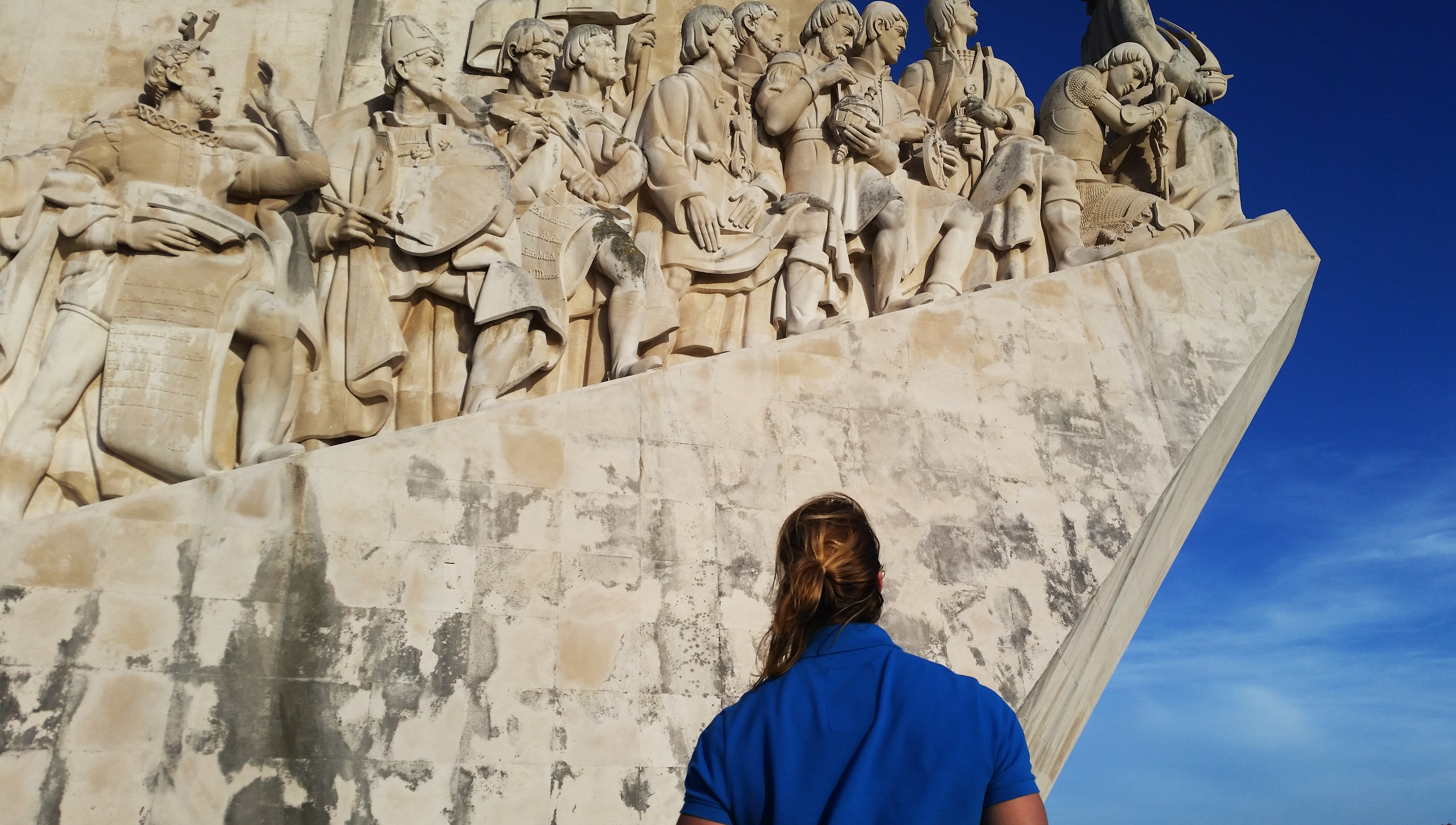
The Templar Order survived, in a way, in Portugal under the name of The Military Order of Christ. Pictured below: A Sensitive Young Man admiring a monument in Lisbon.
Conclusion
The book has 266 pages and contains plenty of valuable insights. Despite the aforementioned inaccurate statement in the introduction, I found it interesting and well worth reading. So, if you can see beyond that, I can recommend the book – especially since there are not so many books in English about mediaeval Spain. I will use the book as the main source for the next podcast episode (The Greatest Podcast comes out once a month – subscribe if you are not already!). Lastly, it must be noted that the book contains both an esoteric aspect (i.e. the theme of the Templar plan of synarchy) as well as purely historical one (i.e. describing events and developments in terms of realpolitik etc.).
The Uniqueness of Western Law by Richard Storey
Posted on June 16, 2024
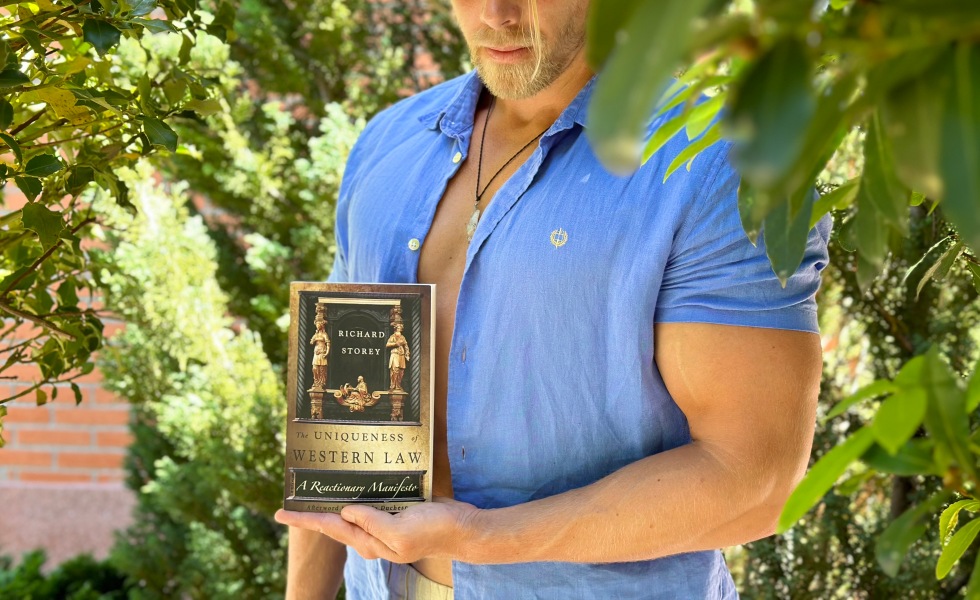
I have read The Uniqueness of Western Law – A Reactionary Manifesto by Richard Storey. It is a compilation of compelling essays written from a Libertarian pro-White perspective.
Pro-Church Perspective
Enjoyers of my book reviews will be familiar with the good baron Evola. A reoccurring theme in his work is the conflict between the Ghibellines (supporters of the Emperor) and Guelphs (supporters of the Pope). Storey, in contrast to Evola, writes from a pro-Church perspective. I am not a Christian, but, as everyone knows, I am fair and open-minded – and thus open to new information regarding the Church’s contribution to European civilisation. The author’s main point is that the Church could keep kings from becoming too despotic.
Under the title of Christianity Takes Up the Torch of Hellenistic Natural Law, the author notes the following:
‘Therefore, the European Christendom of the Middle Ages presented a rather unique situation in which there was no state per se. This continued throughout the period primarily because natural law teachings of the Church largely comported with and developed the customary laws of the Germanic tribes, which, as Prof. Gerard Casey eloquently notes, always tend to the natural law anyway, being its ‘local concretization.’’
Richard Storey – The Uniqueness of Western Law – A Reactionary Manifesto. Page 19.
I must contemplate this matter further before elaborating on it. Interesting stuff for sure! He continues on the same page:
‘In Kingship and Law in the Middle Ages, Fritz Kern explored the two major, similar concepts of law which the Church found among the Germanic tribes (the rule of law and the right to resist tyrants). The Church was able to exert a certain amount of influence in limiting the king’s dominium but expanding his imperium, that is, obliging him to ‘rule and defend this realm which is vouchsafed to thee by God’, as the German coronation order of the tenth century provides. Therefore, he was not to exercise any supposed superior rights, as a tyrant. Otherwise, the king was not consecrated or was excommunicated by the Church.’
Richard Storey – The Uniqueness of Western Law – A Reactionary Manifesto. Pages 19-20.
The author goes on to note that a legally absolute king was impossible in the earlier Middle Ages. The author also points to the Indo-European aristocratic tradition of the king being the First Among Equals – this can be contrasted against what is sometimes called Oriental Despotism (where the regent is much higher above the aristocracy). Elsewhere in the book, the author also points to the positive influence of the Church regarding the development of laws.

Christianity and Chastity
Under the title of So, what are the short-term and long-term social benefits of Christianity?, the author shares some insights from Jim Penman. Penman claims that the Church promoted chastity – ‘Other important factors were the promotion of chastity and the nuclear family.’ The chastity of the pre-Christian Germanic peoples are beyond dispute. I have discussed this elsewhere on numerous occasions; I just thought it reasonable to point out this flaw in an otherwise excellent book.

Gothic Liberators
In the essay titled The Uniqueness of Western Law (i.e. the same title as the book itself), the author shares a quote by Prof. Joseph R. Peden. Peden notes that the (Western) Roman bureaucracy of Late Antiquity was so oppressive (in terms of taxation, for example) that the population viewed the state as the enemy. Part of the quote:
‘In other words, the Roman state was the enemy; the barbarians were the liberators….’
Peden – Inflation and the Fall of the Roman Empire.
I thought it was interesting to share this quote since the Goths have been so maligned in recent decades. As I have noted elsewhere, the Rome that Alaric the Great sacked in 410 was a far cry from the Rome of its golden days. On a similar note, one could argue that the Ostrogothic Kingdom of Theodoric was a better place than pre-Gothic Italy. Genetically speaking, Italy returned to a more European configuration after the Germanic invasions (Italy experienced a shift toward non-European genetics during the Imperial Roman period).
I write more about it in my review of Edred Thorsson’s The Mysteries of the Goths (review). I also elaborate on the matter in Demigod Mentality and Podcast Episode 30. The Gothic Heirs of Rome.
Iran & Rumi
In the essay titled In Search of Non-White Philosophers, the author responds to a demand (to have more non-White philosophers as part of the curriculum) by philosophy students from SOAS (School of Oriental and African Studies). In the essay he notes that most philosophers have, in fact, been White. This is, most likely, no news to readers of my reviews. Something I thought would be interesting to share, however, is the following – the author refers to Jason Reza Jorjani, who notes that when the great Sufi mystic Rumi was born in 1207, Khorosan was still ethnically White. The author also notes that Khorosan was a hotbed for esoteric interpretations of the Koran. Moreover, the author says the following:
‘Yes, Zoroastrianism was developed by white people. Furthermore, the greatest Islamic philosophy was produced by brilliant Iranians, despite Islam, and their work was based heavily on Plato and Aristotle – yet more white men.’
Richard Storey – The Uniqueness of Western Law – A Reactionary Manifesto. Page 59.
I recently reviewed Rumi’s Four Essential Practices by Will Johnson (review). Regarding the Iranian tradition, I reviewed Original Magic by Stephen E. Flowers (review).
Conclusion
The book has 147 pages, including an afterword by Ricardo Duchesne, and is well written. It is suitable for those new to Right-Wing thought; he explains in a clear and concise fashion the drawbacks of multi-ethnic societies (lowering of trust, for example) as well as discussing fundamental biological realities (IQ, time-preference, etc.) among other important issues. The book is also interesting for those already familiar with the essentials – on a personal note, I found his views on the Church as a Libertarian highly interesting. I can definitely recommend The Uniqueness of Western Law. Onwards!
The Myth of the Blood by Julius Evola
Posted on June 14, 2024

I have read The Myth of the Blood – The Genesis of Racialism by Julius Evola.
The City of the Sun
In the chapter titled Origins, Evola introduces the heroic vision of the Italian philosopher and theologian Tomaso Campanella (1589–1639). Campanella’s idea state, the City of the Sun, is described thus:
‘The “Solarians,” who rule in his hypothetic State, mock the Europeans of the time, who “dedicate themselves with great care to the improvement of the race of dogs and horses, and do not deign to occupy themselves with the race of Men.” The Solarians have rather created in their State a ministry which, aided by competent men, by doctors and astrologers, controls all unions between men and women. The authorization of this ministry is necessary in the “city of the sun” not only for marriages, but also for engendering and baptizing children. The purpose is the formation “of the most beautiful race possible.”’
Julius Evola – The Myth of the Blood. Pages 5-6.
I must become further acquainted with the works of Campanella before elaborating further. What I can say for now is that is indeed in the interest of a nation (and all of humanity and creation) to promote eugenics and to halt dysgenic developments.
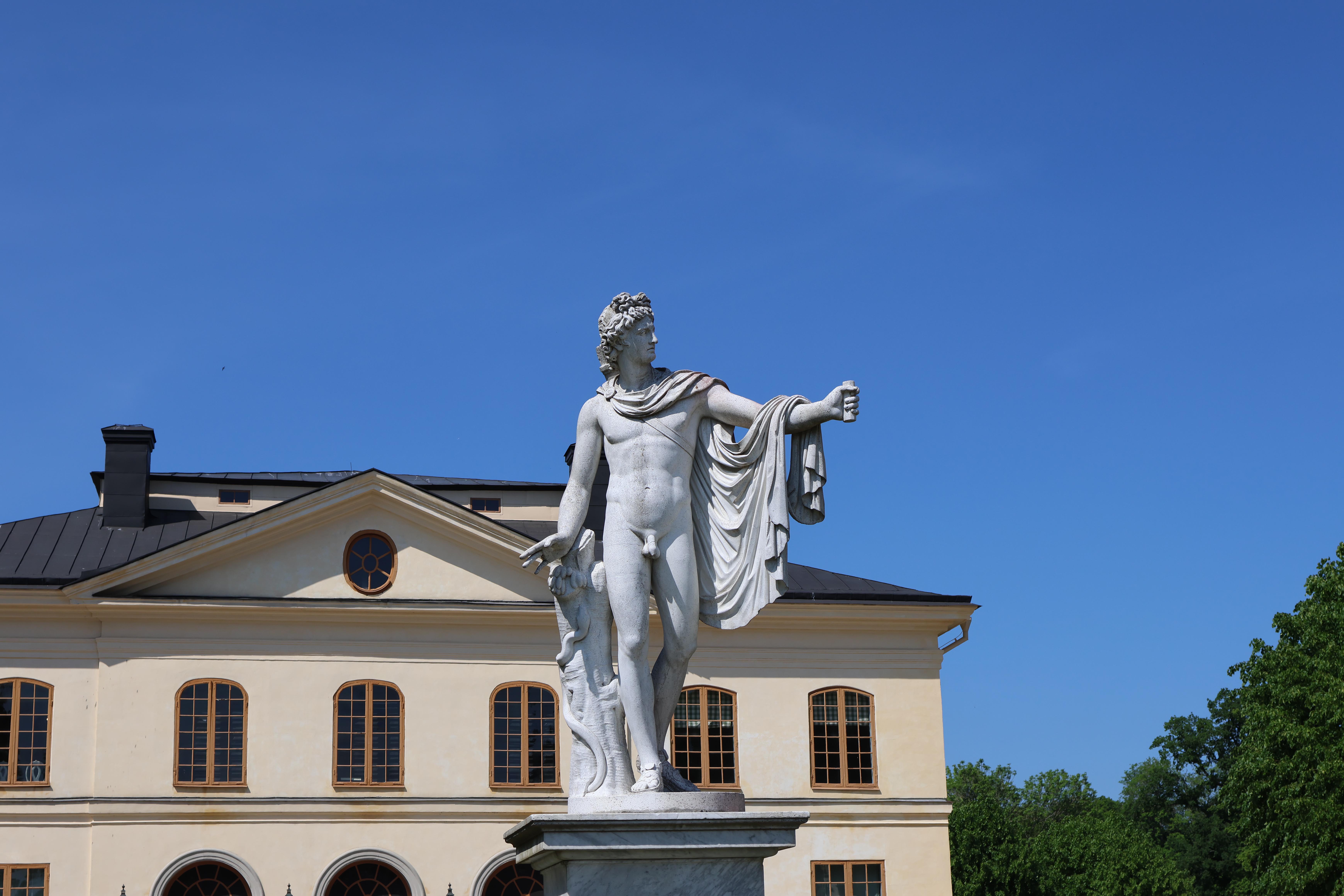
The Aryans
In the chapter titled The Doctrine of the Count Gobineau, Evola shares the insights of ‘the steampunk father of scientific racism’ as Bronze Age Pervert calls him. In regard to the Iranian tradition, he notes the following:
‘The Aryans are conceived as the friends, the faithful, and the allies of the God of Light, who combat for him against the God of Shadows, Ahriman, and against his emissaries.’
Julius Evola – The Myth of the Blood. Page 23.
As will be familiar to Enjoyers of my content, the Iranian Aryans descended from the Corded Ware Culture of Europe. He continues:
‘The name ârya has been sought also in Europe. The ancient name of Ireland, Erin, Erenn, has been referred back to it, and a corresponding trace is thought to be found in the Irish term aire, which means “lord.”’
Julius Evola – The Myth of the Blood. Page 23.
And, moreover:
‘Gobineau finds the concept of light, of splendor, at the center of the spiritualty of the Arya race. The Aryan gods are essentially divinities of light, of solar splendor, of the luminous sky, of the day.’
Julius Evola – The Myth of the Blood. Page 24.
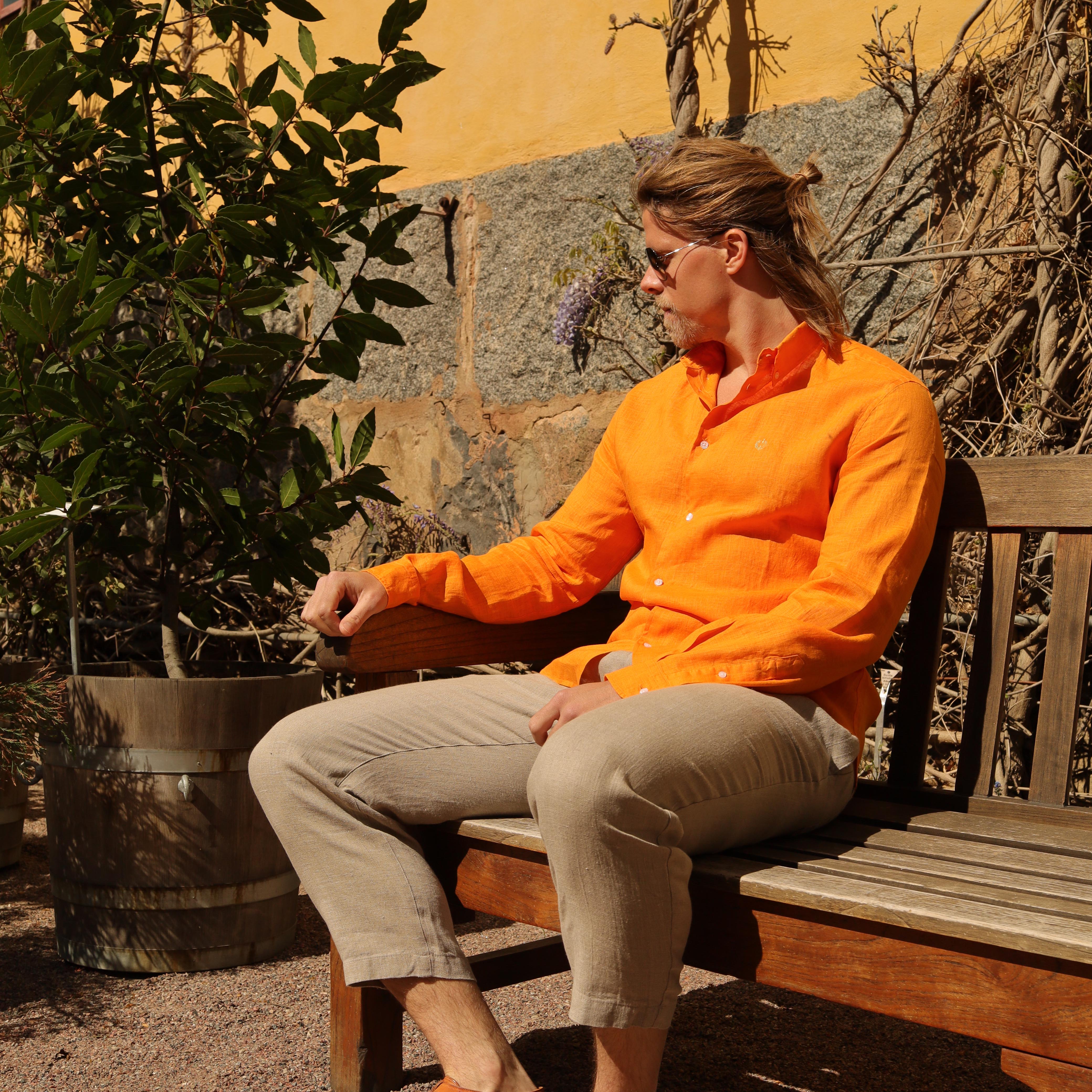
Pictured below: An Emissary of Divine Splendour contemplating the mysteries of the Universe.
Democratico-Jacobin
In the chapter titled Developments, Evola also discusses the teachings of Gobineau:
‘Against the democratico-Jacobin principle of equality, he affirms the principle of humans difference. Against the Enlightenment cult of reason, he affirms the superiority of gifts that are not leaned and that have root in the blood, in the race.’
Julius Evola – The Myth of the Blood. Page 29.
I mainly thought to share this quote because I found the term Democratico-Jacobin useful and fun. Moreover, it is natural that Gobineau, a French aristocrat, should be averse to the French Revolution and its consequences.
Conclusion
I would not necessarily recommend The Myth of the Blood. The book mainly consists of Evola presenting the (often outdated) views of other scholars. So, it is not so much of Evola’s own views that are being discussed. For his own analyses regarding race, I would rather recommend Metaphysics of Power or Revolt Against the Modern World. I am an Evola Autist, so I must read all of his works!
Archeofuturism by Guillaume Faye
Posted on June 12, 2024

I have read Guillaume Faye‘s great classic Archeofuturism – European Visions of the Post-Catastrophic Age.
Metapolitics & Politics
In the chapter titled An Assessment of the Nouvelle Driote, the author discusses and analyses the French New Right. I found this chapter particularly interesting, especially since he critically looks at the New Right (of which he was a part of) and does not refrain from bringing up their weaknesses and failures. He says the following about metapolitics, for example:
‘In order to prove effective, ideological and cultural action must be supported by concrete political forces which it integrates and extends.’
Guillaume Faye – Archeofuturism. Page 29.
This is a simple but vital insight that we need to repeat. We can win non-stop in the metapolitical arena (which we do, by the way) but without having actors in the political arena, real change will not come. Metapolitics and politics must work in tandem. This is why we should encourage young men to go into politics. If we do not contest the political arena, our opponents will simply win by default.
Third-Worldism
In the same chapter, he discusses a topic that has been the subject of discussion in recent times as well – namely, Third-Worldism. This reminds us of a recent debate (sparked by the most recent Israel-Palestine conflict).
‘Fifth ideological mistake: Third-Worldism. I have fully contributed to this and am willing to exercise self-criticism. Alain de Benoist’s essay Europe-Tiers-même combat, a crucial work on the matter, and the articles I myself wrote on the issue in the early 1980s, driven by misdirected anti-Americanism, have been ideological and strategic impasses which have worried me since. No folk in history fights ‘the same battle’ as other peoples: every alliance is temporary.’
Guillaume Faye – Archeofuturism. Page 37.
My position is (as I have noted previously) quite straightforward – I am always for European civilisation. If I am against something, it is only in relation to being for our side. This is also why you will not see me voicing support for either Israel or Palestine.

Realism & Realism
A passage I found particularly good was the following:
‘I reproach Nouvelle Droit for its adherence to a worldview that is undermined by a devastating concept: ‘realism’ – which often takes the form of disheartened fatalism.
Guillaume Faye – Archeofuturism. Page 42.
I am Nietzschean and do not like the term ‘realist’. History is not realist.’
Great stuff! I have emphasised this quite a bit myself over the last year – i.e. correctly identifying the fact that you can change reality via your will-power. I will return to this topic as it is of vital importance.
Archeofuturism
As for the title of the book itself, the following quote explains it fairly well:
‘The second axis may be defined as Archeofuturism: to envisage a future society that combines techno-scientific progress with a return to the traditional answers that stretch back into the mists of time.’
Guillaume Faye – Archeofuturism. Page 45.
The quote continues:
‘It is necessary to reconcile Evola and Marinetti, and do away with the notion of ‘modernity’ produced by Enlightenment ideology. The Ancients must be associated not with the Moderns but with the Futurists.’
Guillaume Faye – Archeofuturism. Page 45.
The Great Baron needs no further introduction. Marinetti was the founder of the Italian Futurist movement. Warhammer 40 000 comes quite close to a representation of Archeofuturism – the Space Marines can be seen as initiatory Männerbund (i.e. a traditional answer that stretches back in time) combined with techno-scientific progress. Pictured below: Yours truly depicted by Alex Cristi as the Primarch Fulgrim.

A True Politician
I found the following passage profound and inspiring:
‘The true politician is an artist, a drafter of projects, a sculptor of history. He is someone who can immediately answer the questions: Who is part of my people and what are their values? Who are its enemies and how can we fight and defeat them? And finally: What destiny should we choose to acquire power and carve out a place for ourselves in history?’
Guillaume Faye – Archeofuturism. Page 153.
The True Politician can be contrasted against the career politician. Needless to say, we need many a True Politician at the moment!
Conclusion
Archeofuturism has 249 pages and contains plenty of valuable insights (the ones shared above are but a few – I could have made this review a lot longer). There are a few ideas that are a bit outdated (Eurosiberianism, for example) and I do not agree with all of his points, but overall it is a great book that I can definitely recommend. I would also say that this is a good starting point for those who would like to get further acquainted with the work of Faye.
Onwards!




 The Golden One
You must be logged in to post a comment.