Calling Us Home by Chris Lüttichau
Posted on February 12, 2023

I have read Calling Us Home – Find your path, your balance and your inner strength by Chris Lüttichau. I became acquainted with Lüttichau’s work after he was interviewed by Thomas Rowsell (you can watch the interview here: JIVE TALK: Danish shaman Chris Luttichau). I was intrigued and wanted to know more – what Chris said in the interview resonated with me. Thus, I decided to read his book – and I am happy I did! The book is well-written and presents spiritual concepts in an accessible manner. Many of the teachings and perspectives are of a perennial nature; meaning that they appear in spiritual teachings throughout space and time. The author’s spiritual teachers are of Native American blood, and he shares interesting insights from his travels in the Americas.
Shamanism and Animism
The author refers to the anthropologist Michael Harner; according to the latter, the word shaman (pronounced SHAH-maan) comes from the Siberian Tungus Evenki tribe. The term is said to mean ‘the one who knows’ or ‘the one who sees.’ Keeping this in mind, it becomes easier to understand the duties of a Shaman as well as the Shaman’s need for a connection to the divine (so that the Shaman may gain otherworldly knowledge). The author says the following about Animism:
‘The understanding that everything is connected and alive has a name: ‘animism.’ Its root is the Latin animus, meaning ‘soul’ or ‘life.’ Animism is a view held by most, if not all, First Nations people worldwide, and it implies that everything in the Universe, all of creation, has consciousness or a soul essence, and thus is alive.’
Chris Lüttichau – Calling Us Home. Page 3.

The Inner Mind and the Outer Mind
A central theme of the book is the distinction between the Inner Mind and the Outer Mind. The Outer Mind is often dominant in most people; it is the mind responsible for the constant stream of thoughts. The author makes it clear that the Outer Mind is not evil or bad, only that there is a danger in letting the Outer Mind take complete control and dominate. To give an example: someone with a totally dominant Outer Mind is perhaps under a constant barrage of worries about potential negative scenarios. Someone with a strong Inner Mind, on the other hand, can live in the moment without being distracted by unproductive thoughts – a strong Inner Mind can facilitate a total focus which can be hard for a mind in turmoil to attain. The teachings of the Inner Mind and Outer Mind reminds me of a Buddhist teaching that we encountered in Evola’s The Doctrine of Awakening (review). It is a beautiful passage worth sharing again:
‘As a perfectly tamed elephant, led by his mahout, will go in any direction; as an expert charioteer, with a chariot ready on good ground at a crossroad and harnessed to a thoroughbred team, can guide the chariot where he wishes; or as a king or a prince with a chest full of clothes, may freely choose the garment that most pleases him for the morning, the afternoon, or the evening – so the ascetic can direct his mind and his being toward one state or another with perfect freedom.’
Julius Evola – The Doctrine of Awakening. Page 80.
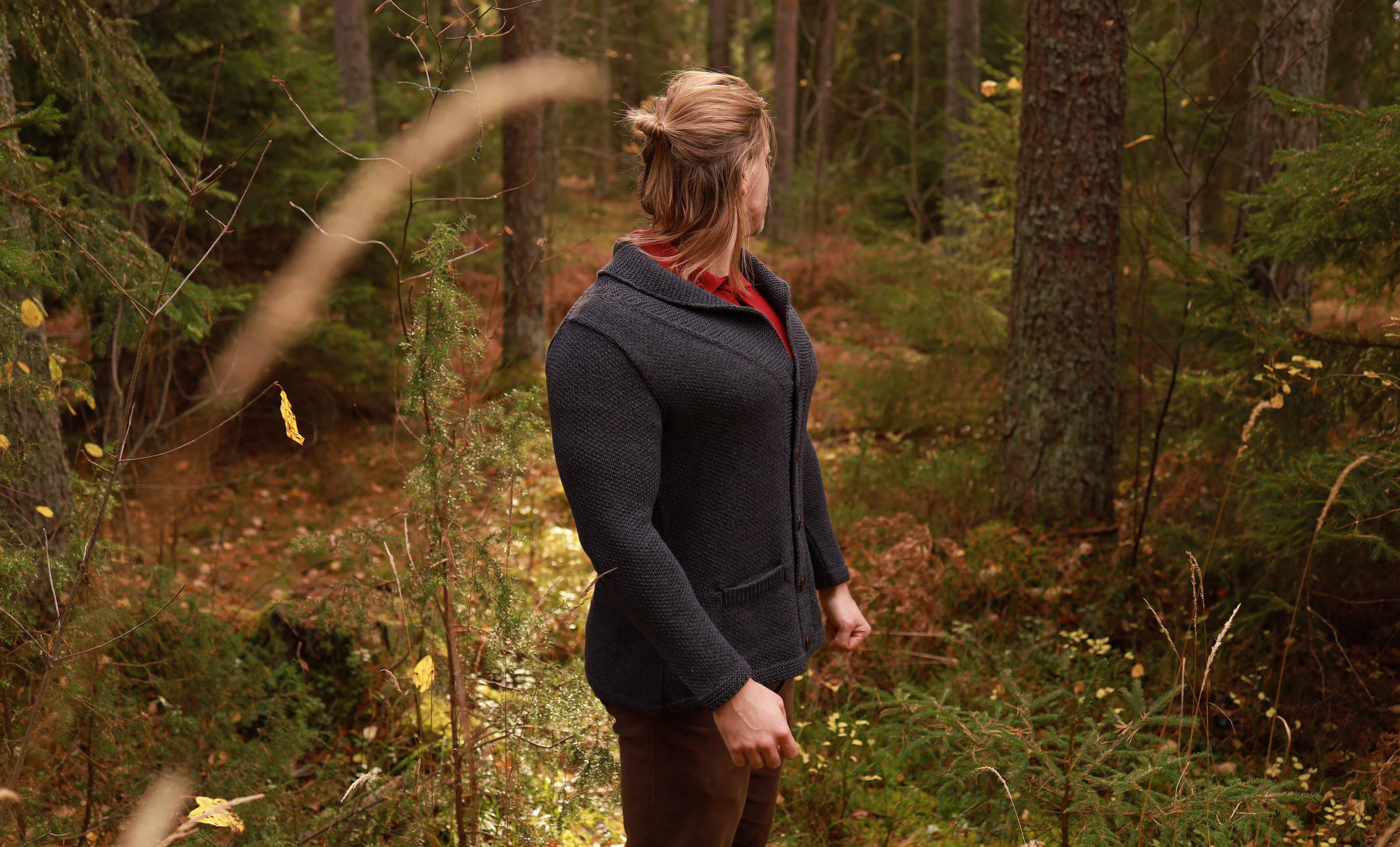
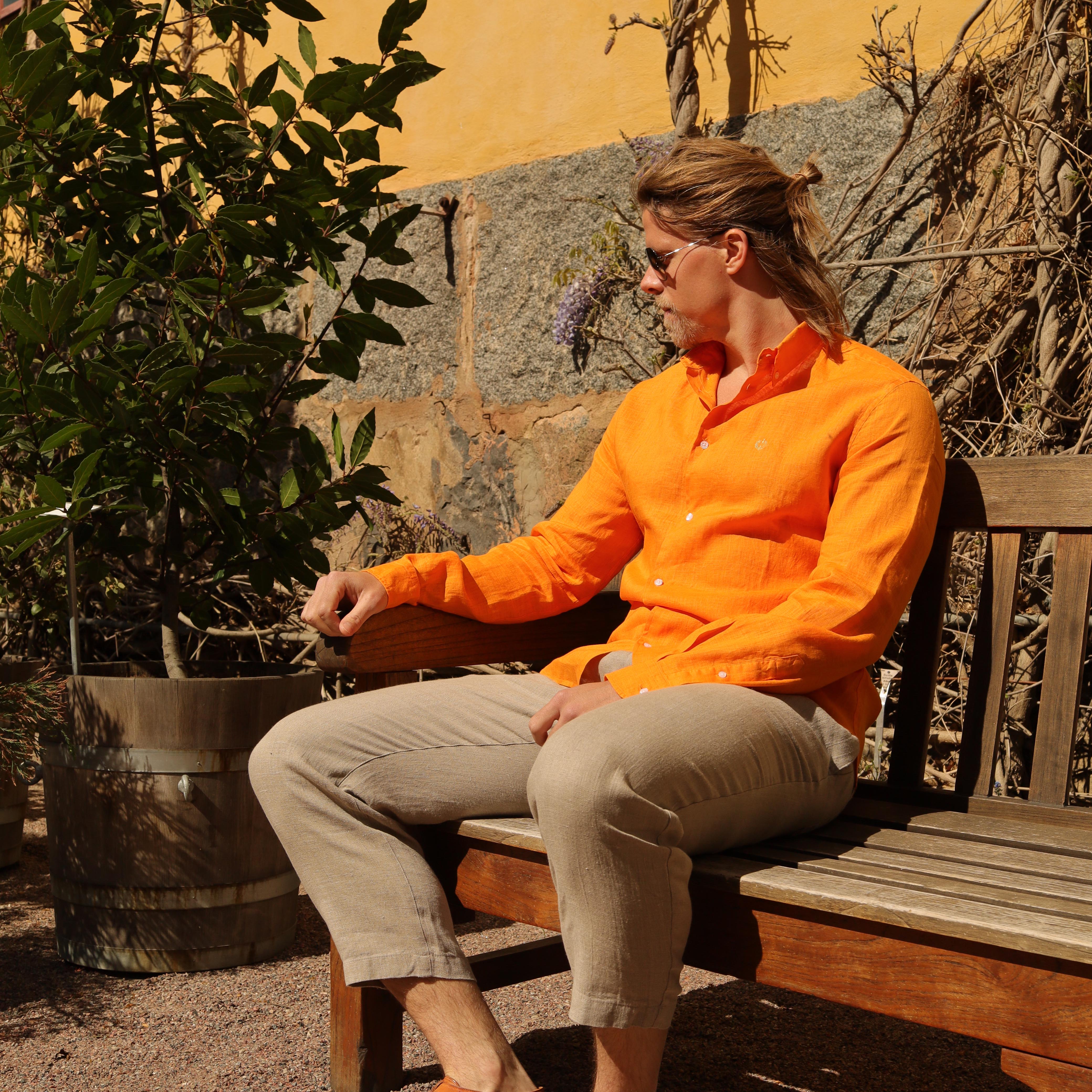
I, a Prince of the Ages, am in control of my thoughts. I choose good thoughts, just as I choose to clothe myself in the garments that please me the most – as pictured below, the Norse-Gaelic Woollen Sweater.
The Chakras
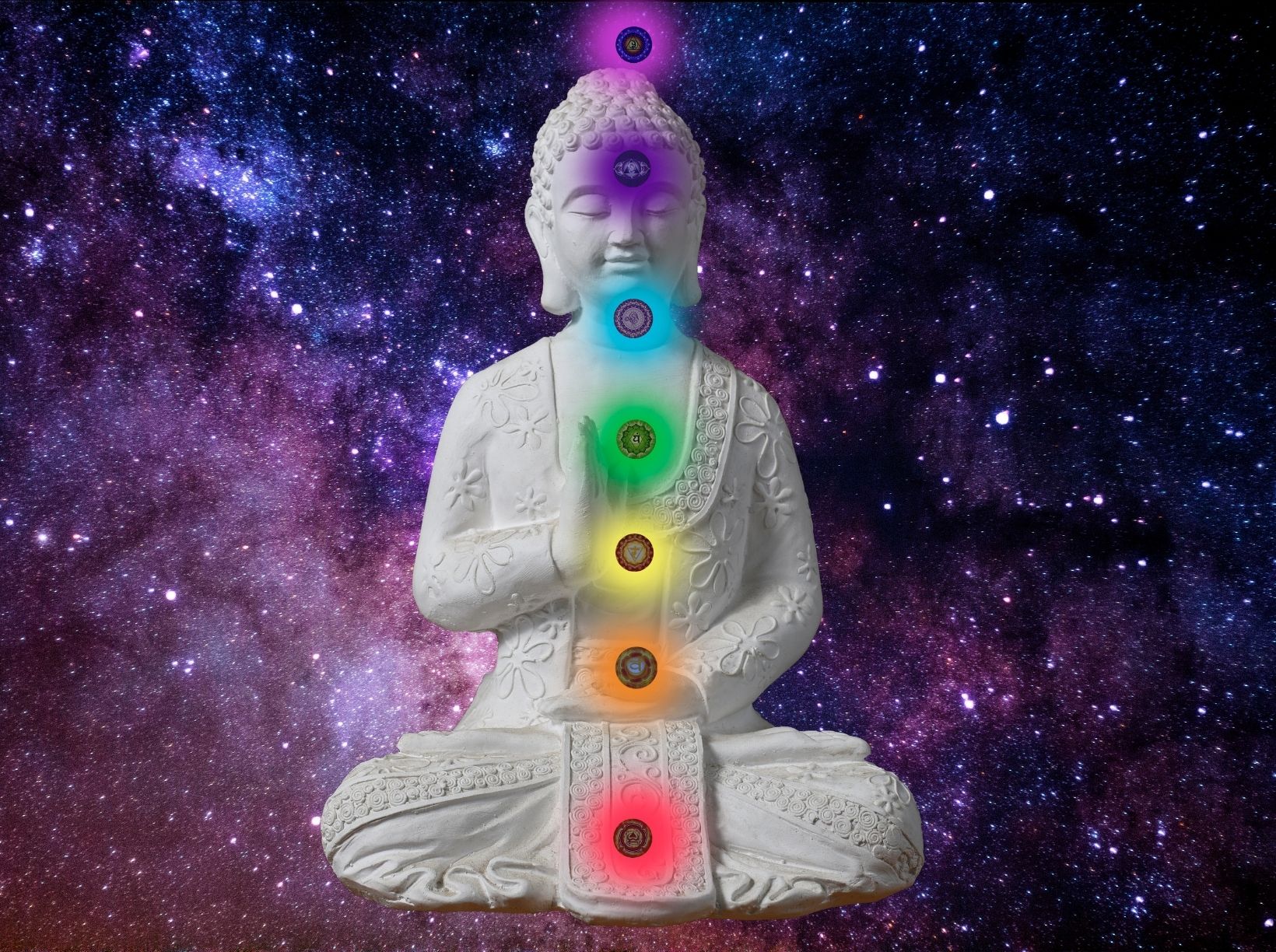
The author discusses the Energy Centres (Chakras in Vedic tradition). It is common to believe that all thinking happens in the brain, but the body actually has many different places where thinking happens. Gut feeling is a good example of this – you know something is going on based on the signals your gut gives you. Aligning and bringing attention to all of the Chakras is a good idea for optimal health. There are guided Chakra meditations (link) on YouTube; it can be good to follow one such meditation to get further acquainted with the Energy Centres.
Anger
In the chapter about the Heart Centre (the green one in the picture above), the author beautifully states the following:
‘In the teachings that were passed on to me, anger is viewed as a resource that can be used to do some good in the world. In order to transform anger into a constructive force, it needs to be lifted from the Power Centre into the Heart Centre. Once you have brought the anger up to the heart, you can use it to make changes in yourself or in the world around you. This is a magical key, and it is the way of the spiritual warrior.’
Chris Lüttichau – Calling Us Home. Page 190.
Learning how to use anger in a productive manner is indeed a magical key. I have done it myself throughout the years.
Giving Thanks Daily
Also related to the Heart Centre is the feeling of gratitude. The author notes that giving thanks daily is an integral part of the Shamanic path – traditionally one can begin the day by facing the Sun and giving thanks for the light of the new day. Feeling grateful for what you have is a great way to instantly feel better. Giving thanks in the morning is a good way to start the day; it can also be a good way to end the day – thinking about the luxury of falling asleep in a nice, warm bed will instantly relax you (optimising the chances of a more harmonious sleep).
Vision Quest – Sitting Out
The author notes that Native American shamans would go on Vision Quests – praying and fasting at a secluded place in nature to receive visions. The Norse equivalent, as attested by Icelandic sagas, is called sitting out (udesidning in Danish and utesittning in Swedish). Related to this practice is the story of Odin taking up the Runes:
‘I know that I hung on that windy tree,
Hung there for nights full nine;
With the spear I was wounded, and offered I was
To Odin, myself to myself,
On the tree that none may ever know
What root beneath it runs.Neither horn they upheld nor handed me bread;
– Hávamál
And there below I looked;
I took up the runes, screaming I took them,
And forthwith back I fell.’
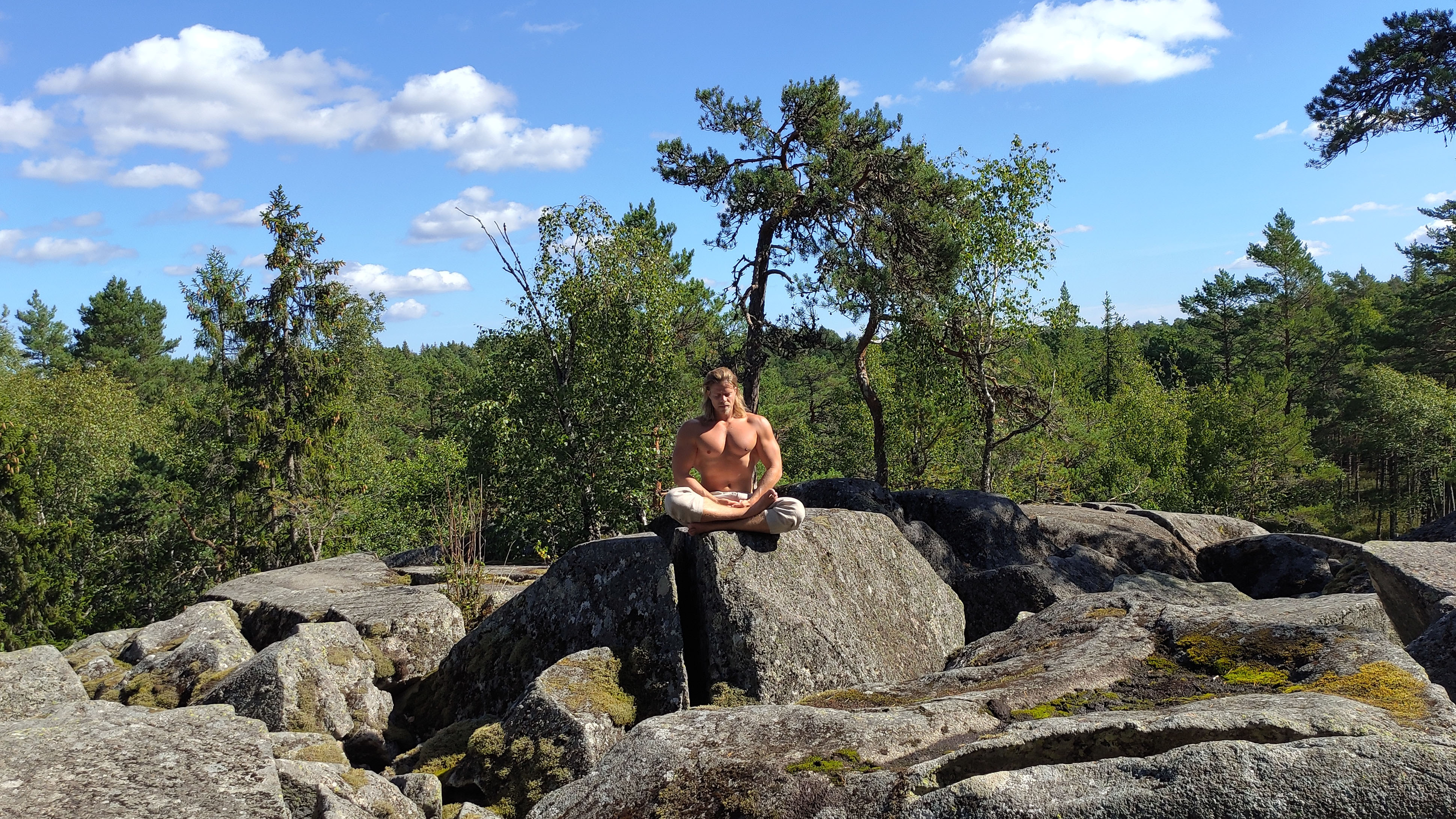
These are my favourite two stanzas from the Poetic Edda. Pictured below: a humble druid on top of a cave. Come spring, I will try an utesittning when opportunity presents itself – perhaps when doing a 24-hour fast!
Plato’s Forms and Shamanic Presence
The author refers to Plato’s Theory of Forms, which stipulates that every object in ‘the real world’ is but an approximation of the ‘ideal’ form that exists independent of time and space. On a side-note, I have actually thought about making a video in which I will say that training in the Temple of Iron is a form of piety – as Gym training enables us to get closer to our ideal form. The author says the following about the matter from a Shamanic perspective:
‘Yet in shamanism, these things are not in such a stark opposition to each other as they might appear. One of the ways that a shaman can enter the gateway into the reality of spirit or essence, beyond what the senses can reveal, is by becoming intensely present with the world of physical forms in nature.’
Chris Lüttichau – Calling Us Home. Page 49.
On a personal note, I view this as a life-affirming and reasonable attitude.
Conclusion
In addition to many interesting insights and perspectives, the book also contains practical instructions for meditations. As I have noted before, I always appreciate practical instructions in spiritual books. Moreover, the book contains biographical elements, which I appreciate – this gives the book a certain spirit that adds to the reading experience. I stumbled upon one factual error; on page 273, Mircea Eliade (whom we have encountered before: link) is presented as Hungarian. In fact, he was Romanian. Aside from that small detail, it is a great book.
The book is 364 pages and is worth a read. Good stuff!
The Northern Dawn by Stephen E. Flowers
Posted on February 8, 2023

I have read The Northern Dawn – a History of the Reawakening of the Germanic Spirit by Stephen E. Flowers. As has been the case with the other books of his I have reviewed, I can warmly recommend this one as well. The book contains the following four chapters:
- Ways of Understanding
- The Germanic Tradition
- The Coming of Christianity
- Ages of Darkness
Christianity – Paradigm Shift or Conversion?
The author references The Germanization of Early Medieval Christianity by James C. Russel (review) throughout the book, so the two books are good to read one after another. He notes that the term conversion is problematic (absurd and impossible, even), and that paradigm shift is a better term to describe the slow entry of Christianity into the societies of the Germanic peoples. As we noted in our review of Russel’s excellent book, it was indeed a very Germanised Christianity that was the dominant religion during the Middle Ages, and Christianity only became less Pagan during the Reformation.

The Indo-European Acceptance of Foreign Influences
The author notes that it is an Indo-European trait to be open to foreign influences (as opposed to the parochial attitudes of most other biocultures). This is a very important insight to keep in mind both for understanding European history as well as for approaching the modern world. A few years ago, someone commented on a social-media post of mine that he did not want to train Thaiboxing because it was not European. Instead, he only wanted to train Glíma. Funnily enough, this was one of the most un-European (or un-Aryan, rather) things I have ever read (hence it stuck with me even after many years). The true attitude is, of course, to embrace good cultural influences – such as Thaiboxing. This must, needless to say, not be misinterpreted as an acceptance of destructive phenomena such as mass immigration from the Global South into European nations. It must also be noted that the safekeeping of biological integrity is also an Indo-European trait (hence caste-systems). The openness for foreign influences is relevant to the discussion of Christianity in Europe since it makes it easy to understand why many were open to another powerful God (Christ) in the already existing pantheon.
Graeco-Roman Influence on Christianity
As we noted in our review of The Germanization of Early Medieval Christianity by Russel, it was an already Indo-Europeanised Christianity that the Germanic peoples encountered. For example:
‘The calendar of festivals, sacrifices, and ceremonial occasions was altered to conform to Christian mythology. This transformation had already taken place in the Greco-Roman world, so the form of Christian ceremonial that confronted the Germanic peoples was entirely Roman with little to nothing of a Middle Eastern or Judaic character. The same can be said about the liturgical forms.’
Stephen E. Flowers – The Northern Dawn. Page 78.
Jesus as a Warrior-Lord
Throughout the book, the author discusses Germanic literature. He presents the Old Saxon poem Heiland (meaning saviour in Old Saxon). The epic verse was composed around 830 by a poet-monk (or perhaps an ex-warrior, as noted by Murphey in the book The Heiland). Flowers says the following about it:
‘It is a retelling of the story of the life of Jesus in Germanic alliterative verse. This is not a translation of the gospels, but an original composition that allows the poet to recast the Christian myth in almost entirely Germanic terms. Jesus becomes a warrior-lord (OS drohtin) with a retinue of twelve warriors who fight against Rome.’
Stephen E. Flowers – The Northern Dawn. Page 104.
Presenting Jesus in a way that was attractive to the Germanic peoples was a key to success in introducing Christianity in Europe. OS in the quote above means Old Saxon.

The Teutonic Knights
The author discusses the Teutonic Knights and notes that they combined martial prowess with mystical fervour and asceticism.
‘The Teutonic Knight not only carried out a “crusade” in the material world, but within his own mind as well.’
Stephen E. Flowers – The Northern Dawn. Page 116.
This is similar to what Evola discusses in Metaphysics of War, where he notes that, in many traditions, the holy war in one’s mind is the greater of the two. For example, the Inner Jihad is the Greater Jihad and the Outer Jihad is the Lesser Jihad. The overcoming of one’s own lower nature is a reoccurring theme in many a spiritual tradition. Speaking of the Teutonic Knights, I will make a Podcast episode discussing them at length (I have a few episodes planned before that).
St Erik as Frey and St Olaf as Thor
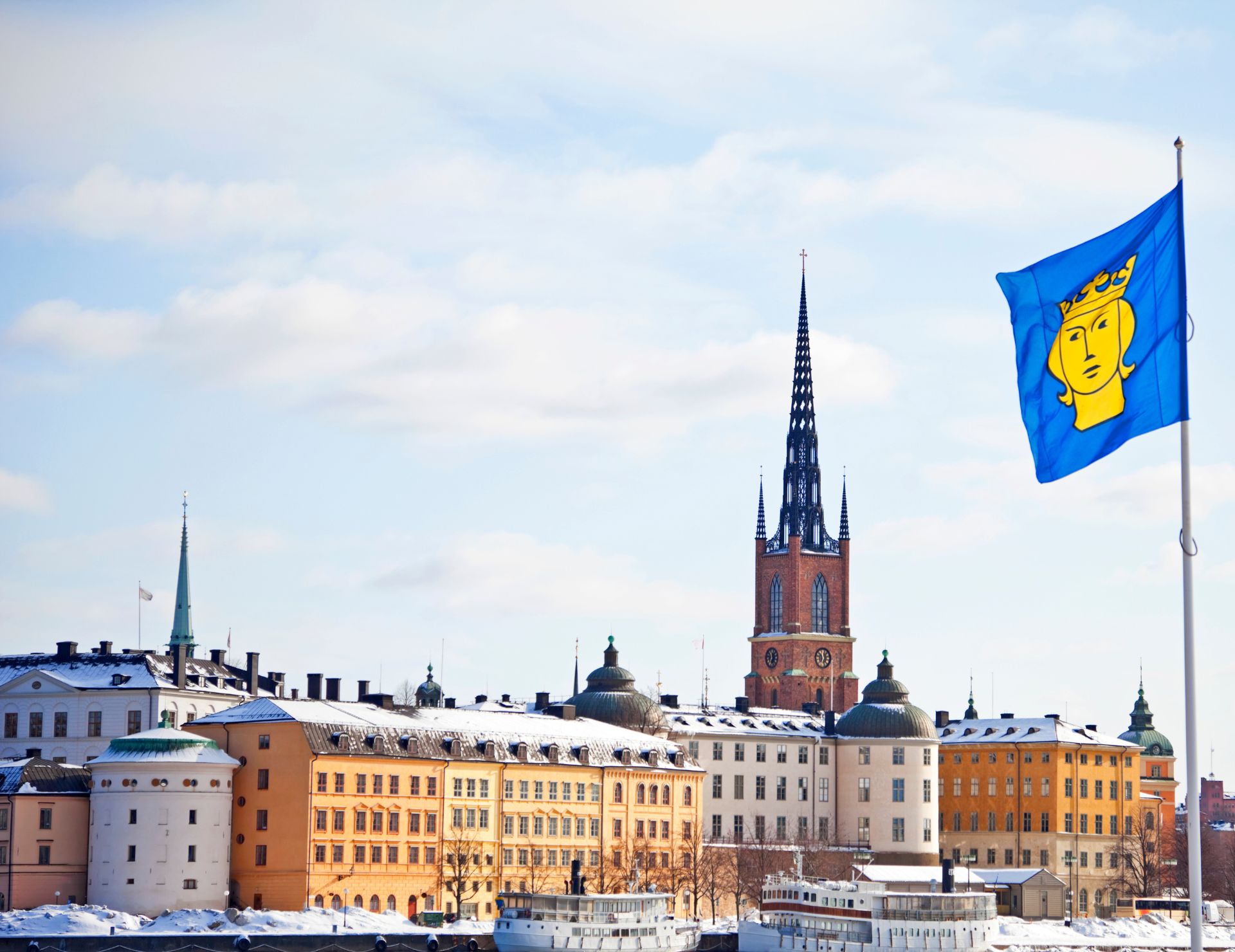
The author shares a very interesting insight that I was actually not aware of (despite both Uppsala and Stockholm being close to my heart). He notes that Christian kings could take on Pagan attributes in the folk beliefs and practices that surrounded their persons. For example, St Olaf (who ruled Norway between 1015 and 1030) bashes trolls with his cross (reminding us of Thor fighting giants with Mjölner). St Erik (as seen on the banner in the picture above), king of Sweden between 1156 and 1160 and patron saint of Stockholm, took on the aspect of Frey (who was a particularly important God in Sweden):
‘During the Middle Ages a procession went forth from Uppsala on 18 May (St. Erik’s Day) in which the banner of St. Erik was borne att helga Fruchten medh på Jorden (“to sanctify the fruits of the earth”).’
Stephen E. Flowers – The Northern Dawn. Page 152.
The Germanic Gods are of two tribes: the Aesir (Odin and Thor, among others) and Vanir (Frey and Freya, among others). Frey is a God of fertility and kingship. Next time we are in Gamla Uppsala, I will pour a libation to him. Last time my wife and I were there, we poured a libation to his sister – Freya. Pictured below: a humble aspiring Enlightened Despot admiring a garden in sacred Uppsala – City of the Gods.

Conclusion
As already mentioned and as with all of Flowers’ book, I can highly recommend The Northern Dawn – for Pagans as well as Christians, or indeed for the historically interested person. The book is 174 pages. Good stuff!
The Germanization of Early Medieval Christianity by James C. Russel
Posted on February 5, 2023

I have read The Germanization of Early Medieval Christianity – A Sociohistorical Approach to Religious Transformation by James C. Russel. It is a scholarly work full of references and valuable historical insights. The book contains seven chapters:
- Transformations of Christianity
- Conversion, Christianization, and Germanization
- Sociohistorical Aspects of Religious Transformation
- Sociopsychological Aspects of Religious Transformation
- Germanic Religiosity and Social Structure
- Germanization and Christianization 376-678
- Germanization and Christianization 678-754
Note: In this case, Germanisation refers to Germanic and not German (as I discussed in Podcast Episode 29. Fehu, Uruz, the Primordial Beast).
Indo-European Religion vs Christianity
In the introduction of the book, the author discusses the different worldviews of the Indo-European religions (Greek, Roman, Germanic etc.) and Christianity. He notes (with the risk of over-generalising) that the former is folk-centred and world-accepting, and the latter is soteriological (relating to salvation) and eschatological (relating to death and judgement) – hence world-rejecting. I agree with this assessment – I have discussed the life-affirming nature of Paganism many times before. Another interesting difference that he points out is the following: the Germanic peoples at the time of their encounter with Christianity had a high level of group solidarity – this stood in sharp contrast to the urban and rootless social environment that Christianity flourished in (i.e. an environment in which alienation and normlessness prevailed).

The Power of the Christian God
The author notes that Anglo-Saxon missionaries did not emphasise the soteriological and eschatological aspects of Christianity. Rather, they sought to emphasise the power and omnipotence of the Christian God, as well as the temporal rewards he could bestow upon those who accepted him through baptism. In a similar manner, Christ was often depicted as a warrior to appeal to the Germanic peoples. Moreover, the Germanic peoples had a magicoreligious view of religion:
‘According to this “magicoreligious character” it was expected that Christ would intervene in the affairs of individuals and groups in direct response to specific prayers or rituals.’
James C. Russel – The Germanization of Early Medieval Christianity. Page 191.
Thus, Jesus was remodelled into a God that could help his worshippers here and now, as opposed to being presented as someone who would safeguard the soul after death. This makes perfect sense when taking the life-affirming weltanschauung of the Germanic peoples into consideration.
The Christian Pantheon
The author notes that the Germanic view of the divine survived into the Christian era, albeit in a transformed manner:
‘The worldly, magicoreligious, heroic, folk religiosity of the pre-Christian Germanic peoples was transferred from Odin, Tiwaz, Thor, and Freyja, and the shrines and amulets dedicated to them, to Christus Victor, his loyal saints, and their shrines and relics.’
James C. Russel – The Germanization of Early Medieval Christianity. Page 188.
Pictured below: a humble poet at Heliga Birgittas bönegrotta (roughly translated from Swedish to: the prayer grotto of St. Bridget of Sweden) – i.e. a shrine dedicated to a saint.

The Germanisation of Christianity
The following quote summarises the Germanisation of Christianity in a great way:
‘The early medieval Germanization of Christianity, in most cases, then, was not the result of organized Germanic resistance to Christianity, or of an attempt by the Germanic peoples to transform Christianity into an acceptable form. Rather, it was primarily a consequence of the deliberate inculturation of Germanic religiocultural attitudes within Christianity by Christian missionaries. This process of accommodation resulted in the essential transformation of Christianity from a universal salvation religion to a Germanic, and eventually European, folk religion.’
James C. Russel – The Germanization of Early Medieval Christianity. Page 39.
This basically means that Christianity was presented in such a way that it would fit seamlessly into the Germanic societies. Since it was presented in a manner attractive to the Germanic peoples, Christianity also stayed heavily Pagan for a long time.
‘The sociopsychological response of the Germanic peoples to this inculturated form of Christianity included the acceptance of those traditionally Christian elements which coincided with Germanic religiosity and the resolution of dissonant elements by reinterpreting them in accordance with the Germanic ethos and world-view.
James C. Russel – The Germanization of Early Medieval Christianity. Page 39.
The Christianity of the Middle Ages
The author refers to John Van Engen who, in his article The Christian Middle Ages, makes the case that mediaeval folk were only superficially Christianised, and that Christian faith and practice first took hold among the European masses during the Reformation and Counter-Reformation movements. This supports the popular argument often seen that Catholicism is a particularly Pagan form of Christianity. This is, of course, a contested topic, but it is worth keeping in mind when formulating a spiritual path for the future.

Religiocultural View of War
The author shares a quote by J. M. Wallace-Hadrill, in which the latter states that the Germanic Pagans viewed war as a religious undertaking in which the Gods were interested. Ragnarök is perhaps the most notable example of this. As we noted in our review of Julius Evola’s Revolt Against the Modern World (review), this view was present during the Middle Ages as well. The following quote by Saint Bernard illustrates this quite well:
‘Whether we live or die, we belong to the Lord. What a glory it is for you to emerge from the battle crowned with victory! But what a greater glory it is to win on the battlefield an immortal crown… What a truly blessed condition, when one can wait for death without any fear, yearning for it and welcoming it with a strong spirit!’
Saint Bernard – De laude novae militiae
The Crusades were, one could argue, more of a Pagan (i.e. an expression of the Indo-European spirit) than a Christian undertaking. The Crusades could actually be a good example to emphasise the extent to which Christianity had been transformed in Europe.
The Situation in Greece and Rome
The author notes that Christianity had already been thoroughly Indo-Europeanised prior to its contact with the Germanic peoples. After all, Christianity grew in an environment dominated by Graeco-Roman culture.
‘Both Greek and Roman influences contributed toward some degree of an Indo-Europeanization of Christianity, not by actively seeking to do so, but as the passive result of the rapid expansion of Christianity to include people in whom the traditional world-accepting Indo-European world-view remained alive and meaningful.
This prior Indo-Europeanization of Christianity may have eased its acceptance within a Germanic society which retained the traditional Indo-European world-view long after it was supplanted in the classical world.’
James C. Russel – The Germanization of Early Medieval Christianity. Page 133.
Therefore, the Christianity that the Germanic peoples encountered was not only presented as something quite different than what it was in its beginning (a salvific religion for the lower, urban masses), but it was also already transformed due to its encounter with other Indo-European cultures.

Another aspect that is important to keep in mind when discussing Rome and Christianity is that Christianity gained popularity in a Rome that was no longer very Roman. The author shares the following quote by Ramsay MacMullen:
‘There was little “Roman” left in the Roman empire. Rather, the “un-Roman” elements had come to the fore, and now controlled the world in which they lived.’
Ramsay MacMullen – Enemies of the Roman Order.
As I have mentioned many times before, the Rome that fell to Alaric in 410 was not the same entity (bioculturally) as the Rome that conquered the world in previous centuries. In regard to Hellenic influence on Christianity, it must be noted that Neoplatonism had a strong impact on Christian metaphysics.

Conclusion
The Germanization of Early Medieval Christianity is, in my humble opinion, a must-read for any European Pagan or Christian. It is of utmost importance to understand just how Pagan Christianity has been historically. It is also important to emphasise the fact that the Christianity that has been in Europe during the last millenium is not the same as the Christianity one encounters today. I will elaborate at length on this topic in my upcoming book (which is coming mid-2023).
The book is 214 pages and is academic in its style (i.e. heavily footnoted and with plenty of references). This makes it both a concise read as well as giving plenty of suggestions for further research on one’s own. Good stuff!
The Mysteries of Mithras by Payam Nabarz
Posted on January 29, 2023 2 Comments

I have read The Mysteries of Mithras: The Pagan Belief That Shaped the Christian World by Payam Nabarz. I can straight away say that it is a great book full of valuable insights. As loyal readers of my book reviews will know, I have been interested in the Mithraic mysteries for quite some time now, and we have encountered Mithraism in many other book reviews. Thus, reading this book was a natural next step.
A note on terminology: Mithra is the Persian God; Mithras is the Roman God. One could, of course, say that they are the same God. Iran (land of the Aryans) and Rome share Indo-European (Aryan) roots, so it is to be expected that they have similar Gods. However, for the sake of academic precision, the difference is worth keeping in mind.
Love, Sun, Friend
In the introductory chapter, the author shares the following interesting insight; namely, that the name Mithra has three meanings in Farsi – love, sun, and friend. In the Roman Cult, Mithras wrestles with Sol and thereafter becomes his friend – in certain depictions they appear side by side. In the same chapter the following is said regarding the friendship aspect of Mithra:
‘Mithra is the beloved, with whom the Magi seek union. He is seen as the protector of the Aryan nations, giving victory to “those who lie not unto Mithra.” He is the warrior deity carrying the “hundred knotted mace,” from whom all demons flee in fear.’
Payam Nabarz – The Mysteries of Mithras. Page 5.
This is similar to Thor, who is also a friend and protector of mankind. Moreover, the author notes that Zoroastrian priests, to this day, carry the mace of Mithra as a symbol of fighting evil (this is a powerful image!). He also notes that when Zoroastrianism ascended to become the dominant religion of Persia, Mithra made the transition from the old religion to the new due to his popularity with the people. Some good old syncretism at work!
The Tauroctony – Mithras and Perseus
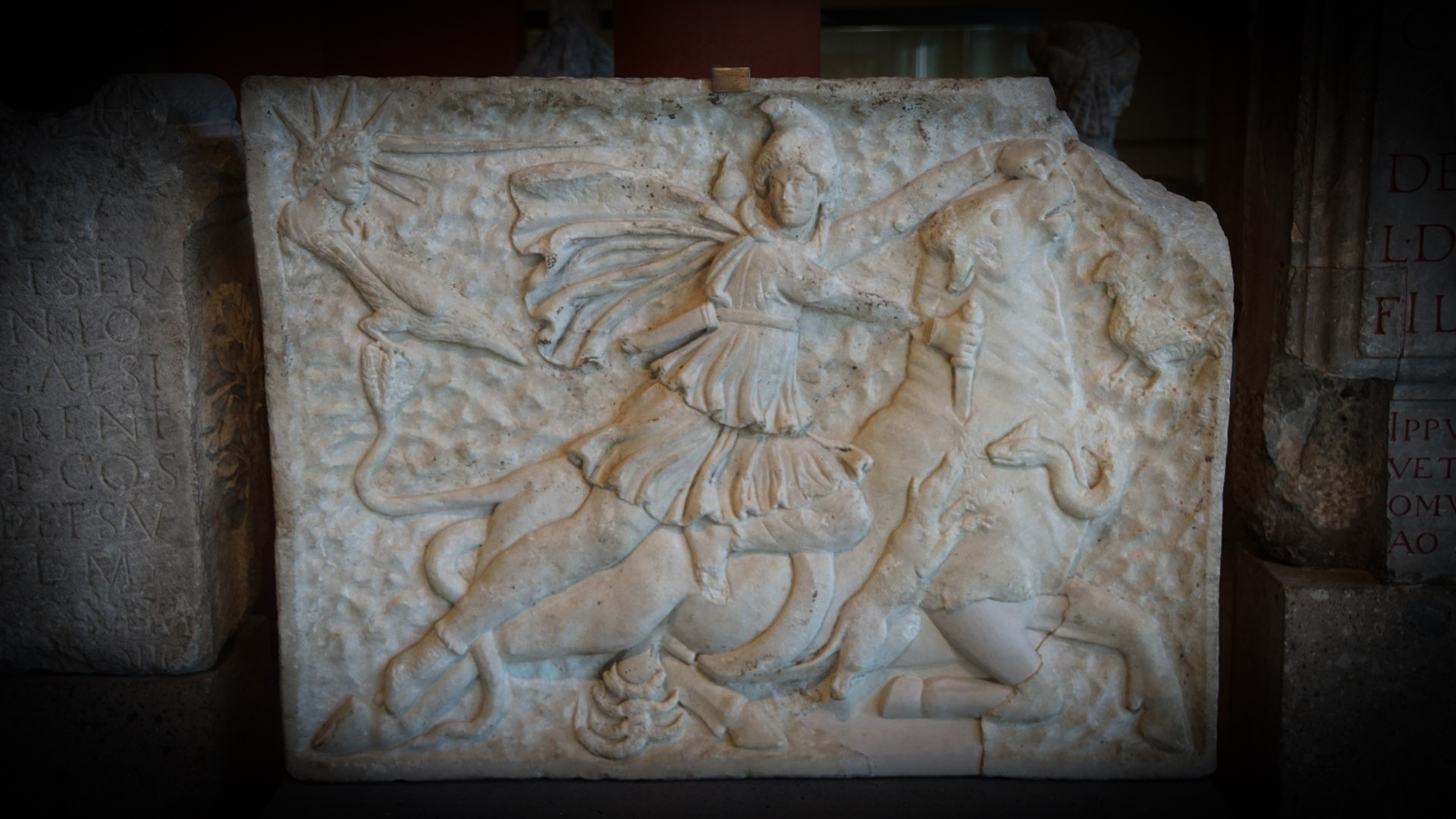
The Tauroctony (pictured above) is a familiar picture. The author shares the following wisdom in regard to interpreting the symbolism.
‘The bull that Mithras kills is his ego, the aim of all followers of Mithras. Mithras always looks away from the bull while stabbing him, just as Perseus looked away from the Gorgon when he decapitated her. One who looked upon the Gorgon would turn to stone; that is, the ego would turn the heart and the soul to stone. In order to overcome this ego (nafs in Sufism), one must turn the head (the intellect) away, because the intellect is unable to overcome the ego.’
Payam Nabarz – The Mysteries of Mithras. Page 41.
My own interpretation of Perseus and Medusa is simply the overcoming of one’s weaknesses. The garment pictured below is available here: LegioGloria.com

Mithraic Influence on Christianity
In the chapter titled thus, the author lists some similarities between Mithraism and Christianity – the most notable one being the birthday of Mithras and Jesus, the 25th of December. In this chapter, two epic quotes are included, from the Great Magical Papyri and Revelation respectively. As I have noted before, quotes like these are always a pleasure to read. Moreover, regarding the description of Mithras: the mystery cult was heavily influenced by astrology (hence the astrological references).
‘Mithras having a bright appearance, youthful, golden-haired, with a white tunic and a golden crown and trousers, and holding in his right hand a golden shoulder of a young bull: (seven stars of the Plough) this is the Bear which moves and turns heaven around, moving upward and downward in accordance with the hour. Then you will see lightning-bolts leaping from his eyes and stars from his body.’
– The Mithraic Liturgy from the Great Magical Papyri
‘And in the midst of the seven candlesticks one like unto the Son of man, clothed with a garment down to the foot, and girt about the paps with a golden girdle.
Revelation
14 His head and his hairs were white like wool, as white as snow;
and his eyes were as a flame of fire;
15 And his feet like unto fine brass, as if they burned in a furnace; and his voice as the sound of many waters.
16 And he had in his right hand seven stars: and out of his mouth went a sharp two-edged sword: and his countenance was as the sun shineth in his strength.’
Aside from their shared birthday, the author also notes that (among other things) both were born of a virgin and that both had worshippers who were baptized, called themselves ‘brothers,’ and held Sundays sacred. Another interesting thing to note is the following: in Icelandic Magic (review), Stephen E. Flowers mentions that the Our Father prayer may have been used by the Cult of Mithras as well.
The Beautiful Goddess
Speaking of epic quotes, the following beautiful passage appears in the chapter Meditations and Initiations:
‘On the throne sits a Lady in silver and gold garments, proud and tall, an awe-inspiring warrior woman, as terrifying as she is beautiful. Tall and statuesque she sits, her noble origins evident in her appearance, her haughty authority made clear and commanding through a pair of flashing eyes. A crown of shining gold rings her royal temples, bejeweled with eight sunrays and one hundred stars; it holds her lustrous hair back from her beautiful face.’
Payam Nabarz – The Mysteries of Mithras. Page 128.
The Zoroastrian Primordial Bull
As I noted in Podcast Episode 29. Fehu, Uruz, the Primordial Beast, bulls and cows have a special place in the Indo-European heart. In Germanic cosmology, Audhumbla is the primordial cow that gives nourishment to Ymir, the primordial giant. The author notes that in Zoroastrian tradition, the first animal in the world was a white bull as bright as the moon. The bull is, of course, central to the Mithraic mysteries as well.

The Phrygian Cap
The author shares the following quote illuminating quote in regard to the iconic Phrygian cap (as seen in the Tauroctony):
‘Mithra’s Phrygian cap originated from Phrygia, a centre of Mithraism in Anatolia, the capital of which was Konya. It was worn there by manumitted slaves, and Mithra’s wearing of the cap denotes his freedom from slavery of the lower self.’
Massoud Homayouni – The Origins of Persian Gnosis
On a personal note, I have contemplated whether or not to release a red Phrygian cap for Legio Gloria. There are two aspects to the matter; I do not want to wear anything associated with the destruction and evil of the French Revolution, but I do want to wear a cap associated with the glorious Mithraic mysteries. I am inclined to release such an item because of the following reason: the Mithraic mysteries came before the French Revolution. Furthermore, wearing it as a statement that one has overcome one’s lower self is indeed a good thing. We will return to the topic at a later time!
Conclusion
As already noted, The Mysteries of Mithras is an interesting book that I can wholeheartedly recommend to anyone interested in the Mithraic mysteries, or indeed esoteric matters in general. It is 164 pages and written in accessible language. It also contains some beautiful poetry in addition to practical instructions for rituals.
Good stuff!



 The Golden One
You must be logged in to post a comment.