Elemental Magic by Nigel Pennick
Posted on October 9, 2024
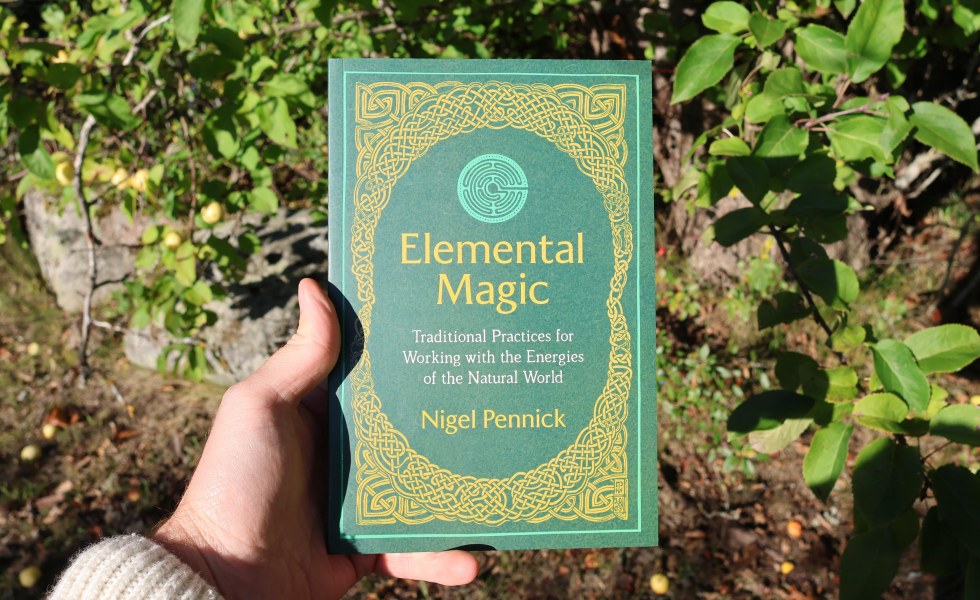
I have read Elemental Magic – Traditional Practices for Working with the Energies of the Natural World. As the title suggests, the book contains information about the spiritual elements one can find in nature (trees, elements, stones, etc).
Earth – A Beautiful Quote
In the first chapter, the author shares a beautiful quote by a mediaeval German alchemist Basilius Valentinus:
‘The Earth is not an inanimate body, but is inhabited by the spirit which is its life and its soul. All created things draw their strength from the Earth Spirit. This spirit is life; it is nourished by the stars and gives nourishment to all living things that it shelters in her womb.’
Pictured below: A Gentle Druid absorbing energies from the beautiful Iberian mountains.

Colours
In the chapter titled Magic in Action, the author discusses colours. Among other things, he notes that blue green is the colour of the sea, of primal and unfathomable depth. This reminded me of Oswald Spengler’s take on the colour:
‘Blue and green are the colours of the heavens, the sea, the fruitful plan, the shadow of the Southern noon, the evening, the remote mountains. They are essentially atmospheric and not substantial colours. They are cold, they disembody, and they invoke impressions of expanse and distance and boundlessness. Blue and green are transcendent, spiritual, non-sensuous colours.’
Oswald Spengler – Decline of the West
Pictured below: A Sensitive Young Man wearing a tanktop in the colour of unfathomable depth.

Wassailing
Under the title Spirit Trees and the Wild Wood the author talks about wassailing:
‘It us customary each winter to honor the apple trees by wassailing, when traditional songs are sung and offerings of food and drink are left for the trees and the spirit-guardians of the orchard.’
Nigel Pennick – Elemental Magic. Page 74.
A quite wholesome tradition indeed! Survive the Jive made a documentary about wassailing for those who are interested:
Garlic Against Demonic Interference
In the chapter titled Precautions and Remedies the author notes the following about garlic:
‘Garlic (Allium sativum) is a tried-and-tested remedy against all kinds of malevolent spirits, harmful magic, and demonic interference.’
Nigel Pennick – Elemental Magic. Page 125.
Garlic is indeed the good stuff!
Conclusion
Elemental Magic is a concise (132 pages) and informative book. I enjoyed the book and can recommend it for those interested in European folklore!
Physiognomy Analysis – Spengler & Evola
Posted on August 11, 2024

I am almost done with the first volume of Decline of the West by Oswald Spengler. I will elaborate on it at length in the next episode of The Greatest Podcast. As for now, I just have to note the following: Spengler is, for lack of a better way to put it, quite hostile to the Classical (Apollonian) Soul.
Usually, when people are hostile to the Classical World (i.e. Ancient Greece and Rome) and to the European Middle Ages, they are often in a poor physical shape. Right enough, Spengler suffered from a heart condition. He was even exempt from service during WW1.
A few words about his physiognomy – highly intelligent, but also bitter, brooding, sceptical. Not life-affirming, not high-thumos. Someone not keen on praising others. Contrast this against Evola. In Evola we see a man of action as well as contemplation – a man in good physical condition. An accomplished mountaineer and mage. Evola served in WW1. In his eyes we see timeless wisdom.
Physiognomy aside, Spengler was wrong in making a distinction between the Classical (Apollonian) and the Western (Faustian) Soul. They are the same Soul and the highest aim of this Soul is glory (a yearning for infinity would merely be an expression of the yearning for glory). This Soul is named the Aryan Soul. For the Aryan Soul, there is nothing better than glory and nothing worse than shame.
Achilles, Alexander, the Roman Emperors, the Norman conquerors, Gustav Adolf the Great, Frederick the Great, Napoleon – the list goes on. The same spirit imbued all of them. As Dominique Venner (in The Shock of History) so eloquently put it in regard to the Iliad: “Of the need for glory that pulls men up to the height of the gods.” Spengler was wrong in making a distinction between the Classical and the Western in another way as well. We now know (thanks to archaeogenetics) that there is a continuation of blood stretching back into the mists of time. As I have noted before, Europeans are (simply put) made up of three population groups: Western Hunter-Gatherers, Anatolian Neolithic Farmers, and Aryans (often referred to as Indo-Europeans or Western Steppe-Herders).
Biospiritually speaking, the Aryan component is the most interesting one – Evola understood this with perfect clarity. This Aryan spirit has been present in Europe since the the Aryans merged with the Early European Farmers (EEF = a combination of Anatolian Neolithic Farmers and Western Hunter-Gatherers). We could actually go further back in time than this but that will be for another time. The Aryan spirit can (among other ways) materialise in the form of Divine Heroes and in the form of Imperium. Examples of the former are Alexander and Theodoric. Examples of the latter are the Roman Empire and the Holy Roman Empire of the Middle Ages. Thus, there is no break between the Classical and the Western. They are one and there is a continuity of blood and spirit connecting them. Indeed, connecting all of Europe.
Another observation that I thought to share in order to illustrate a difference between Spengler and Evola is the following: Spengler erroneously states that yellow and red are “the colours of the crowd, of children, of women, and of savages.” Evola correctly notes that red is a regal colour. It is also worth noting that yellow is a colour of power – it is connected to the Solar Principle as well as to the Solar Plexus Chakra (which is connected to a man’s Will-To-Power). Spengler also makes a great mistake in grouping the Iranian together with the Arabian under the title of Magian. Evola correctly understood the ancient Iranians as an Aryan nation. We now know (again thanks to archaeogenetics) that the ancient Iranians came from Europe.
All that being said, Spengler was a genius and a great thinker. As already noted, I will discuss his work at length later on. I will, of course, discuss his theory of the cycles of civilisations – and what it means for us Sons and Daughters of Europe at this particular moment in time. Onwards!
Eros and the Mysteries of Love by Julius Evola
Posted on July 23, 2024

I have read Eros and the Mysteries of Love – The Metaphysics of Sex by our esteemed baron Julius Evola. As the title of the book suggests, Evola explores the higher dimensions of the union of man and woman. He refutes the merely material view of sex (i.e. the view that sex is only related to procreation and about primal desires). He also takes issue with the Freudian view of sex – which focuses on the Lower (damaged, faulty) aspects of it. Where Freud and other degenerates look ‘down‘ to study these matters, Evola looks ‘up‘ and presents the Higher aspects of it.
A Profound Quote
I first saw the following quote a few years ago – it resonated with me back then as well as now:
‘There can be no doubt that a woman who is perfectly woman is superior to a man who is imperfectly man, just as a farmer who is faithful to his land and performs his work perfectly is superior to a king who cannot do his own work.’
Julius Evola – Eros and the Mysteries of Love. Page 34.
Everyone striving to fulfil their unique role to the best of their abilities!

The Metaphysics of Sex
Evola notes the following in regard to the spiritual aspect of sex:
‘Here is the key to all the metaphysics of sex: “Through the Dyad towards the Unity.” Sexual love is the most universal form of man’s obscure search to eliminate for a short while, to existentially overcome the boundary between ego and non-ego, between self and non-self. Flesh and sex are the tools for an ecstatic approximation of the achievement of Unity.’
Julius Evola – Eros and the Mysteries of Love. Page 44.
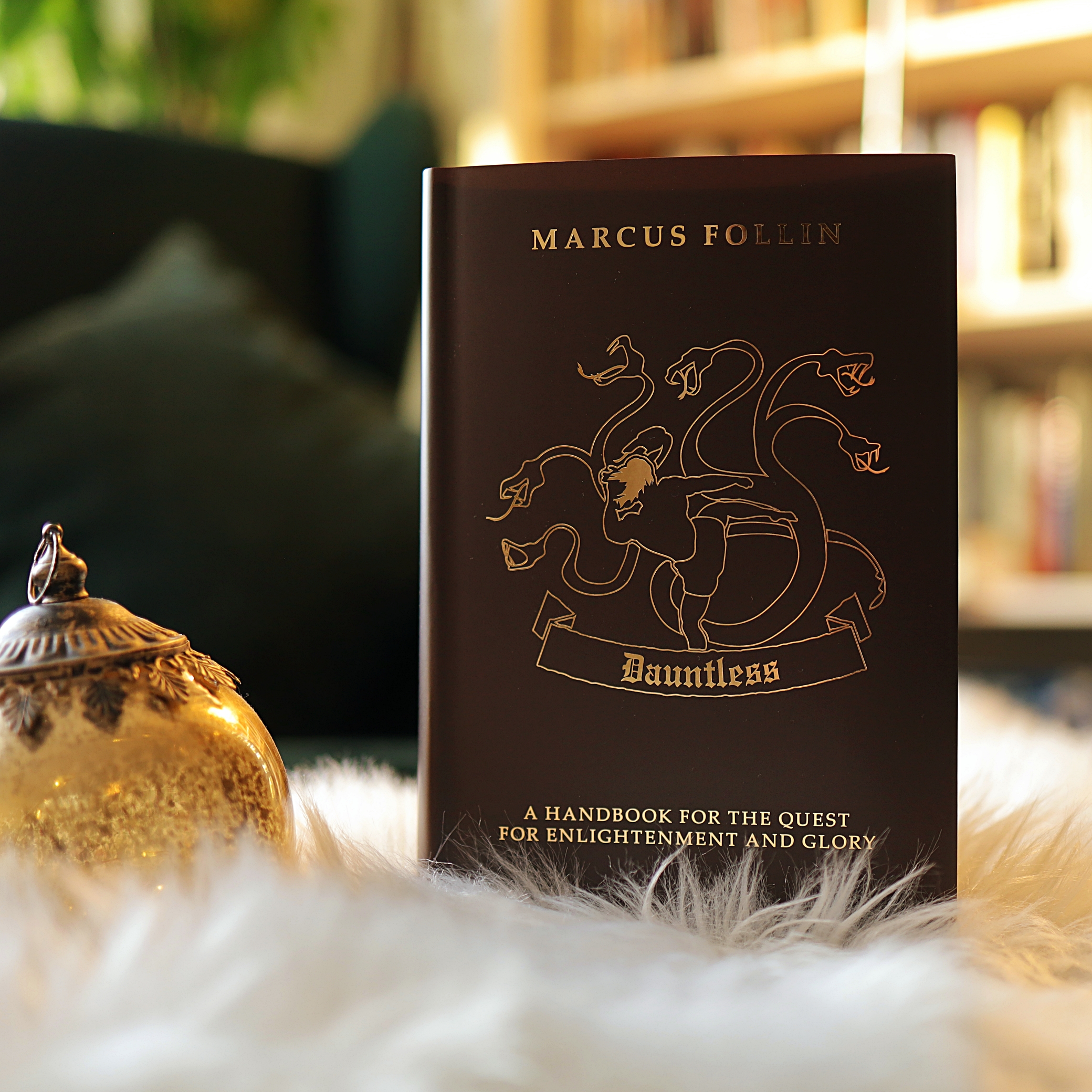
Sex then, in this view, is not always about the animalistic urge to procreate, but rather to find a mystical union with the divine. Another similar interpretation could be that it is a way to escape loneliness – i.e. the sense of Self. On a similar note, I mention in Dauntless that the highest sensation of sex (i.e. being completely absorbed in the moment) is more or less impossible when under the influence of pornography (this is one among many reasons to not expose your mind to pornography).
Demeter & Aphrodite
Under the title of Woman as Mother and Woman as Lover, Evola presents two archetypes of women – Demeter (corresponding to the Mother) and Aphrodite (corresponding to the Lover).
‘The “mother” type seeks man for the child, whereas the “lover” type seeks him for the erotic experience by itself (in lower forms, for “pleasure”).’
Julius Evola – Eros and the Mysteries of Love. Page 158.
This insight is valuable when trying to attract a woman of the Demeter archetype. Create yourself into a man that a Demeter woman would see fit to have children with – become an Apollonian Patriarch! Simple yet profound advice.
Degenerate Pre-Aryan Practices
The author discusses various religio-magical sexual practices of Mediterranean antiquity (letting virgins be ritually despoiled in a temple setting, for example). Although he does not comment upon it in this work, I can only suppose that the Aryans (i.e. Indo-Europeans) would have found many of these practices repulsive. In other books, Evola juxtaposes the Olympian morality of the Aryans with the Chthonic morality of the pre-Aryan populations of the Mediterranean. These degenerate practices resurfaced in various contexts long after the Aryan invasions – Imperial Rome is, after all, known for its decaying morals.
Retention of Dragon’s Breath
In the chapter titled Sex in the Realm of Initiations and Magic, Evola discusses sex in various religious traditions (sex in the context of magic and rituals). A common theme among these cultures is the importance of ‘penetrating without emitting.’ He shares the following insight from Taoist doctrine:
‘He who enters strong and withdraws weak will perish even when he has had the best destiny.’
Yang-sing yen-ming lu, II, 13 a, b
To conclude, releasing one’s Dragon’s Breath is not recommended (even when being intimate with a woman) – unless, of course, the aim is to create life. Releasing one’s Dragon’s Breath without a woman is strictly prohibited for true disciples of our Neo-Mithraic endeavour.

A Profound Statement
Evola ends the book with the following profound statement:
‘With regard also to sex, the rediscovery of its primary and deepest meaning and the employment of its highest capabilities depend on the possibility of the reintegration of modern man and on his arising once more and betaking himself beyond the psychic and spiritual lowlands into which he has been led by the mirages of his material civilisation, for in this lowlands the meaning of being truly a man or woman is doomed to vanish. Sex will only serve to take him still further downward; furthermore, even apart from what concerns the masses, sex, being reduced to its content of mere sensation, will only be the misleading, obscure, and desperate alleviation of the existential disgust and anguish of him who has stumbled into a blind alley.’
Julius Evola – Eros and the Mysteries of Love. Page 276.
Alas, how right he was! It is, of course, our political goal to ban pornography and to reinstate healthy social codes that disable the soul-crushing promiscuity that is rampant today. Make sex sacred again!
Conclusion
Eros and the Mysteries of Love has 276 pages and is well worth a read for Evola Enjoyers. Even those who are previously unfamiliar with his work could gain new insights from reading it. His perspective on sex is so radically different from anything today that it serves as a good anti-dote to the current (faulty) view of sex. Good stuff!
The Fall of Spirituality by Julius Evola
Posted on July 8, 2024
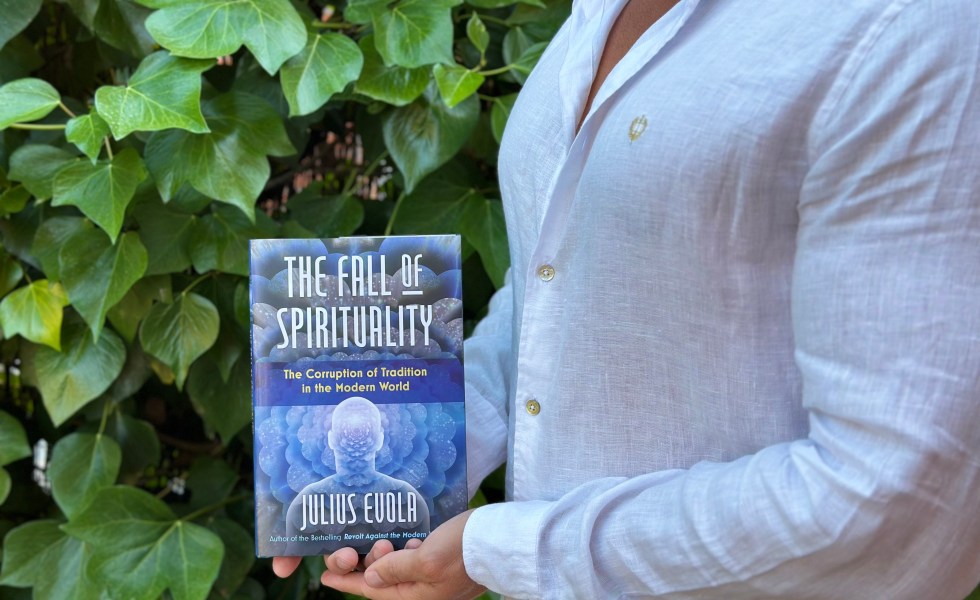
I have read The Fall of Spirituality – The Corruption of Tradition in the Modern World by Julius Evola.
Evola’s Warning – Dark Forces
If I were to summarise the main point of the book in the most concise fashion possible, I would describe it as a warning. Evola’s critique of many of the spiritual trends of the time (the early 1900s, primarily) is that they concern themselves with the Lower regions of the metaphysical. Or, worse, that they ‘open the doors’ to the Lower regions and to the entities dwelling therein.
‘Neither the common man nor the “optimists” of today have any idea of the dark and impersonal forces that linger at the borders of the reality from which they have been excluded.’
Julius Evola – The Fall of Spirituality. Page 15.
I am paraphrasing a poster on X when I say that it is often the most spiritually inept who seek supernatural thrills – i.e. the Hippie who takes Ayahuasca (who knows what sort of entity might possess the unprepared?). I am in full agreement with Evola here. In fact, I have had a video planned for a while now in which I will also warn people to not engage with the occult without having adequate preparation.
To summarise another point Evola makes in the book, we could say that one can go either upward or downward (spiritually speaking) – his warning goes out to those who seek to go downward. In most of his other works, he elaborates on the path upward (the path of initiation – the Mithraic Mysteries, to name an example). This is at least how I interpreted Evola’s views on the matter. I will elaborate on this at length later on (most likely in a coming book).

Evola’s Praise of the Catholic Church
The Lower regions do indeed present dangers to the uninitiated. Evola actually praises the Catholic Church for having served as a protector in this regard – i.e. protecting people from themselves (from their own Lower regions). Evola criticises the Church in his other books – often for the fact that they close the doors to higher initiation. To conclude, the Catholic Church closes the doors leading downward as well as upward (I am simplifying here) – which is good because it hinders spiritually inept people from hurting themselves (i.e. engaging in the occult and becoming the target for demons, to use that terminology) and is bad because it hinders spiritually gifted people from pursuing magical aims. This is, again, my interpretation of Evola’s teachings.
‘Moreover, every saturation with “lower” influences, which is produced in life through these or other means, acting between the weft and weave of consciousness, is today more worrying than it has ever been, because our day almost entirely lacks the counterparts to those influences in an opposite sense; that is, effectively supernatural influences, which the great traditions knew how to invisibly attract and graft onto our intentions, thoughts, and actions.’
Julius Evola – The Fall of Spirituality. Page 16.
The passage above could be explained in the following way: too many demons, not enough angels to counteract the influence of the demons (to use that terminology). Again, the door must be opened upward but must be closed downward.
Critique of Psychoanalysis – Freud & Jung
In the chapter titled Critique of Psychoanalysis, Evola shares his views on Freud. He essentially critiques Freud for focusing on sex in its lowest and darkest aspects. Evola discusses sex in a higher sense elsewhere (I will review Evola’s Eros and the Mysteries of Love soon). On a personal note, I have always found the teachings of Freud to be uninteresting, I will not discredit his entire work as the thoughts of a degenerate, but I do not believe his work should hold the position it does today. Of greater interest is the work of Jung (which I must get further acquainted with). A while back, I asked my friend John Morgan, an authority on matters of Tradition, about Evola’s views on Jung, and he responded thus:
‘He rejected psychology as a modern, scientifically-based movement, first of all. But additionally, he rejected Jung since he attributed the gods and the myths to being archetypes of human consciousness, rather than something that exists outside of and superior to human consciousness — i.e., being real in their own right.’
John Morgan
Evola shares the following insight:
‘It is certain, in any case, that if we were to psychoanalyze psychoanalysis as a general phenomenon, at its bottom we would find a Schadenfreude, a malicious pleasure in demoralizing and contaminating, applied not only to others and to the spiritual world but also, in the general vision of life, to oneself – almost as if one of those autosadistic complexes of which we have already spoken was acting here under the guise of “science”. It could also be called the counterpart of the Darwinian myth: it manifests the same tendency, the same unconscious joy in being able to reduce the higher to the lower, the human to the animal and the primitive-savage, which manifests in the so-called theory of evolution.’
Julius Evola – The Fall of Spirituality. Page 59.
On a personal note, I do believe in evolution. I thought this quote was worth sharing because of how accurate it describes the attitude of many low-thumos individuals today – i.e. the ones finding joy in reducing the Higher to the Lower. Plenty of examples can be found – said low-thumos individuals often have matching political views (Liberal-Leftist).

Definition of Magic & Crowley First Principle
Evola presents the following definition of magic (or rather one type of magic):
‘It is the art of consciously activating and directing certain subtle energies, whose place and field of action is the domain that exists behind “form” – that which has both form in the psychic field and in an external reality governed by the laws of nature.’
Julius Evola – The Fall of Spirituality. Page 169.
This can be compared to Aleister Crowley’s definition ‘Magick is the science and art of causing change to occur in conformity with the Will.’ Speaking of which, Evola discusses Crowley in the book (actually in quite favourable terms). Most notably he discusses Crowley’s principle: ‘Do what thou wilt shall be the whole of the Law’. This principle does not mean that one should do whatever one wants, but rather that one’s purpose must be discovered and realised. I believe the confusion about his principle is due to the fact that he took a lot of drugs.
Evola on Theosophy
There is a joke about “Evola’s book on Theosophy” – stemming from the fact that a Leftist content creator was asked if he had read it, whereupon he responded in the affirmative. The one who asked the question then noted that Evola did, in fact, not write a book about Theosophy. Evola does, however, include a chapter on Theosophy in The Fall of Spirituality. As one might expect, Evola does not have much good to say about Theosophy (i.e. Madame Blavatsky’s spiritual school) – being too “New Agey” (my term and interpretation). I am not yet familiar enough with Blavatsky to comment further on the matter.
Conclusion
The Fall of Spirituality 194 pages. I must admit that it was quite hard to read – hard but interesting. It is probably easier to read for those who are better acquainted with the spiritual schools he is critiquing. I will most likely reread the book later on. I would not necessarily recommend the book for anyone new to Evola; I would rather recommend Meditations on the Peaks (review) in those cases. I can recommend the book for Evola Enjoyers, however!



 The Golden One
You must be logged in to post a comment.