Julius Evola and the UR Group – Introduction to Magic: Volume II & III
Posted on January 30, 2022

I have read Introduction to Magic: Volume II – The Path of Initiatic Wisdom and Introduction to Magic: Volume III – Realizations of the Absolute Individual by Julius Evola and his companions of the UR Group. If you have not already read my review of the first volume, you can do so here: Julius Evola and the UR Group – Introduction to Magic: Volume 1. Also, if you are curious about the term ‘magic’, I elaborate on how I use it in this video: What Do I Mean By ‘Magic’?
At over 400 pages each, these two volumes contain many more interesting insights than shared here. These are just a few that I found particularly interesting.
Attempts to Influence Mussolini
As already mentioned in the previous book review (link above), the UR Group was active during the Interwar period. In the foreword to the second volume, it is mentioned that rites were done to influence Mussolini in a Roman Pagan direction. However, due to realpolitikal reasons, Mussolini sought an alliance with the Catholic Church (as was common for many Fascist parties throughout Europe at the time).
A woman who had participated in these rites prophesised to Mussolini in 1919 that he would become Consul. Consul was the highest political position in the Roman Republic (509 to 27 BC) – two Consuls were elected per term. In 1923, when Mussolini was the head of government, the woman approached him again and gave him a lictor’s bundle of rods with an antique Etruscan ax.
One of the members of the Ur Group, Dr Arturi Reghini, who had a strong desire to influence Fascism in a Pagan direction, expressed these views in his publications. Perhaps disappointed by the lack of progress done in this regard, he shared his opinions in an aggressive manner. Mussolini (under a pseudonym) actually responded to the criticism, which means that he felt strongly about the topic (since the publication only reached a niche audience; it was not a matter of a major newspaper criticising him).
After the war, Evola responded to accusations of being a Fascist by stating that he was a superfascista (meaning that he was beyond Fascism). Evola writes more about this in his book A Traditionalist Confronts Fascism, which I have read and can recommend for those interested in the views of Evola. I also refer to Evola in Dauntless in a chapter discussing racial materialism. Moreover, I composed a few thoughts on Evola in this article: A Few Notes on Julius Evola – Metaphysics of Power.

Evola and the Theosophists
In several essays, Evola makes critical comments about various other spiritual movements. He often comes with scathing remarks about the Theosophists, whose movement was cofounded by a Russian woman whose name may be familiar to some – Madam Blavatsky. Below are two quotes that illustrate quite well Evola’s attitude towards them.
‘Seen from the outside it is a blatant absurdity that shows the mental level of today’s spiritualist currents, especially the Theosophical ones. While they pretend to be proclaiming and revaluing the teachings of the ancient Wisdom, they indulge in democratic and humanitarian views, professing the gospel of more or less universal equality.’
Julius Evola – Introduction to Magic Volume III: Aristocracy and the Initiatic Ideal
‘Keeping in mind that esoteric science is simultaneously a regal and priestly art, Éliphas Lévi asks with good reason of anyone wanting to approach it: Do you feel a kingly nature within yourself? A priestly one? Such a question is not meant to demoralise, but indicates that one must at least have clear ideas about a basic human qualification. This is especially true in our time, when the type of the adept is lumped together with the often suspect type of the “occultist,” and of creatures like mediums, spiritualists, sensitives, and diviners who do not even attain the level of a sane and normal man. A certain natural aristocratic qualification, as the mark of a human type that is not just normal but superior, is the general premise for any participation in an initiatic order, which for that reason was restricted to an elite, and always will be.’
Julius Evola – Introduction to Magic Volume III: Aristocracy and the Initiatic Ideal

Evola vs Guénon – Spiritual Authority and Temporal Powers
Perhaps the two most famous writers on Tradition are René Guénon and Julius Evola. Although Evola had great respect for Guénon, he also disagreed with some of his teachings. In an essay signed by Ea (i.e. Evola) titled ‘Spiritual Authority and Temporal Power‘, Evola takes issue with Guénon’s statement that spiritual authority is tied to ‘knowledge’ and ‘contemplation’*, and to the priestly caste – whereas temporal power is tied to ‘action’ and the warrior or regal caste. *The citation marks around those words appear in the essay.
Evola, in response to this, points out that the kings and (later) emperors of Rome simultaneously held the title Pontifex (the highest spiritual authority). And Rome, as we all know, was a society that valued martial virtues – thus, in their case the spiritual path was the path of action.
Evola also points to the Eleusinian Mysteries, which conferred a higher dignity on the king than priests or sages. Similarly, the Cult of Mithras (which I have mentioned before) was an initiatic brotherhood mainly popular with military men.
In other books, Evola discusses the conflict between the Guelphs and Ghibellines during the Middle Ages. The Guelphs supported the Pope, and the Ghibellines supported the Holy Roman Emperor. We will return to both the Eleusinian Mysteries and the Guelphs vs Ghibelline conflict in coming articles, videos, and Podcast episodes.

Evola vs Jung
In one essay, Evola expresses his views on Carl Gustav Jung. I must confess that I found the following passage hilarious:
‘And in fact Jung has not understood anything, and has been handling things with which he should never have concerned himself.’
Julius Evola – Introduction to Magic Volume III: Esotericism, the Unconscious, Psychoanalysis
More scathing criticism from the Baron! I asked my friend John Morgan, an authority on matters of Tradition, about Evola’s views on Jung, and he responded thus:
‘He rejected psychology as a modern, scientifically-based movement, first of all. But additionally, he rejected Jung since he attributed the gods and the myths to being archetypes of human consciousness, rather than something that exists outside of and superior to human consciousness — i.e., being real in their own right.’
On a personal level, I have not read enough of Jung to make a statement.
Right-Hand and Left-Hand Path
These two concepts can be summarised as being the dichotomy between white magic (benevolent) and black magic (malicious). The concepts of Right-Hand and Left-Hand paths appear in numerous spiritual contexts. In the essay Magical Perspectives, According to Aleister Crowley, Evola actually gives credit to Crowley. He says that the Satanic aspect of Crowley’s work was mainly a front and that Crowley was an accomplished spiritual master – who was ‘extraordinarily qualified’ to follow the Left-Hand Path. This is high praise coming from Evola!
I do, of course, follow the Right-Hand Path.

Ex Oriente Lux
In this essay, Evola takes issue with the notion that the ancient spiritual traditions that so fascinate Westerners come from the East. In the same essay, he also mentions the Dorian component of Hellenic civilisation.
‘The light that shines from Hindu or Persian civilisation did not originate in the Orient, because those civilisations were created by races that came from the West and the North in a distant prehistoric epoch.’
Julius Evola – Introduction to Magic Volume II: Ex Oriente Lux
‘The light of authentically Greek civilisation, namely that which it owes to the Dorians and Achaeans, descended from the North.’
Julius Evola – Introduction to Magic Volume II: Ex Oriente Lux
Any talk of Aryans is, as you may know, controversial in this age. However, that does not mean that we should not talk about them. In fact, it is useful to highlight this fact, especially since it helps us understand why many of us (myself included) have a certain affinity for both India and Persia. For more about India, read this article: The Agni and The Ecstasy by Steven J. Rosen.
For more information about the Aryan invasion of India, watch this video: Aryan Invasion of India: Myth or Reality? For more information about the genetic composition of ancient Greece, watch this video: JIVE TALK: Ancient DNA news: Greece and Italy.

Experiences Among the Arabs
In this essay, signed by Gallus, the author describes his experiences in North Africa, where he was stationed at a government post when Libya and Tripolitania were in Italian possession. The author notes that he was always interested in the esoteric and was drawn to the Arab world for its mysteries.
This essay evokes a certain sense of nostalgia. A nostalgia for the Arab world as it used to be in Western imagination. The Arab world of One Thousand and One Nights. The Arab world of mystics and beautiful architecture.
On a personal note, I would have liked to see more of these diary-like essays. This is something I will keep in mind for coming books of my own – giving a personal touch to the topic you are analysing. Putting teachings in a context undoubtedly make them both more interesting and accessible for the reader.
Related to this, the aforementioned René Guénon actually converted to Islam. We will return to the teachings of Guénon in coming articles.

Corrosive Waters
A reoccurring topic that is discussed in several essays, in all three volumes, is that of corrosive waters. ‘Regular’ waters can be said to be the non-harmful way of reaching spiritual insights. Corrosive waters entail the use of otherwise harmful substances (various drugs including alcohol) to reach spiritual insights. The authors caution against the use of these, but mention that they can be useful in some circumstances.
This reminds me of the use of steroids when it comes to gym training. The better and safer way to put on muscle is without corrosive waters (in this case steroids), but in some cases exogenous testosterone can be useful. What must always be emphasised, however, is that steroid use before the age of 23 is strictly prohibited, as it may damage your physical development. Testosterone replacement therapy for older men may be a good way to optimal health. On a personal note, I have never taken any such substances; if I ever do, it will be when or if my natural testosterone levels decrease by a significant amount. I elaborate more on this in Dauntless.

Conclusion
As with the first volume, I can recommend these two volumes for those interested in spiritual traditions and esoteric matters.
Lastly, if you have not already done so, I recommend you listen to Podcast Episode 18. The Divine Blessing (which deals with magic and spirituality).
Julius Evola and the UR Group – Introduction to Magic: Volume 1
Posted on January 21, 2022
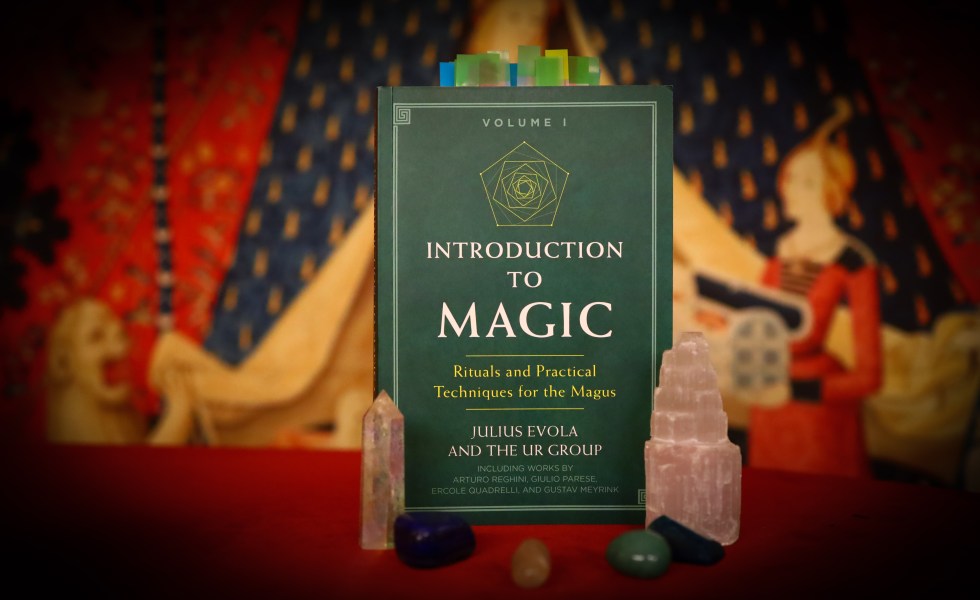
I have read Introduction to Magic: Volume 1 – Rituals and Practical Techniques for the Magus by Julius Evola and his companions of the UR Group – in Italian: Gruppo di UR. The Baron needs no introduction; the UR Group, however, may be unfamiliar to some (see below).
Volume 1 of Introduction to Magic is more practically oriented that Volume 2 and 3 (which will be the subject of a coming book review), and can be read on its own.
Reading all three volumes will be quite time-consuming, especially since the material is rather heavy. Therefore, it might be good to read the first volume for its practical advice and leave the second and third volumes for a later time.
Again, the essays make for some quite heavy reading, so if you are not used to this type of literature, it may be a better idea to start with a book such as Icelandic Magic (read my book review here: Icelandic Magic by Stephen E. Flowers).
Below are some insights from the first volume I thought would be interesting to share.
The UR Group
In Swedish, the word ‘ur‘ is a prefix that basically means primordial or ancient. If I were to translate The Primordial Beast into Swedish, it would be something like Urbesten. Ur + besten (besten = the beast). Except for Evola himself, the group consisted of individuals who wrote under pseudonyms – such as Abraxas*, Luce, and Arvo (among others). The essays were mainly written during the turbulent Interwar period. The material the group presented dealt with magic (religious practices, rituals, meditation, and metaphysics etc.). I will write more about their influence in Italian society in the next book review.
*Abraxas is a Gnostic deity. In the first volume of Introduction to Magic, the pseudonym is spelled as Abraxas (which is the standard spelling of the deity). In the second volume of Introduction to Magic, the name is spelled as Abraxa – which was the synonym chosen by Ercole Quadrelli.
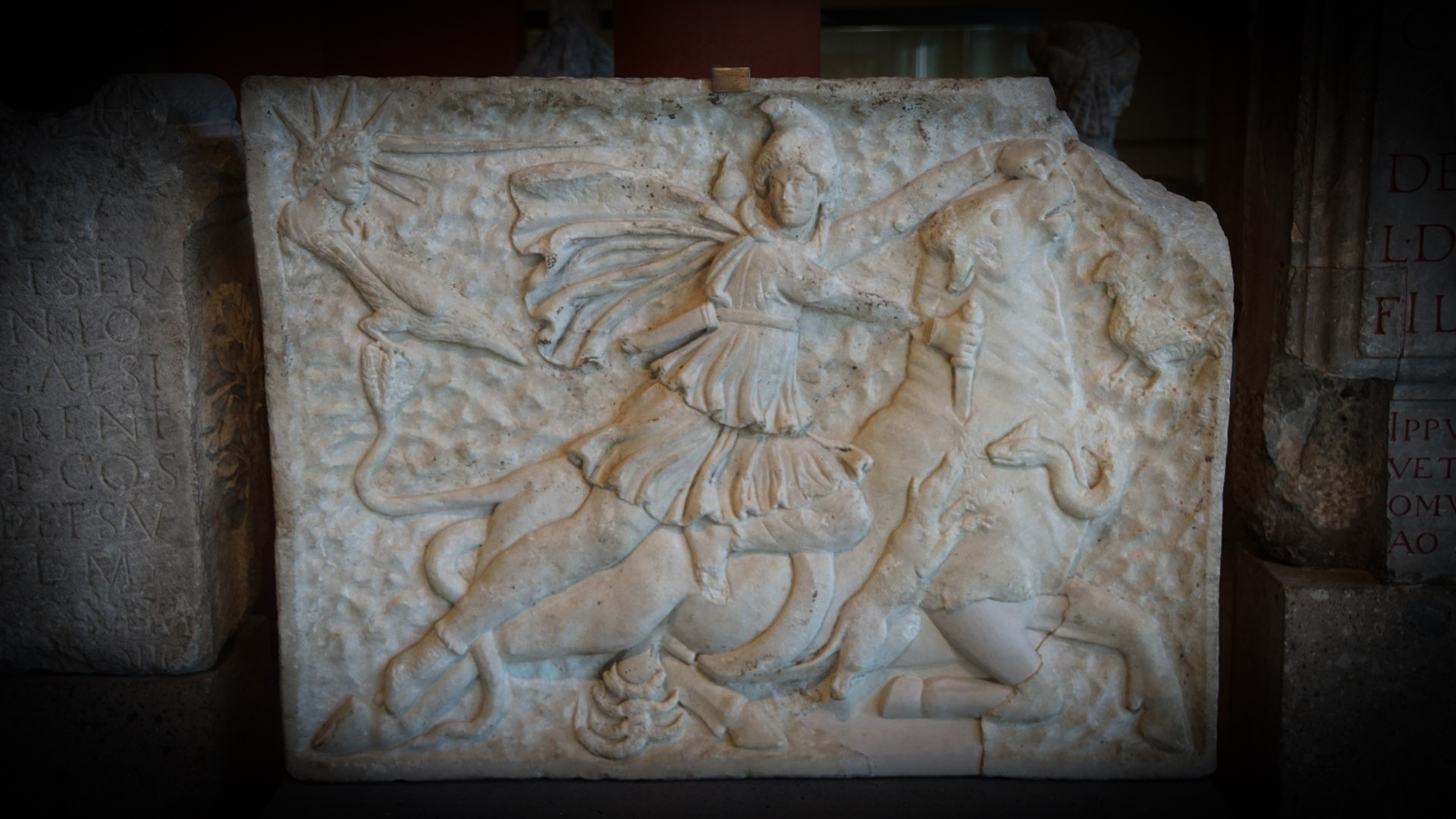
Mithraic Ritual of the Great Magical Papyrus of Paris
One of the most interesting essays in the volume is about the Great Magical Papyrus of Paris. For those who have read Dauntless, the Cult of Mithras will be familiar. For an introduction to the cult, you can watch Survive the Jive’s video: The Military Cult of Mithras – Very Indo-European.
The papyrus describes and gives instructions for a magical ritual. The ritual contains both breathing techniques and bodily postures – the UR Group points out that this confirms that these matters are not limited to Hindu Yoga. The same is true for the use of ‘names of power’, which correspond to mantras of Hindu tradition.
In Dauntless, I introduce my own two favourite Pranayama techniques; Bhastrika (Bellows Breath) and Nadi Shodana (Alternate Nostril Breathing) – these are taken from India.
Come summer, I will experiment with the instructions in the papyrus. It is winter as I write this, and since one of the instructions is to ‘breathe from the solar rays, inhaling three times as deeply as you can,’ it is more reasonable when Sol Invictus returns to the fair lands of Moder Svea.
The text as it appears in the volume is translated into English from Italian (and from the original Greek into Italian). As with many ancient texts, much will inevitable become lost in translation – even so, it contains many epic passages. I am always on the lookout for such epic passages that I can memorise and meditate upon, and thereafter draw strength from.
‘Be favourable to me, O Providence and Fortune, as I write these first mysteries to be transmitted to the only Son, who will be rendered immortal, to the Initiate worthy of this Power of ours. The great Sun God Mithras ordered me to transmit these mysteries through his own Archangel. Be favourable to me, so that I alone, the Eagle, may reach the Heavens and contemplate all things.’
Propitiation Formula
‘Having said this, the solar rays will converge on you. You will become their center. When this is fulfilled in you, you will see a young handsome God, with fiery hair, wearing a white tunic and a scarlet mantle, with a fiery crown on his head. Greet him straightaway with the greeting of Fire’
Fourth Logos
‘The earth will shudder and a God will descend, an immense, radiant presence. He is young, with golden hair, wearing a white tunic, a golden crown, and a long robe.’
Seventh Logos
The passages above are within a context too long to elaborate on here, but I wanted to share them so you can get a feel for the text. Getting a feel is often more useful and powerful than the intellectual insight itself – this is especially true when we are talking about magic and mental techniques. The second and third passages above reminded me of the God that appears in Lucifer’s Court – you can read my review of it here: Lucifer’s Court – Book Review and Inspiring Quotes. A good esoteric book should contain passages about such Gods!

Knowledge of the Waters
In this essay by Abraxas, a primordial force is discussed. It can be introduced in the following manner:
‘The Wise spoke of it as a wonder and as a terror. They called it: Universal and Living Fire, ύλη (matter), Green Dragon, Quintessence, First Substance, Great Magical Agent. The principle of their “GREAT WORK”, since the Magistery of Creation and the Magistery with which man realizes himself according to the Royal Arts are one and the same.
Abraxas – Knowledge of the Waters
This Matter of ours is neither an abstraction of profane philosophy nor a myth or a fairy tale, but a living and powerful reality, the spirit and the vitality of the Earth and of Life.’
Later in the essay Abraxas likens the harnessing of this power to a strong man grasping a bull by the horns to subjugate it, thus enabling him to dominate its cosmic nature in himself. This is similar to what I mention in Dauntless in regard to sexual energy – instead of wasting it on unfruitful endeavours, it can be harnessed and used for your ascent to greater heights of being.
The energy described in the quote above can be found within you – an Esoteric Master who seeks to increase his power and leverage in the world wants to find said energy and use it as fuel for his quest. This will not make much sense to most people, but since you are reading this, you are not most people and will thus have a different appreciation for this insight.
This energy is part of a greater energy, your being is part of something greater – like a branch is just a part of a tree. Abraxas notes that this is similar to the Buddhist conception of ‘sâmsaric consciousness.’

Instructions for the Awareness of Breath
Another passage by Abraxas discusses a meditation technique. I tried this technique during a meditation and found it quite useful. It is actually quite similar to something Wim Hof says: ‘with your mind, follow your breath.’
The technique can be summarised as follows:
1. Lie down horizontally, completely relaxed.
2. Abandon the body.
3. Evoke the image of air: free, without bonds, infinite, fleeting.
4. Slowly reawaken the breath without ‘touching’ the body – using the mind to draw breath as opposed to a movement of the muscles.
5. Envision your consciousness as the air. Instead of feeling the lungs moving the air, feel the air moving the lungs.
When I meditate, I either sit down cross-legged on a meditation pillow, or I lie down on my shaktimat (seen below).

The Problem of Immortality
An interesting essay in the volume is The Problem of Immortality. It is signed as Ea, but it is clear that it is Evola who has written it (one can tell from the style and sentiment). A particularly insightful passage is the following:
‘The idea that everybody possesses an “immortal soul,” conceived moreover as a facsimile of his living consciousness and individual earthly Self, is a true
ideological aberration, although its usefulness as opium for the masses at
times cannot be denied.’
Julius Evola (signed as Ea)
Evola’s anti-egalitarian views are refreshing – and gives credibility to his teachings. This is especially true since many ‘spiritually’ oriented persons subscribe to false ideas such as the equality of humans. Anyone with a modicum of experience and reason can clearly see that humans differ greatly in their quality and value. Treating humans and animals with dignity is always a good idea though.

Conclusion
At 376 pages the volume contains many more valuable insights than shared in this review. As already mentioned, the book is quite heavy to read so I would not necessarily recommend it to anyone who is unused to reading material like this. However, if you are interested in these matters, I would highly recommend it.
Lastly, if you have not already done so, I highly recommend you to listen to Podcast Episode 11. Demigod Mentality (which deals with magic and mentality).
Spirits of the Past – Legio Gloria January 2022 Release
Posted on January 9, 2022
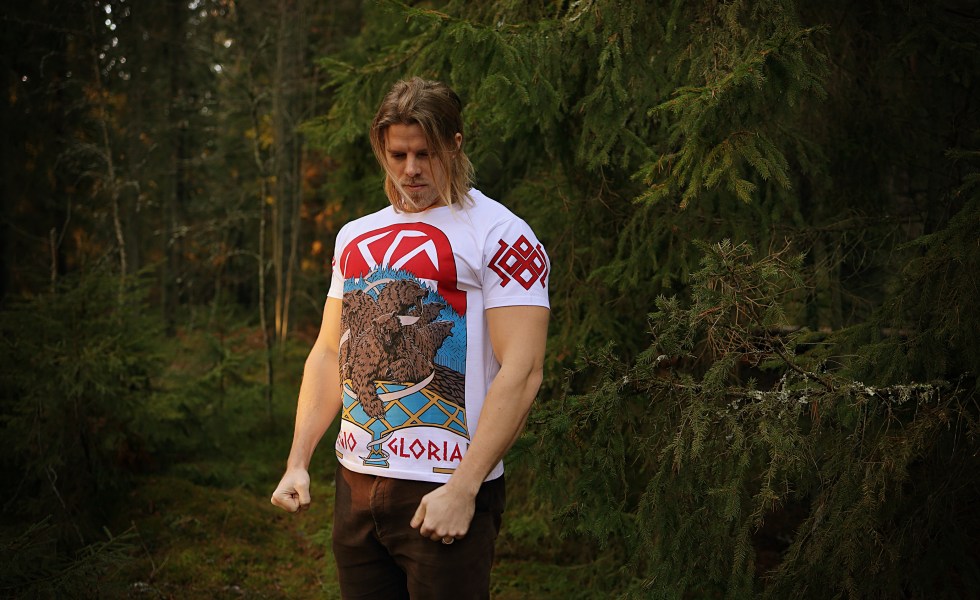
The only reasonable course of action for Legio Gloria is to start the year in high-Thumos fashion. Before presenting the new garments, I thought to mention the following first:
European Wars
European history is full of Europeans killing other Europeans. This is no unique or revolutionary insight. I mention this to make a point.
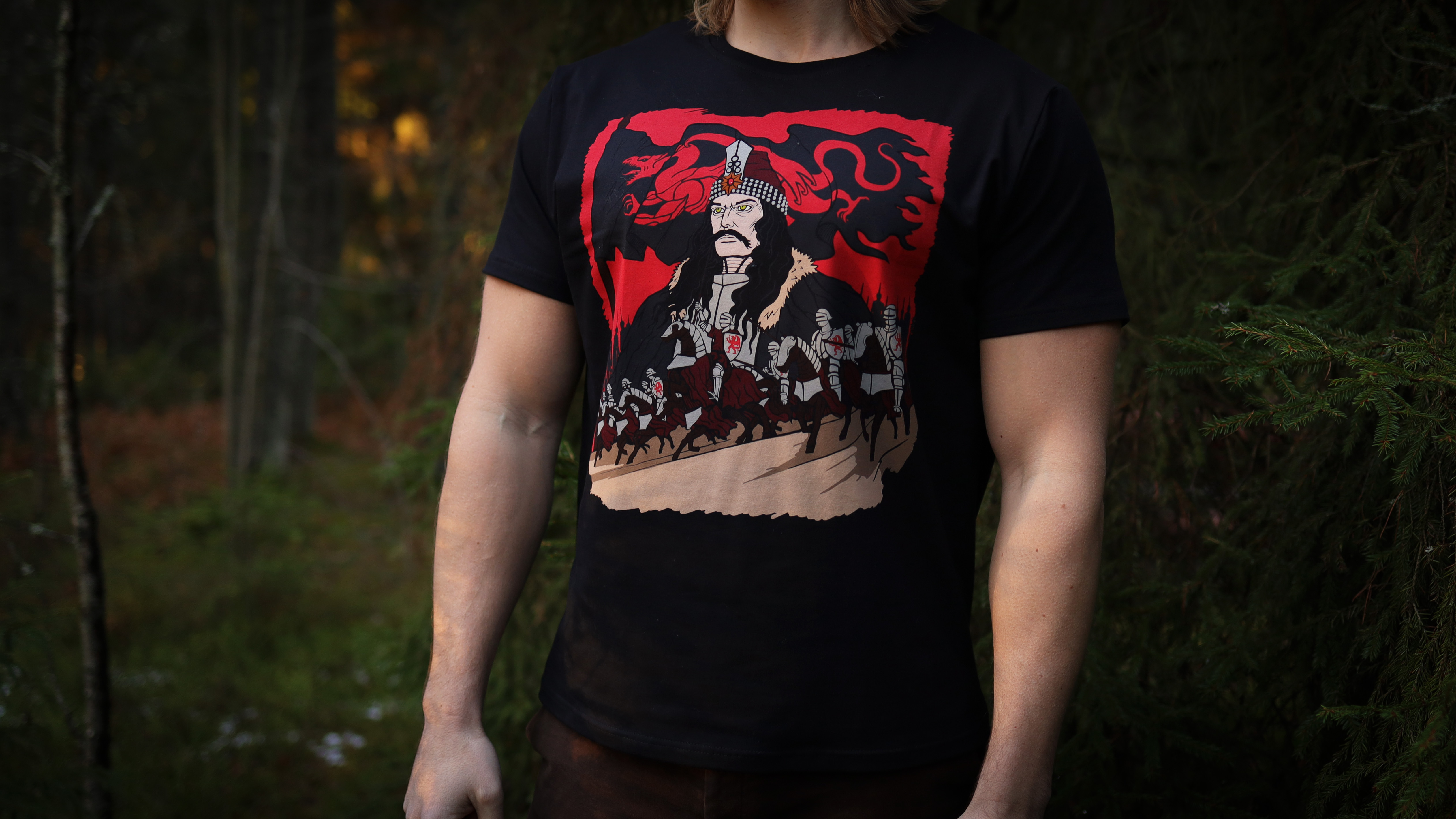
Vlad impaled Transylvanian Saxons and Wallachian nobles. The Teutonic Order mainly fought in the Baltic area – they even occupied the sacred island of Gotland for ten years (1398-1408).
The point of presenting this type of imagery is to inspire the good aspects of these historical figures and factions. Vlad was a hero to his people and fought bravely and successfully against the Ottomans. The Knightly Orders (the Teutonic Knights in this case) embodied ideals that are needed in our age – ideals that I would like the wearer of the garment uphold.
Legio Gloria, as a clothing brand, has no religious affiliations – the only affiliation is to European civilisation. The same is true for me. Any religious imagery that appears in our clothing is as a part of the biocultural theme of that particular design.
New Releases
Below are the new releases. All of the t-shirts are proudly made in Poland. They are designed to fit an athletic physique (muscular yet normal). They are made with 93% organic cotton and 7% elastane for an optimal fit.
The cookbook is printed in Latvia (as is Dauntless).
Note: be sure to wash the organic cotton t-shirts in no more than 30 degrees Celsius. The same is true for linen and wool. If your washing machine has the option of hand wash – go with that. This is especially important when a t-shirt has a design that is water printed (meaning that the design is in the cloth as opposed to on the cloth). Too high temperatures may harm the colours.
Take care of your clothes, and they will take care of you!
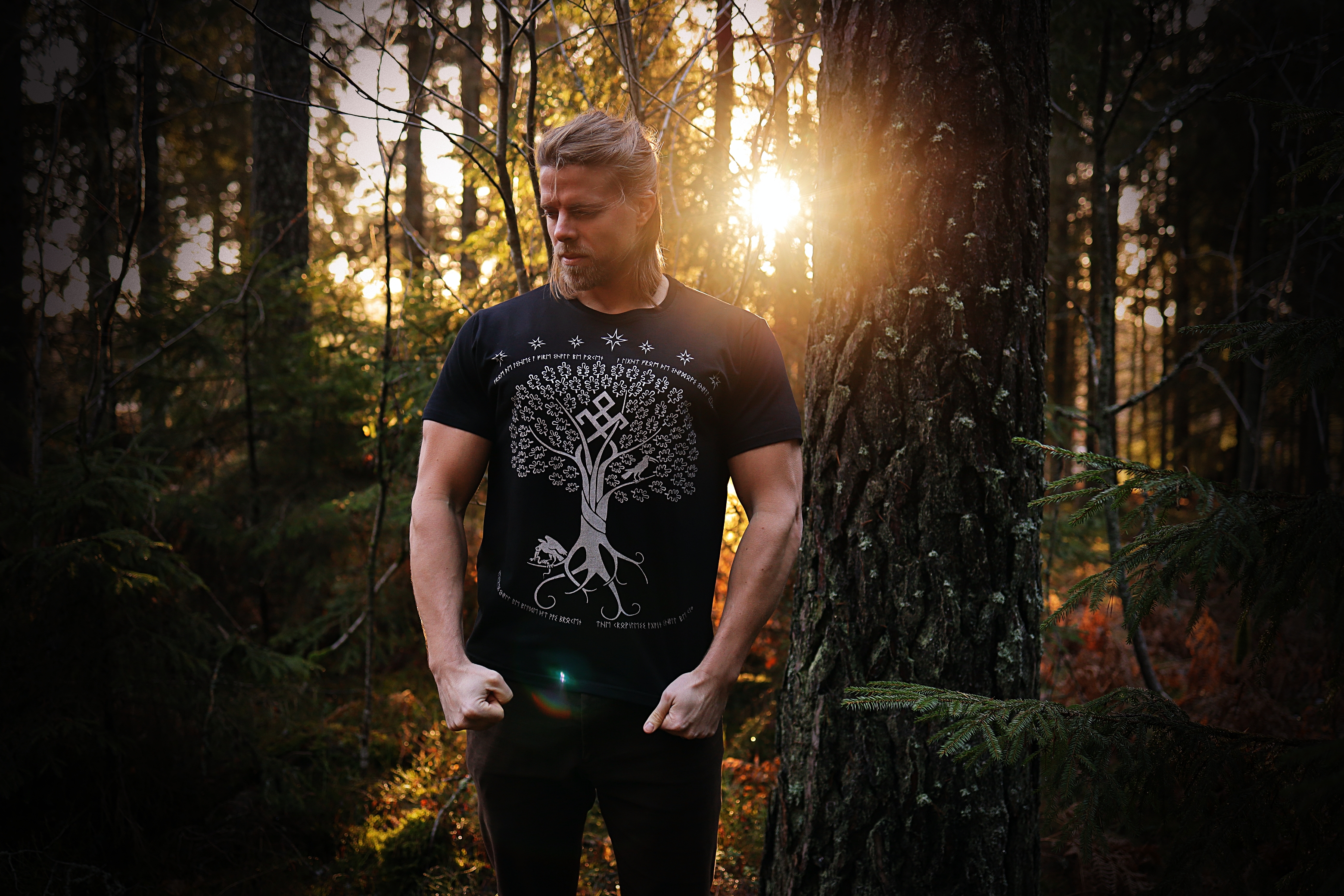
Yggdrasil – T-Shirt
Yggdrasil – the World Tree in Norse mythology – is on proud display. Odin’s ravens, Hugin (thought) and Munin (memory), are also present; one is vanquishing a serpent of deceit, and the other is gazing out into the world.
Vlad Dracula – T-Shirt
Channel the spirit of Vlad Dracula – Defender of Europe – as you strive to become a force of nature. Vlad lived in brutal times and had brutal enemies – brutal measures were required to keep his people safe.
Teutonic Knight – T-Shirt
Embrace the spirit of the Knightly Orders and let it fuel your quest for excellence and chivalry. Brotherhood, dedication to higher ideals, martial prowess, and humility are all things to aspire to in the modern world. Wear this as a reminder to yourself to live in accord with higher ideals.

Dark Enlightenment Handsome T-Shirt
A handsome t-shirt for athletically built gentlemen. A plain black t-shirt with the Legio Gloria emblem embroidered. The garment is black (but looks blueish in this picture).

Old World Feast
I am very proud to present my wife’s cookbook – Old World Feast – it contains nourishing and delicious recipes to fuel athletic and cognitive performance. Traditional recipes from all over Europe. I have had the great pleasure of eating all of the recipes in the book and can vouch for their quality.
Great stuff!

All new releases are available at LegioGloria.com
Lastly, stay tuned for more garments – we have plenty in the works!
Legio Gloria Instagram: https://www.instagram.com/legiogloriaclothing/
Icelandic Magic by Stephen E. Flowers
Posted on December 22, 2021

I have read Icelandic Magic: Practical Secrets of the Northern Grimoires by Stephen E. Flowers, Ph.D, and I can straight away recommend it for anyone interested in esoteric matters.
At around 100 pages it is a rather quick read. It is also written in an easier language than many other esoteric books, making it a good starting point. I am currently reading Introduction to Magic by Julius Evola and the UR group (which will be the subject of a coming article), and compared to those books, Icelandic Magic is much more accessible. Below are some interesting aspects of the book which I thought to highlight.

Religious Background
Iceland, like all Nordic countries, has had three different religious time-periods; Pagan, Catholic, and Protestant. As in most other countries that experienced these shifts, it was not a matter of an overnight change – rather, the transition happened gradually and many traditions survived into the later eras. Yule (Christmas) is a good example of this, although it changed and adopted Christian elements – just as it has changed even more over the last century.
One would perhaps expect rune magic to be a phenomenon restricted to the Pagan era. However, the practice continued throughout the Catholic era and long into the Protestant era (and is now alive again thanks to the work of the author). Moreover, just as Icelandic society as a whole became influenced by Christianity, so did the rune magic become influenced. Below is a quote from the book showing this:
‘In the world of magicians this meant that Christian figures could sometimes be used right next to pagan deities. And as our wondrous example in spell 46 of the Galdrabók shows, the northern sorcerer was so free magically that he could use the names of Odinn, the Saviour, and Satan in the same litany.’
Stephen E. Flowers
On a similar note, a majority of runestones in Sweden are actually from the Christian era (which is why you often see crosses on them).
Legendary Black Books
The Galdrabók is an Icelandic grimoire (a book of spells) written in the latter part of the 1500s. The book contains references to Germanic Paganism, which is interesting considering the fact that it was written in the Protestant Reformation Era (as mentioned above, much survived from previous eras). The book found its way to Denmark, and eventually came into the possession of a Swedish* philologist named Johan Gabriel Sparfwenfeldt.
*The author refers to him as Danish, but he was a Swedish diplomat (and orientalist, courtier, and, as mentioned above, philologist – a true renaissance man!).
The Galdrabók was translated into English by the Stephen E. Flowers in 1989 – which incidentally is the year of my birth. It is now in the possession of Kungliga Vetenskapsakademien (The Royal Swedish Academy of Sciences). I will investigate the possibility of seeing it – if that is possible, I will make a videolog for Odysee and YouTube to show it.
Rauðskinna is another book of magic. According to legend it was compiled by Bishop Gottskálk Niklásson the Cruel (1469–1520). Rauðskinna translates as Red-Skin and is said to be a grimoire of magic dating from the Pagan period.
Gráskinna (Grey-Skin) is another grimoire, which is translated and constitutes the second part of the Icelandic Magic book.

Sator Square
The Sator square (which conceals the Paternoster formula) was found in Nordic practice. Icelandic Magic includes a reproduction of a Sator square that was found on the bottom of a silver bowl dating to the 1300s. The bowl was found on Gotland (the sacred island in the Baltic). The author notes that the Paternoster (Our Father) may actually predate Christianity. This is based on a Sator square found in Pompeii (the Roman city that was buried under volcanic ash in AD 79). This may show that the Our Father prayer was used by another sect, most likely the Mithras cult. The Mithras cult appears in Dauntless: The Wild Hunt Edition and will appear in coming articles and books as well – it is a highly interesting topic!
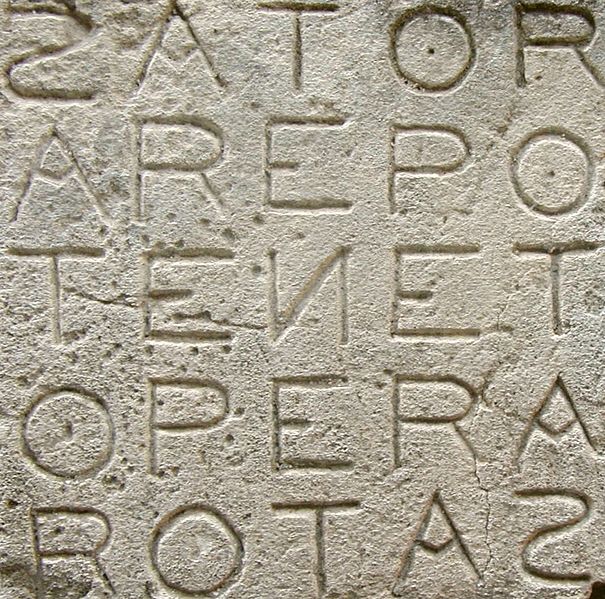
Regardless of the origins of the Paternoster, it was used in Icelandic rituals – and most likely came to Iceland as a part of Christian influence. To give an example, there is a concealment spell (if you want to hide something from others) that requires a reading of Paternoster.
Moreover, regarding incantations, the author points out that ‘the power of a name’ is a reoccurring phenomenon in magic texts. I elaborate on a similar topic in Podcast Episode 11. Demigod Mentality.
Practical Rune Magic
As mentioned above, the second part of the book consists of practical instructions for rune magic (taken from the Gráskinna).
The magic itself will be easier to do if you have some experience with meditation – when you draw the runes/staves/signs, you must visualise them in your mind. Some drawing practice may also be in order before doing a ritual to ensure that you can draw the sign in a fast and beautiful manner during the ritual itself.
In addition to plenty of spells (signs to draw and words to read etc.), there is also a practical guide to set up the ritual table. The recommended equipment is also listed: pens, parchment or paper, straightedge, compass, candles (not all are required for all spells).
Moreover, in Icelandic folklore, four guardian land-spirits watch over Iceland: a dragon in the east, a large bird in the north, a bull in the west, and a mountain giant in the south. These can be summoned in your mind (via an incantation and visualisation) to shield the practitioner before a ritual – epic stuff!

Conclusion
Again, I can definitely recommend the book for those interested in topics like this. I would also like to salute Stephen E. Flowers for his tremendous work in bringing these old texts back to life. When reading the book, I got got good vibes – perhaps as a result of ancient spirits blessing my quest for enlightenment!




 The Golden One
You must be logged in to post a comment.