The Hermetic Tradition by Julius Evola
Posted on March 12, 2022
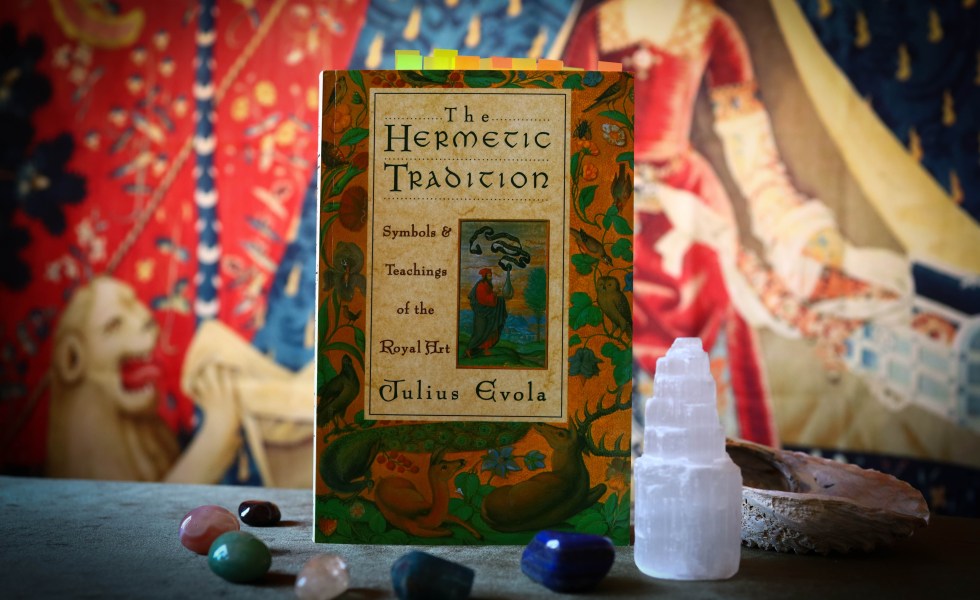
After reading the three volumes of Introduction to Magic (reviews here and here) by Evola and the UR Group, I decided to continue on the same esoteric path by reading The Hermetic Tradition. Whereas Introduction to Magic contains more of Evola’s (and his companions’) thoughts on matters of magic and metaphysics, The Hermetic Tradition draws more heavily upon the teachings of older mystics and alchemists (who will be presented further down). The book is still Evolian in its nature, so the style will be familiar if you have read Evola before.
Evola’s View of Hermeticism and Alchemy
Evola approaches hermeticism and alchemy (he sees them as one) in a spiritual fashion – which means that he is not interested in the material aspects of alchemy (i.e. the classic ‘turn lead into gold’ type of alchemy that may be familiar to some). Evola, as a seeker of Tradition and spiritual ascent, seeks to present the teachings of hermetic mystics throughout the centuries from this perspective.
Alchemy, in this view, is placed together with other hermetic disciplines – magic and astrology, for example. Magic, as we have discussed elsewhere, can be seen as mental techniques. Astrology is a topic we will return to – suffice to say that the planets feature quite prominently in the book. It can also be noted that astrology is one of the lost sciences (like physiognomy) that the modern world has cast aside.
Evola, in this book, shows that alchemy was not just the humble beginnings of the science of chemistry but a profound mystery-science in its own right. As illustrated by the quote below, he identified the true spiritual teachings as being hidden from the unworthy (and the Inquisition). This led mystics and esoteric masters to approach the Great Work, the Royal Art, in a spiritual fashion – whereas the materialistically oriented early scientists approached it in a profane fashion (i.e. in the sense that they were out for physical transformations as opposed to spiritual ones).
‘Much better then to speak of Mercury and Sulfur, of metals and puzzling things and impossible operations, better to attract the greedy attention and curiosity of of the “puffers” and “charcoal burners”, of those who then gave birth to modern chemistry; and best of all, in order to keep others from suspecting that the rare and enigmatic allusions were actually metallurgical symbolism referring to things of the spirit.’
Julius Evola – The Hermetic Tradition. Page 97.
The author of the foreword notes that Evola was influenced by an Indian alchemist – C.S. Narayana Swami Aiyar of Chingleput – who emphasised the importance of breath-work to achieve alchemical results. This is highly interesting. In my own meditations, I have found that entering a meditation by first doing a breathing exercise is greatly helpful. Wim Hof, the Dutch Iceman, has a good guided breathing-exercise. Interestingly, in a chapter titled The Path of the Breath and the Path of the Blood it is noted that focusing on the breath (the first key) and focusing on the blood (the second key) is an alchemical technique. Wim Hof encourages the practitioner to focus both on the breath and the blood in the breathing-exercise mentioned above.

Alchemical Work – the Great Work – the Royal Art
When reading the book and approaching the Royal Art from Evola’s perspective, which, in my humble opinion, is the correct way to approach it, it becomes clear that the whole art is one of ascending and transforming oneself in metaphysical matter. One could even say it is about finding God – God in this case is the One, the animating force of all life. We can also refer to this animating force by other names. This force can be described using a quote which may be familiar if you read our book review of Introduction to Magic: Volume 1:
‘The Wise spoke of it as a wonder and as a terror. They called it: Universal and Living Fire, ύλη (matter), Green Dragon, Quintessence, First Substance, Great Magical Agent. The principle of their “GREAT WORK”, since the Magistery of Creation and the Magistery with which man realizes himself according to the Royal Arts are one and the same. This Matter of ours is neither an abstraction of profane philosophy nor a myth or a fairy tale, but a living and powerful reality, the spirit and the vitality of the Earth and of Life.
Abraxas – Introduction to Magic: Knowledge of the Waters
When the alchemists (in this context) talk about substances and how to transform, separate, and combine them, they are referring to the inner forces in man (body, soul, spirit). Another insightful quote regarding this great force is the following:
‘We can also say that in the One the All, the “One” and the “All” now crystalize as two distinct principles. The “One” takes on the meaning of a center that manifests in the heart of chaos (the “All”) and affirms itself there as a principle of incorruptible fixity, stability, and transcendence. From the signature, of O—“the first matter” we move on to ☉, which is the ancient hieroglyph of the Sun.’
Julius Evola – The Hermetic Tradition. Page 33.

Soul, Spirit, and Body
In a chapter titled thus, Evola discusses these three concepts from an alchemical perspective. He notes that ‘man carries hermetically in his soul, the presence of a solar and golden force ☉; in his spirit he carries that of a lunar and mercurial force ☿; and finally, in the body, the force of Salt 🜔 is expressed.‘
Jakob Böhme writes the following:
‘Everything that grows, lives, and moved in this world is in Sulfur, and Mercury is its life. And Salt is the corporeal essence of Mercury’s hunger.’
Jakob Böhme – De Signatura Rerum
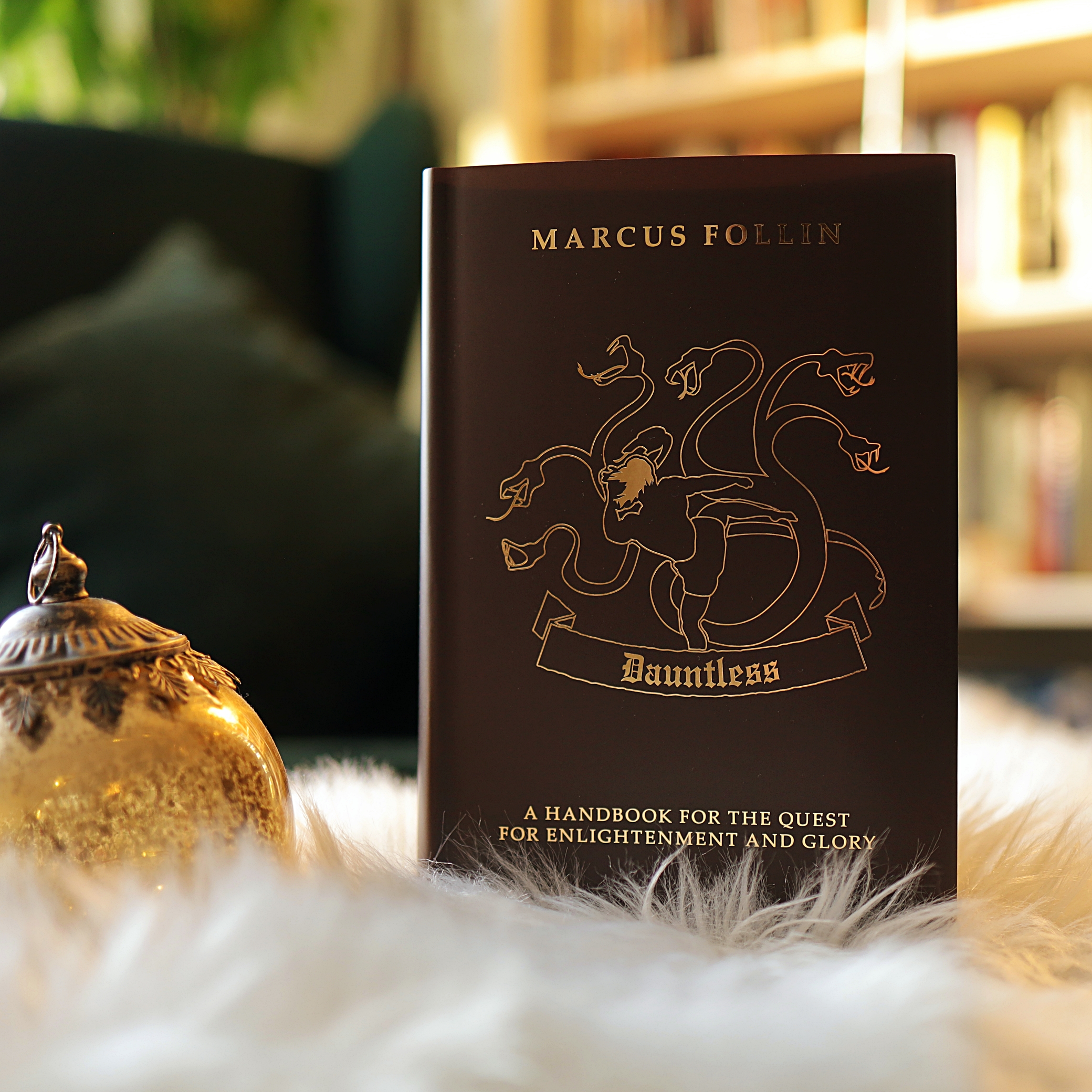
When reading passages like this, it becomes clear that they are talking about the animating life-force. Many alchemical teachings are unclear at a first glance; this is to hide the teachings from the unworthy. The quest to find or create gold within oneself, to master the Quintessence and make the most out of the divine energy, is what we can take with us from alchemical studies. As we noted in Dauntless and in previous book-reviews, it is about taming the inner dragon and using its energy to fuel your own ascent.
Mithras and the Bull
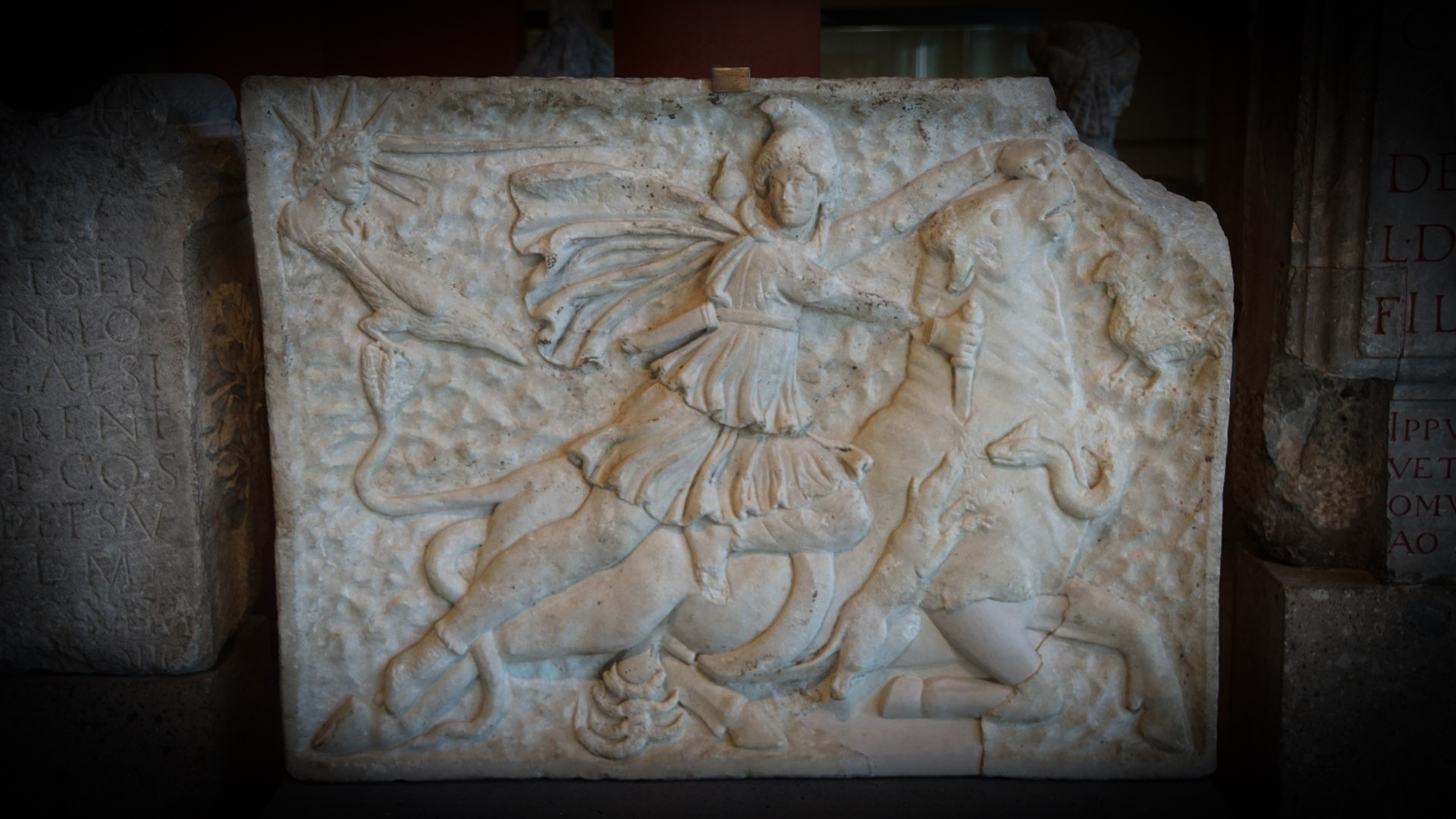
As you, my dear reader, are probably aware of by now, I always enjoy the appearance of the Cult of Mithras in esoteric literature. Thus, I thought to share the following quote – which follows up nicely with what is mentioned above. Subdue and harness the primordial power within you:
‘We must awaken the force but not let it unseat us. The characteristic depiction of this ability is dramatized by the myth of Mithras who seizes the bull by the horns and does not let go despite the animal’s mad stampede until the bull, exhausted, gives up and allows himself to be led back to the “cavern” (the alchemical texts speak specifically and frequently of Mercury’s cavern), where Mithras gives it death. After its death there follows the symbolic emerging of vegetation from the earth, sprouting from the blood of the sacrificed animal.’
Julius Evola – The Hermetic Tradition. Page 113.
Immortality
Evola notes that the true alchemical immortality does not entail an immortality of the body. He also notes the following in regard to the immortality of the soul:
‘It was the vulgarization and abusive generalization of a truth valid exclusively for initiates — a vulgarization that began in some degenerate forms of Orphism and was soon fully developed by Christianity — that was to give birth to the strange idea of an “immortality of the soul,” and then extended unconditionally to the same for all souls.’
Julius Evola – The Hermetic Tradition. Page 96.
I am not yet wise enough to comment upon the immortality of the soul, but something that always struck me as unreasonable was the immortality of everyone’s soul. Thus, I thought to share this insightful quote. We will return to this discussion in coming works.

Guénon’s View of Alchemy – White Work and Red Work
The disagreement between Julius Evola and Réne Guénon (that we mentioned in the review of Introduction to Magic: Volume II & III) appears in this context as well. Guénon rejected the idea of alchemy as a complete metaphysical doctrine. Moreover, according to him, a true tradition could not have come from an Egypto-Hellenic origin. This is stated in the foreword of the book and no further explanation is given. Thus, I consulted Thomas Rowsell, who notes that Guénon was quite anti-Greek in the sense that he considered their polytheism to be a divergence from the primordial and monotheistic Tradition he imagined.
As we have already noted, Evola and Guénon disagreed upon who the highest spiritual authority was: the Warrior or Priest. Note, Evola and Guénon respected each other, and this is a minor disagreement that does not take up any space in this book itself. I just thought to mention it since we have encountered the disagreement before, and because it is interesting.
In alchemy, the Red Work is above the White Work. The Red (or Purple) embodies an active state (of the Kshatriya – Warrior), whereas the White embodies a contemplative state (of the Brahmin – Priest). The White Work (White Elixir) is not the final stage, because it lacks the Fire – the Fires of Saturn, the Gods of the Golden Age. Evola notes that to the Red stage is attributed the purple, the sceptre, the crown, and other symbolic elements of royalty and empire. An interesting comparison is the Catholic Church, where the Pope (the highest) wears White and the members of the lower levels of the church hierarchy wear Red.
‘There is a measure of legitimacy in connecting the White Work and the Red Work, respectively, to initiation into the Lesser and Greater classical Mysteries. The promise of both was immortality, which is, let us reiterate, something positive and very different from the vague “spiritualist” conception of simple survival. But the first immortality was only such in terms of “life,” even Cosmic Life, and therefore, ultimately, a conditional immortality linked to manifestation. The second, that of the Greater Mysteries, was a “supercosmic” immortality in the sense just indicated, and it was in the Greater Mysteries that use of the royal symbolism predominated.’
Julius Evola – The Hermetic Tradition. Page 186.
Thus, Evola connects the White Work to the Lesser Mysteries and the Red Work to the Greater Mysteries. We will return to these insights in coming works – when discussing the Mithraic and Eleusinian Mysteries.
Cast of Characters
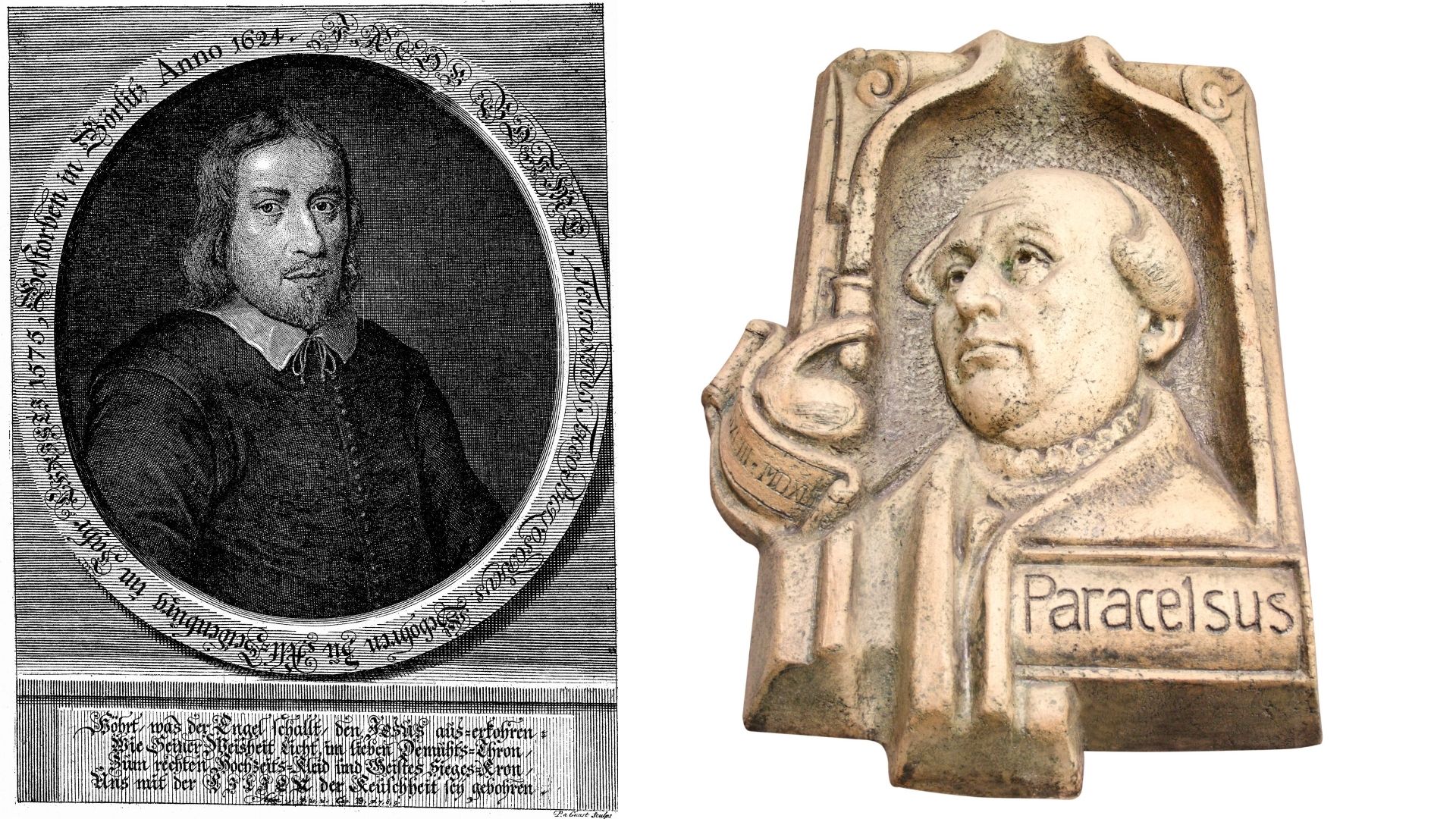
When talking about alchemy as it is presented in the book, it can be good to be familiar with a few historical individuals that appear frequently in it. As mentioned above, Evola presents the teachings of various spiritual masters. Below are some of them – you may recognise some, and you will probably encounter them again if you are interested in esoteric matters. I present these men in brief to emphasise the fact that alchemy was not merely a historical curiosity without merit but a study that interested high-capacity men.
Heinrich Cornelius Agrippa (1486–1535) was a German polymath, physician, legal scholar, soldier, theologian, and occultist. Evola refers to his De occulta philosophia.
Theophrastus von Hohenheim, also known as Paracelsus, (1493–1541) was a Swiss physician, theologian and philosopher; he has been given the honourific “the Father of Toxicology”. His contributions to science in particular highlight the fact that alchemy was not an art for charlatans, but often went hand in hand with science and metaphysis.
Jakob Böhme (1575–1624). In the book his name appears as Jacob Boehme (which is often the case in English literature). Böhme was a German philosopher, Christian mystic, and Protestant theologian. Many unenlightened Christians react negatively to terms such as magic and mysticism. They fail to recognise that many esoteric mystics have been Christians.
Cesare della Riviera, author of The Magical World of the Heroes (in Italian: Il mondo magico delgi heroi) (1605), which, according to the foreword of The Hermetic Tradition, was a decisive influence on Evola’s views on alchemy. Not much more is known about the author, but I mention him here since his work feature prominently in The Hermetic Tradition.
Hermes Trismegistus is a legendary Hellenistic (Hellenistic = the cultures that sprung up in the areas conquered by Alexander the Great, in this case Egypto-Hellenic) figure that originated as a combination of the Greek god Hermes and the Egyptian god of wisdom Thoth. In The Hermetic Tradition, Evola refers to the Corpus Hermeticum on numerous occasions. The term hermetic stems from Hermes Trismegistus. Both this mythological character and the Corpus Hermeticum are important to alchemy and the hermetic art on the whole. Evola notes that Hermes (Trismegistus) ‘should not be considered an actual historical personage, but the special spiritual influence that defined the initiatic chain and the organisation‘ (the organisation he refers to is the Sons of Hermes). Hermes Trismegistus also appears in Islamic teachings (which was pointed out to me by a Muslim follower of mine on Instagram).

The Centres of Life – Chakras
In one chapter, a hermetic teaching named the Seven is presented. Evola refers to Plotinus (a Hellenistic Neoplatonist), who said that there are forces within us that are analogous to the powers of the different planets. Interestingly, Evola notes that the teaching of the Seven is seen in explicit terms in Hindu tradition in the form of chakras. We will return to the chakras in coming works – as they are an important component of meditation and yoga. Evola’s The Yoga of Power will be the subject of a coming book-review.
Related to the teaching of the Seven is a mystical Syrian text which talks about the Mirror. I found this passage powerful and useful:
‘The Mirror represents the Divine Spirit. When the soul sees itself in it, it observes the shameful things in itself and rejects them.’
The Hermetic Tradition. Page 62.
In alchemical terms, one could say this would be a purifying process – purifying one’s inner being (soul and spirit) from impurities (shameful aspects).

Conclusion
The Hermetic Tradition is a rather dense read, although not particularly thick (the book is 216 pages), it requires a certain level of concentration to digest. I re-read it upon finishing it to ensure I got the most out of it (I will most likely re-read certain chapters later on as well). Many of the alchemical teachings were purposefully hard to access (to keep the esoteric wisdom available only for the worthy) and since many of the teachings are from the Middle Ages, it is possible that some nuances were lost in translation.
I can recommend this book to true Evola-appreciators and aspiring mystics. If you are interested in magic and spirituality but are not used to reading Evola, I would recommend starting with Introduction to Magic instead.
Lastly, if you have not already done so, I recommend listening to Podcast Episode 18. The Divine Blessing for further discussions on the divine.
Patreon Removed My Account
Posted on March 9, 2022

Patreon just removed my account – I have supposedly not adhered to their ‘community guidelines’. I have asked them to supply evidence of when and where this happened.
I am not expecting an answer though. And, being honest, we all know what is going on here. It is always the same story. You can watch this video: Why They Hate Me, and read this article: Statement on the Legio Gloria Instagram Removal for further context.
I get censored for who I am, not for anything in particular I say.
This is a heavy blow (it directly impacts my ability to supply for my family – which tells you quite a bit about the people who work against us).
🎙The Greatest Podcast will thus no longer be available on Patreon. However, it is available on SubscribeStar (the same is true for the Physique Manufactorum).
Am I down and demoralised? Not at all, this only shows that my work has effect. In fact, I will increase the uploading frequency of the Greatest Podcast. My initial plan was to make one episode a month, but going forward it will be more often.
Adversity only strengthens my resolve.
I am extremely appreciative of everyone signing up to continue subscribing to the Podcast.
The Sword and Shield of Carl Gustaf Wrangel
Posted on February 21, 2022

The sword and shield were taken as spoils of war by Carl Gustaf Wrangel from Voivode Jan Zamoiskij following the Battle of Warsaw in 1656. The set was, according to some sources, initially a gift from the Ottoman Sultan Murad III to Stephen Báthory – King of Poland and Grand Duke of Lithuania, Prince of Transylvania.
Picture: Skokloster, Sweden, Anno Domini 2020.
Taliesin’s Map: The Comparative Guide to Celtic Mythology
Posted on February 13, 2022

I have read Taliesin’s Map: The Comparative Guide to Celtic Mythology by J. Dolan. Taliesin was a Welsh seer-poet who is said to have tasted the liquid of poetic illumination – historical details of his life are sparse, so he remains a semi-mythological individual. He does not have a prominent role in the book, but the title of the book, Taliesin’s Map, fits rather nicely nonetheless.
The book is not only about Celtic mythology; the author compares myths from various Aryan traditions (Aryan = Indo-European) – primarily Celtic, Germanic, Greek, Roman, Iranic, and Indian. Below are some insights from the book I found interesting.
Note: if some of these topics seem unclear, it is natural. Many interpreters of religious traditions disagree with each other, and for each interpretation there are several that go against it. Religious tradition can be a bit of a jungle – the best way to navigate it is to simply read as much as possible and contemplate what sounds reasonable. When I am in doubt, I consult Survive the Jive.
Comparative Mythology
Comparative mythology basically means finding common themes in myths from different cultures – this ties into Perennialism, which I have mentioned before.
I have read quite a few books and articles that make rather far-fetched comparisons and speculations regarding religious traditions and myths. An example of this is Otto Rahn’s comparison between Balder (and Apollo) and Lucifer – more on this here: Lucifer’s Court – Book Review and Inspiring Quotes. Lucifer’s Court is a quite interesting book, despite some inaccurate claims, which is why I mention it here. I will not mention certain other books that are not as interesting. I point this out to emphasise the fact that many of the comparisons in Taliesin’s Map actually make a fair bit of sense.
The Heroes of the Iliad as Indo-European Gods
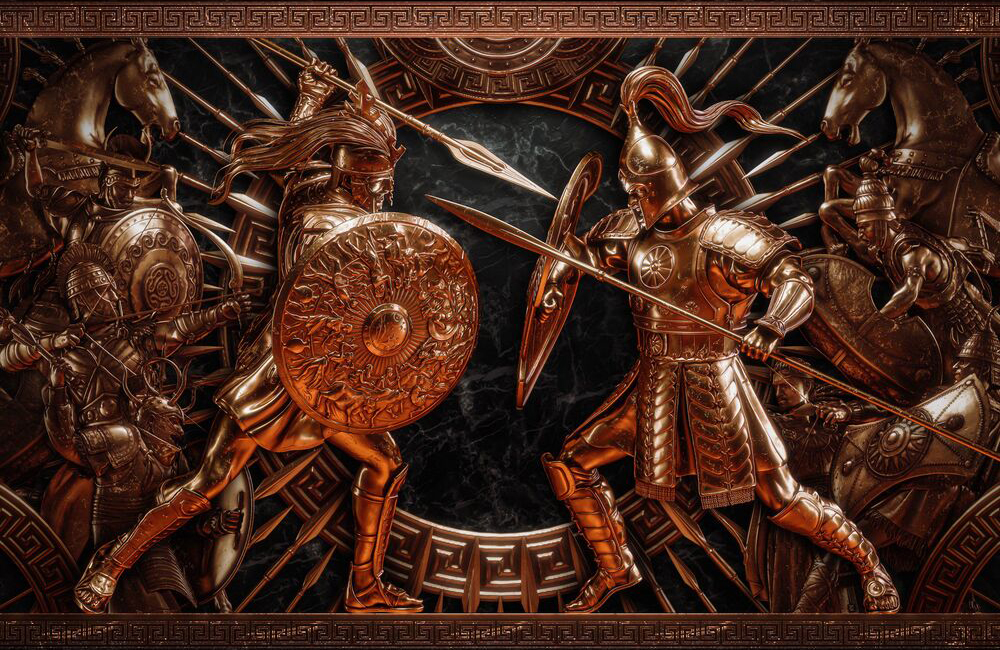
In the first chapter of the book, the author makes the case that, as the title suggests, the heroes of the Iliad can be seen as Indo-European gods. He connects many themes found in the Iliad with themes found in other mythologies. I found this chapter quite interesting. Below are some of the heroes he connects to gods.
Agamemnon – Varuna (The Terrible Sovereign)
Menelaus – Mitra (The Lawful Sovereign)
Ajax – Vayu (The Lord of the Wind)
Achilles – Indra (The Thunderer)
Odysseus and Diomedes – The Horse Twins (Nasatya and Dasra)
Paris – Surya (The Sun)
Hector – Kali (The Demon of the Dark Age)
Helen – Ushas (The Dawn Goddess)
The mythological aspect of the Iliad is intriguing, as is the historical aspect. I am not in a position to make a statement regarding the historicity of the the Trojan War, but it is not far-fetched to assume that the war itself happened and that many of the details surrounding it have their roots in historical facts. This was certainly the view of the German businessman and archaeologist Heinrich Schliemann (1822–1890), who mounted several expeditions in search of Troy. Below is the Mask of Agamemnon, discovered by Schliemann in 1876 at Mycenae. I will comment further upon the Iliad at a later stage.

Warrior Caste vs Priestly Caste
In the chapter The Great Lunar Cycle, under the title of Peredus as Horse Twin, the author discusses a reoccurring theme in various myths – the conflict between the warrior caste and the kingly/priestly caste. This ties into the disagreement between Evola and Guénon mentioned in this book review: Julius Evola and the UR Group – Introduction to Magic: Volume II & III.
Although the disagreement between Evola and Guénon is not strictly related to the context of the chapter in Taliesin’s Map, I thought to mention it since it is a reoccurring topic in discussions regarding religion and tradition.
This conflict appears in the Iliad between Achilles (warrior) and Agamemnon (king) and in the ancient Indian Mahabharata between Arjuna (warrior) and Yudhishthira (king). The author also mentions the legendary third king of Rome, Tullus Hostilius (warrior), who succeeded Numa Pompilius. The former viewed the latter’s pacifism as a weakening of Rome. More examples from the various Indo-European mythologies are given.
Trifunctional Hypothesis
The trifunctional hypothesis of prehistoric Proto-Indo-European society, introduced by French mythographer Georges Dumézil in 1929, postulates a tripartite ideology (in French: idéologie tripartite) reflected in the existence of three castes – kings/priests, warriors, and producers/farmers.
Although the hypothesis has some merit, it does not apply to all Aryan societies. As Evola mentioned in a response to Guénon (read more here), the kings and (later) emperors of Rome simultaneously held the title Pontifex (the highest spiritual authority). Germanic kings were also from the warrior caste.
I mention this here since it can be good to be familiar with this concept prior to reading Taliesin’s Map.
The Ambivalent Nature of the Sun and Sun Gods
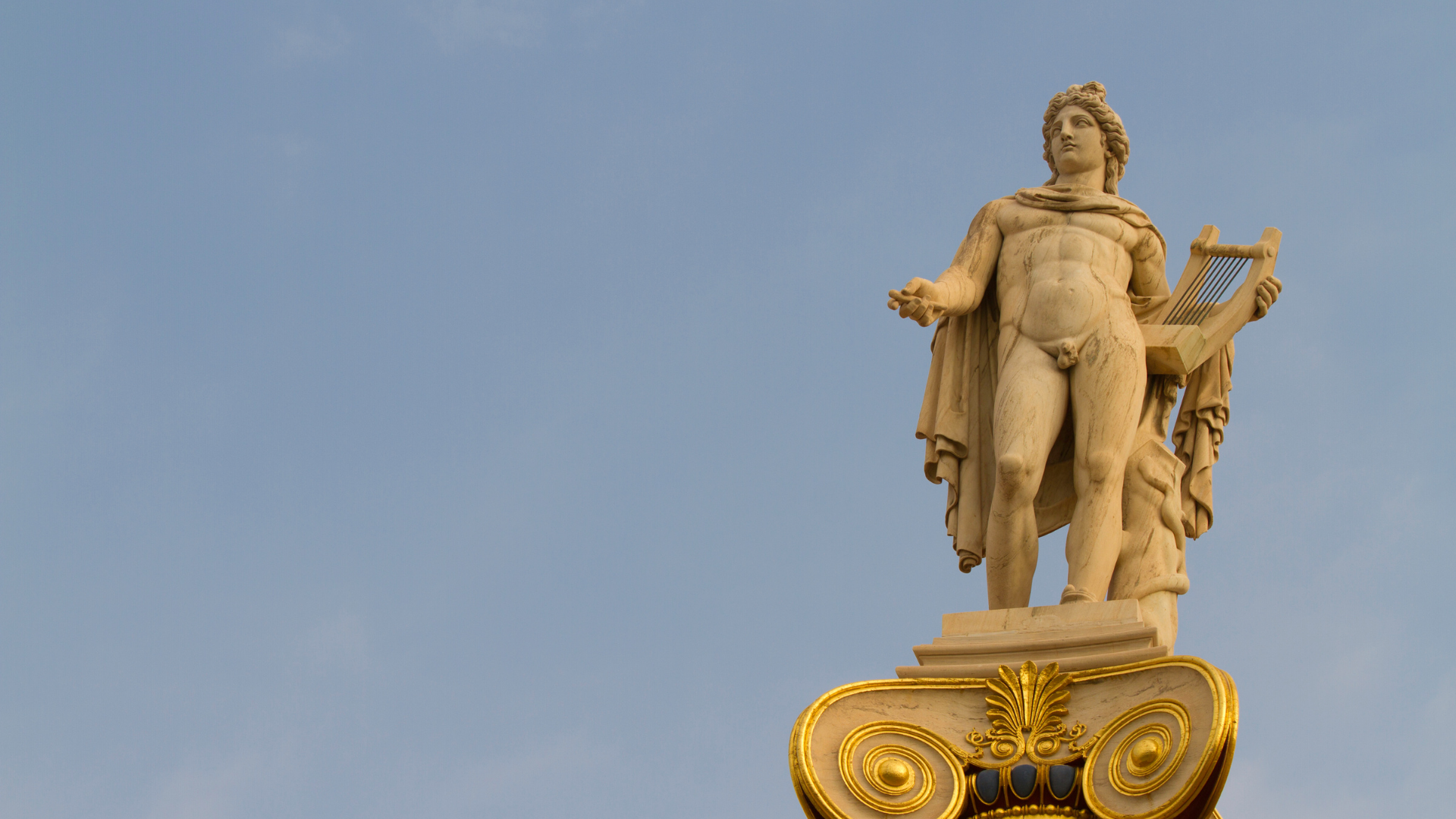
‘The Sun God heroes are always depicted as morally ambivalent, yet highly noble nonetheless. This is due to the way the Indo-European peoples viewed the Sun, as often inhospitable, even abusive, potentially exceedingly destructive, a psychopomp who draws souls down to their fates and then to the land of the dead, and yet as beautiful, life giving, a symbol of intellect and sovereignty, and associated with the elitist esoteric pursuit of immortality. ’
Taliesin’s Map. Page 34.
Over the last while, I have talked quite a bit about solar worship. Worth pointing out is that the Sun can indeed be seen as both benevolent and malevolent. For someone who lives in Scandinavia, it is virtually always benevolent. Especially for the particular Scandinavian phenotype that tans well and gets lighter hair as a result of sun exposure – as I pointed out in the latest Podcast episode when talking about the blessings of solar gods. On the other hand, for a redhead living in California (to give an example), the Sun will most likely not only be seen as benevolent.

The Golden Irish God Bres
‘Then she saw that it was a man of fairest appearance. He had golden-yellow hair down to his shoulders, and a cloak with bands of gold thread about it. His shirt had embroidery of gold thread. On his breast was a brooch of gold with the lustre of a precious stone in it.’
Description of the Irish god Bres. Page 39.
As we have previously noted, any good esoteric book must contain descriptions of golden gods. The context of this passage is in regard to a comparison between an Irish and an Indian myth, where a Sun god makes love to women – in the Irish case, the woman may be a representation of Ireland.
Rome and the Sabine Women
In a the chapter The Great Lunar Cycle, under the title of The Welsh “Aesir-Vanir War”, the author notes that there are similarities between the Welsh myth of the Mabinogi (also called Mabinogion) and the historical-mythic Roman ‘Rape of the Sabine Women’. The story of the Romans and the Sabine women may be a myth, but the story closely aligns with the modus operandi of the Aryan (Indo-European) Koryos – i.e. a band of young men entering a territory, conquering land and women, thus (in some cases) creating a civilisation (in this case Rome).
This is a highly interesting topic that we will return to. To learn more about the Koryos and Bronze Age Europe, I can highly recommend the videos of Dan Davis. Available on Odysee here: Dan Davis Author.
Mithraic Mysteries
By now, we are all familiar with the Mithraic Mysteries. The author begins the chapter The Mithraic Path of Immortality and the Mithraic Mysteries with a reference to an essay by Julius Evola titled The Path of Enlightenment in the Mithraic Mysteries, I will elaborate on this essay in a coming post (or Podcast episode or video). The author notes that there are two extremes in current scholarship regarding the Mithras Cult – one which denies any links to Iranic religion, and one that views it as a direct religious import. He then correctly emphasises the fact that both Roman and Iranian mythology share common Aryan origins:
‘Could it be that the Mithraic mysteries derived their general narrative framework from the archaic Indo-European mythological narrative itself, from the clearly central and important path of the great Sovereign of Justice, the Mitraic god?’
Taliesin’s Map. Page 506.
The deity in question has different spellings: Mithras, Mithra, Mitra etc. Mithras = the Graeco-Roman god. Mitra = the Iranian god. This can be good to keep in mind to avoid confusion!
Conclusion
At 525 pages, reading the book will be a bit of a time investment. Many chapters are also quite technical and detailed – which lends credence to some of the comparisons and takes. However, for someone who is new to this sort of material, it might be overwhelming. I enjoyed reading it and found many of the chapters insightful. If you are interested in mythology, I can recommend it.
You can follow the author at Telegram here: https://t.me/solarcult (the Telegram channel is also worth following).



 The Golden One
You must be logged in to post a comment.