The Nine Doors of Midgard by Edred Thorsson
Posted on July 26, 2022
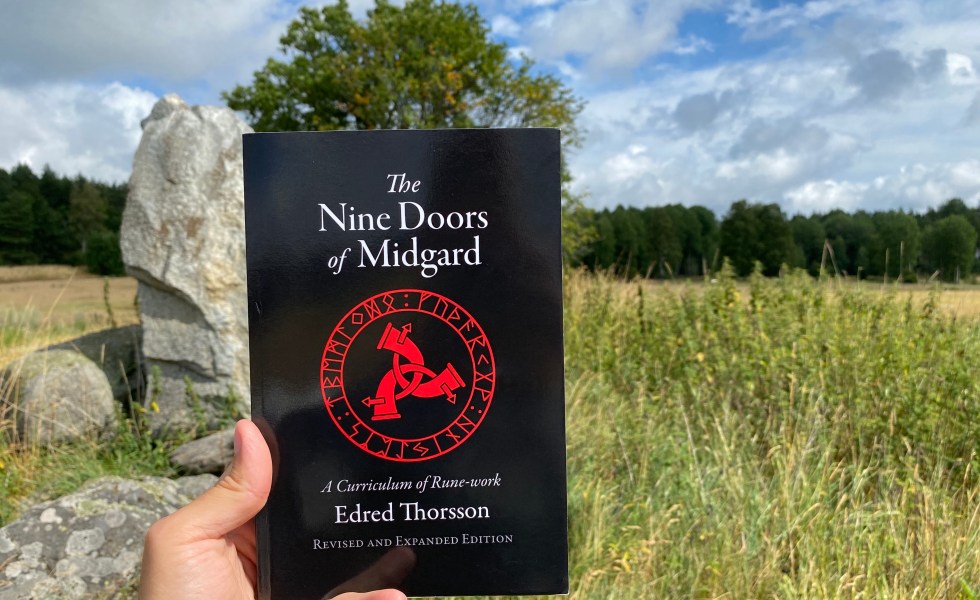
I have read The Nine Doors of Midgard – A Curriculum of Rune-work by Edred Thorsson (Stephen E. Flowers). Reading this was a natural follow-up to the previous books I have reviewed: Icelandic Magic (review), Rune Might (review), and Revival of the Runes (review).
The Nine Doors of Midgard – A Curriculum of Rune-work is, as the subtitle suggests, a guide for practical applications of Rune magic. As I have stated before, I appreciate the amount of practical techniques Flowers presents in his works; I am always in search of techniques I can add to my meditations. Thus, I can, without further ado, highly recommend the book for anyone who wishes to start practising rune magic. For those who are unsure about the term magic, I discuss it briefly in this video: A Heads Up – Also, What Do I Mean By ‘Magic’?
As the title of the book suggests, the curriculum consists of nine doors – each door is a period of training, the training gets more complex for each door (and is dependent upon the training of the previous doors.

The Raido Rune Poem
The author presents a number of rune poems, each gives some insight into the mystery of the corresponding rune. One of the poems dear to my own heart is the following:
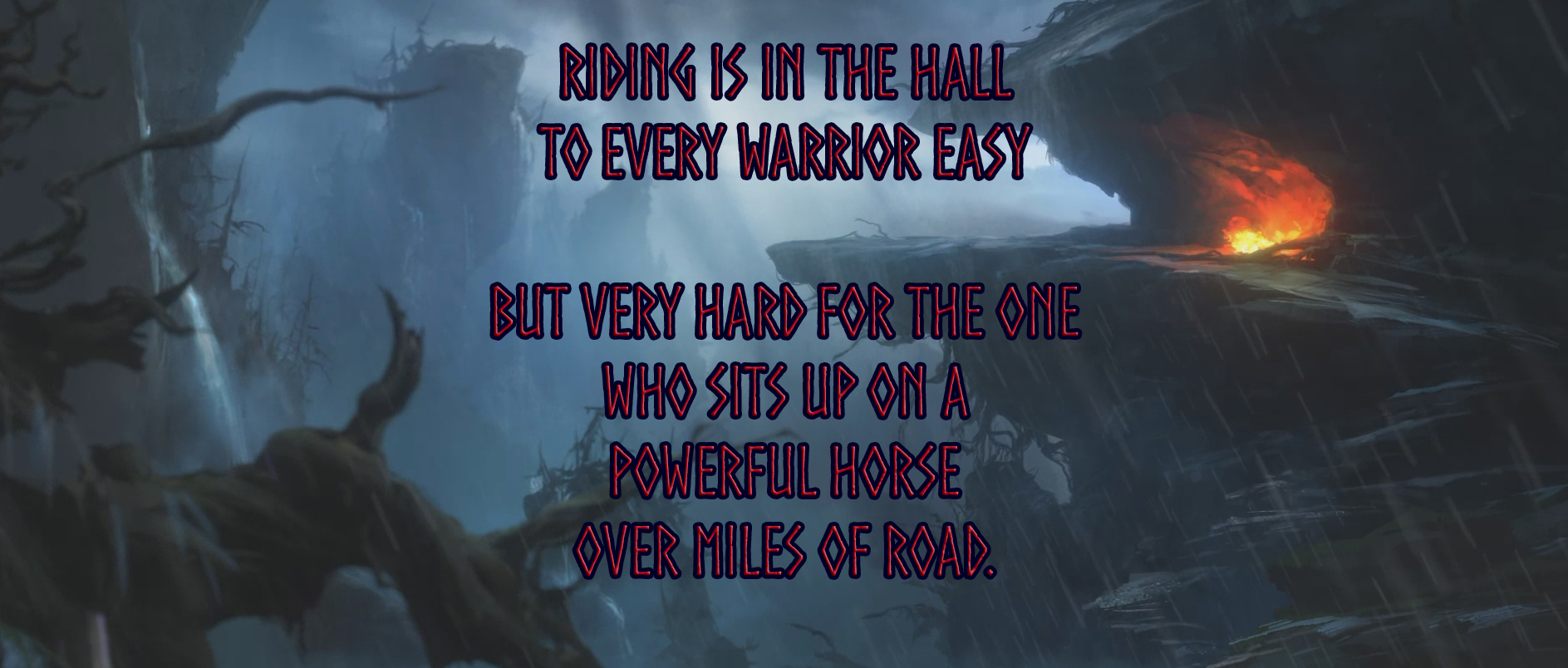
[Radio] Riding is in the hall
to every warrior easy
but very hard for the one who sits up on a powerful horse
over miles of road.
Paul Waggener mentions this poem in his Rune course as well. I, too, appreciate the wisdom in it. The insight is similar to the one presented in the great speech ‘The Man in the Arena‘ by Theodore Roosevelt. In its essence, it highlights the difference between talking about the things you will or could do and actually embarking upon a quest. This poem can be useful to keep in mind when dealing with doubts or detractors. You will find that those who are riding on a powerful horse (i.e. being on their own quests) are not the ones trying to denigrate your own efforts. Keeping this poem in mind is also valuable if you feel like things are not quite going exactly according to plan, they seldom do! As the poem says: riding (being on a quest) is hard. If it is not hard – time to set a higher pace!
A Beautiful Blessing
Under the title The Meal Stave, the author presents the following beautiful blessing to be used for drinks:
‘Drink of power, loaded with the force of life – flow into me and fill my being with energy without bound!’
Edred Thorsson – The Nine Doors of Midgard. Page 32.
As I write this, I am enjoying my daily espresso and decided to bless it with the words above. Blessings like this have the added bonus of bringing gratitude (a high-vibration emotion) to one’s consciousness. In blessing my drink, I appreciate it more. Gratitude leads to happiness.

Biology of the Runes
The following no-nonsense explanation is given regarding the use of the Runes. I have mentioned blood memory in several Podcast episodes, and this ties into the concept quite well:
‘But why the Runes and not Chinese characters or Egyptian hieroglyphics? Most Gilders know the answer here. Because we are of Wōden (descended from him as our ancestral sovereign god-head), it is through his gifts – in their original forms – that we will most easily gain access to the hidden magical realms of ourselves and of the objective universe.’
Edred Thorsson – The Nine Doors of Midgard. Page 42.

Germanic Soul and Metaphysics
The author notes that Asgard is the realm of consciousness and that focus on this realm is the highest form of consciousness. The nine realms of Germanic cosmology are connected to different aspects of the human being; this is a highly interesting discussion, and one that is relevant to many of the workings detailed in the book (I will meditate further upon these concepts and elaborate on them at a later point).
Moreover, he notes that ancient Germanic psychology does not only speak of a single soul but of a number of them, which are connected to the cosmology and together make up a whole person. As we have noted before, the author is not a fan of Christianity, and shares the following critique of the Christian view of the soul:
‘The “substance” in which the Runer works is the soul or psyche. The soul has become less and less well known in our culture as Christianity – with its primitive, unsophisticated, and confused psychology – slowly destroyed our knowledge of our souls and thus of ourselves.’
Edred Thorsson – The Nine Doors of Midgard. Page 22.
On a personal note, I am greatly delighted to have discovered the depth and complexity of ancient Germanic metaphysics. Up until recently, I was unaware of this – thus, I can conclude that it was a good call to follow Odin’s encouragement and continue to seek spiritual wisdom. As I mentioned in a recent Podcast episode, I was hit by a certain energy a while back. The energy caused my hunger for knowledge to increase greatly. I cannot explain it in any other way than as a blessing from Odin.
Becoming familiar with the various realms is important when it comes to the practical applications of the Rune magic, as noted in the quote below. Moreover, this shift of consciousness is sometime the goal with certain meditations.
‘The normal ego-consciousness, the subjective I-focus of the self, is in or near the center of the soul, in or near the Midgard-center. Since this is where the magician normally lives, this is indeed the ideal center for this focus. However, when there is magic to be worked, this center can be shifted from the center to the apex of the soul – to the Asgard-center, if you will.’
Edred Thorsson – The Nine Doors of Midgard. Page 162.
Elemental Breathing
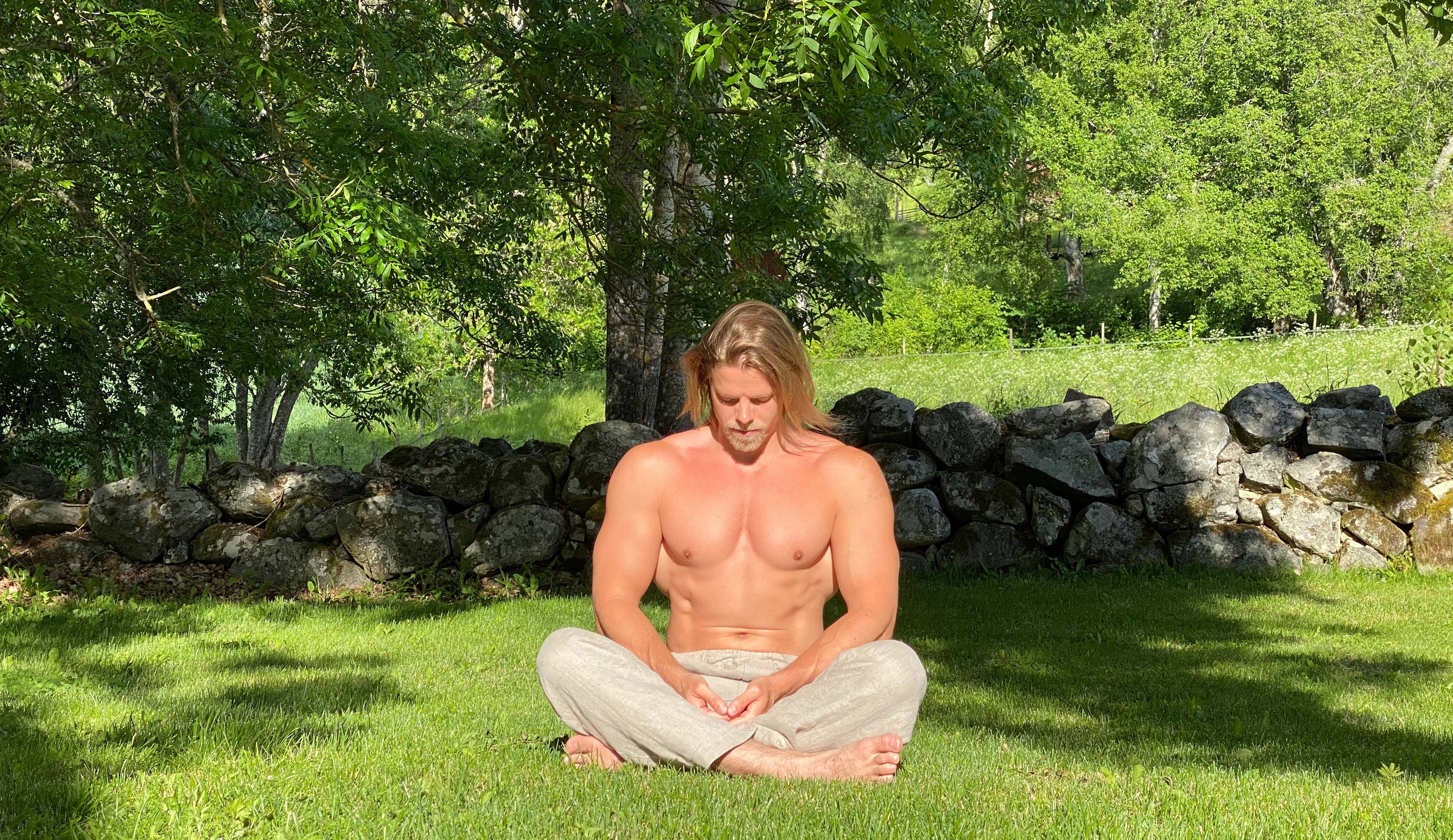
The author presents several useful meditation techniques. One of those is Elemental Breathing, which (briefly summarised) entails visualising yourself being surrounded by a sphere filled with an element (fire, for example). Your body is a vacuum within that space. As you breathe, visualise the element entering you with each breath. Breathe until you have absorbed all of the fire. I will experiment with this meditation both in the Temple of Iron and in other settings.
The author notes that in the Indo-European system (from which the Germanic and Indic systems are derived) breath was considered a source of spiritual power. This is worth keeping in mind when doing pranayama exercises – they are not foreign to us, which can be good to point out should someone say that they belong to another spiritual tradition.
Conclusion
As stated above, I can definitely recommend this book to anyone who is interested in the Runes and/or Germanic cosmology and metaphysics. It contains both interesting insights as well as plenty of instructions for practical applications of Rune magic. I enjoyed reading it and will continue to experiment with the techniques. Thank you, G, for the recommendation.
Onwards and upwards!
Hymns for the Gods – From Olympus to Asgard
Posted on July 21, 2022

I have had the pleasure of reading Hymns for the Gods – From Olympus to Asgard, published by Heliotroph Books. As the title suggests, the book contains hymns to the Graeco-Roman and Germanic Gods. It also contains an insightful introduction in which God, polytheism, metaphysics, and relevant topics are discussed. Thereafter, a number of Gods are introduced and hymns that can be recited (sung) to them are presented. Many of the hymns are quite beautiful, I might add!
‘We affirm that the mystic and perennial truths elucidated by the Orphic, Platonist, Asatru, and Vedic traditions are in fact uniquely and providentially suited to addressing the problems of modernity and post-modernity because they teach us the proper relationship of our selves to our experience, our selves to others, our selves to our spaces, and our selves to their source and cause. They lift our eyes upwards to reveal the fantastic and mysterious motions of the web of forces above us and give us the opportunity to live our lives attuned to that divine clockwork instead of being mindlessly tossed about by it.’
– Hymns for the Gods
Plato’s Tripartite Soul
The author introduces Plato’s theory of the soul, which we encountered in our review of The Practical Art of Divine Magic by Patrick Dunn (as well as in my video: Lose Fat With Plato – Mental Technique to Resist Cravings).
In essence, Plato presents the soul (or psyche) as being divided in three:
- Logos – the rational charioteer. The head.
- Thumos – the white horse of will and spirit. The heart and solar plexus.
- Epithymetikon (Eros) – the black horse of desire. The belly and genitalia.
Note: in my own work, I use the term Thumos to mark spiritedness, the Faustian spirit, the Homeric yearn for glory.

Poseidon’s Prayer
Below is a beautiful prayer that appears in the book (the other prayers and hymns are in a similar style):
‘Poseidon of the waters,
– Poseidon’s Prayer
God who sends the rollings waves,
May you with royal power
Spur my soul to greater works,
And, tireless with stallion’s might,
Grant us lives so full of life,
Abounding with your blessings’

Helios and Julian the Blessed
In the description of Helios, the author notes that Zeus-Helios was the favourite god of Julian the Blessed. Julian is perhaps more commonly known as ‘Julian the Apostate’, which is the name given to him by Christians. Julian was emperor between 361 and 363 CE and attempted to restore Paganism to the Roman Empire (hence the aversion Christians have felt towards him throughout the centuries). Julian the Blessed sounds good, so I will use it henceforth when referring to him.
My Pantheon
On a personal note, Helios has always been close to my own heart. My pantheon is otherwise dominated by Germanic gods. This is something I will elaborate on at length later on, but what we can say for now is that I am, as keen readers of my book reviews may have noted, looking for the Indo-European roots of the gods. Thus, I do not view Helios as a foreign god, nor do I necessarily view some of the Vedic gods as particularly foreign – especially since we noted the following in Revolt Against the Modern World (review):
‘In relation to the Aryan element, in India the attribute used for salvific deities and heroes is hari and harit, a term which means both “the golden one” (in relation to the primordial cycle: Apollo, Horus, etc.) and the “blond god.”’
Julius Evola – Revolt Against the Modern World. Page 245.
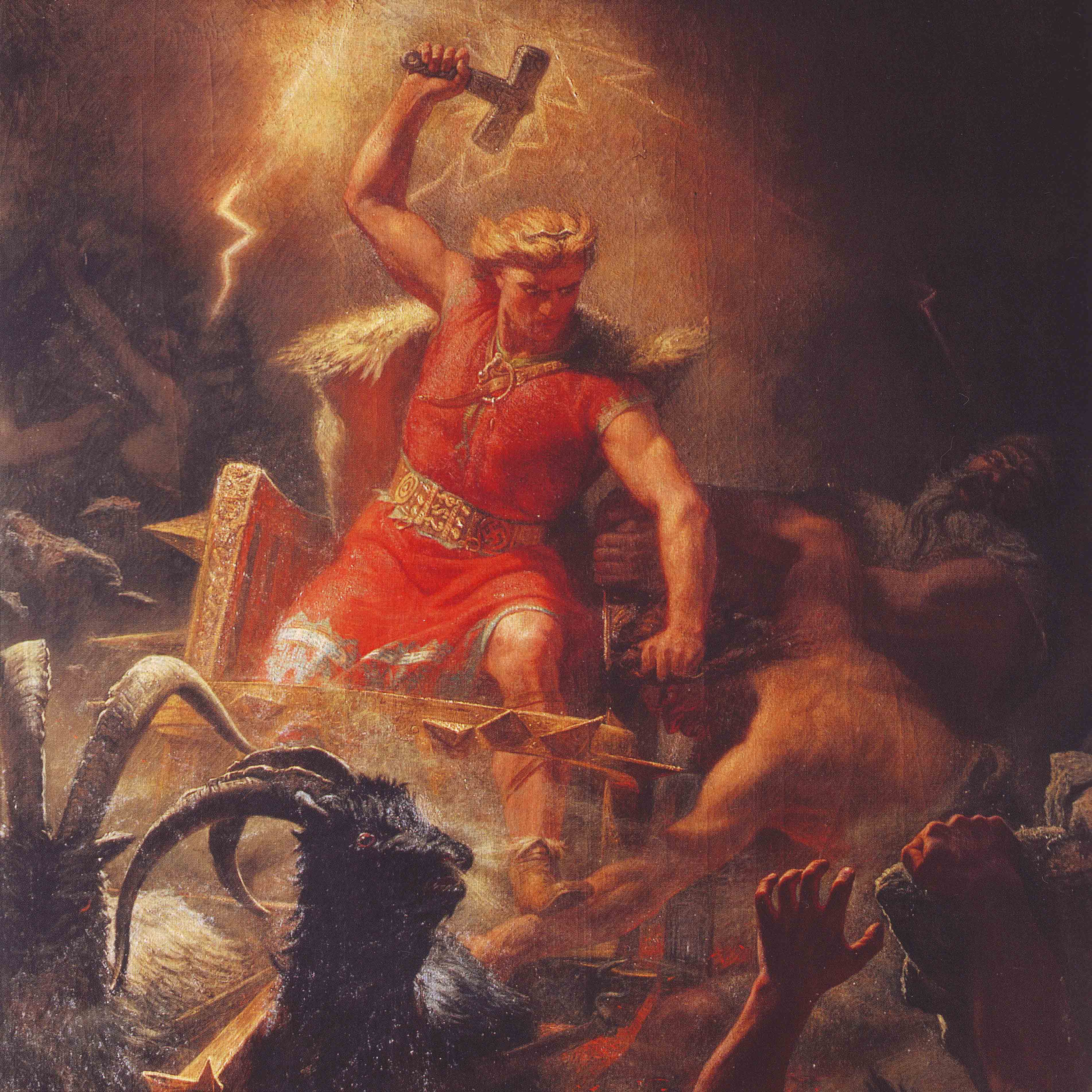
Hermes
In the description of Hermes the Messenger, the author shares the following insight, which I found interesting:
‘As the bridge between higher and lower, matter and Intellect, Hermes is the leader, the serial fountainhead, of Soul in the specifically Neoplatonic sense. This is because Soul is the intermediary between the unchanging Intellect and ever-changing matter and therefore becomes the first layer of godhead which could be said to be mobile, interacting with time and space but not contained by them.’
– Hymns for the Gods
Speaking of the Soul and Neoplatonism, Keith Woods recently made an interesting video on the subject, which can be watched here: The Ascent of the Soul in Neoplatonism.
Conclusion
Hymns for the Gods is rather concise and therefore does not present a great time investment. It can be viewed as a handbook that can be used alongside one’s worship. The cover is also really nice – great work by Brendan Heard of the Aureus Press! I can definitely recommend the book for someone interested in the subject.
Revolt Against the Modern World by Julius Evola
Posted on July 18, 2022 1 Comment
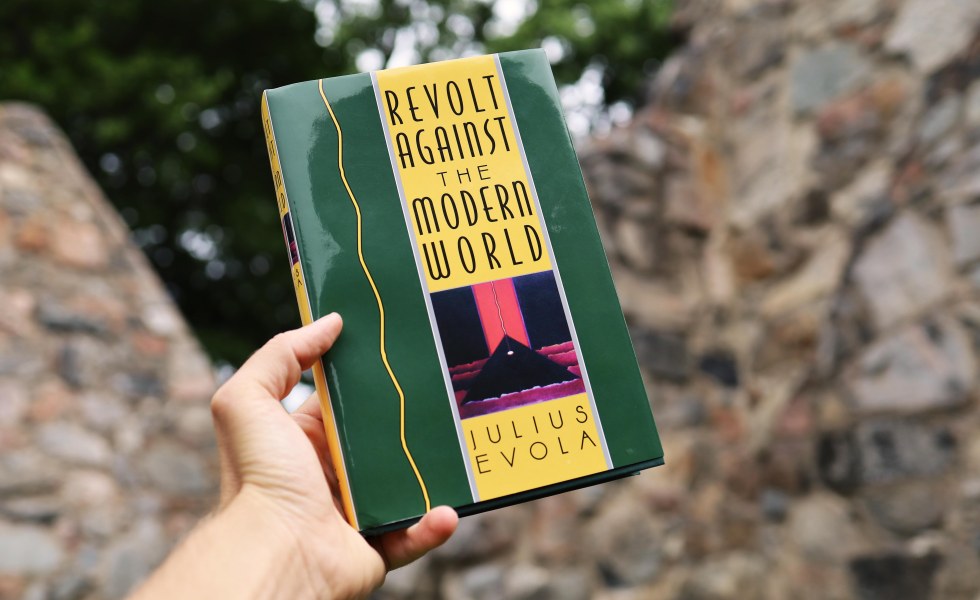
If you have not already read my review of Men Among the Ruins, I recommend that you do so before reading this article, as it contains a more general overview of Evola’s work.
I have read Julius Evola’s magnum opus – Revolt Against the Modern World. Many of the teachings in the book will be familiar for those who have read other works by Evola. If you have not read any of Evola’s books, I would recommend starting with Revolt Against the Modern World, as it gives a good overview of many of the topics which he deals with in more detail in other works.
I asked Modern Platonist, a fellow Evola appreciator, about his top-three Evola titles, and he responded thus: Revolt Against the Modern World, Pagan Imperialism, The Hermetic Tradition. I wrote a review of The Hermetic Tradition but have yet to read Pagan Imperialism. My own top-three titles (at the time of writing this at least) are Revolt Against the Modern World, Men Among the Ruins (review), The Mystery of the Grail (review). That being said, many of his other works contain valuable insights – for those interested in magic the Introduction to Magic books are recommended (review of part one, review of part two and three). Metaphysics of Power (review) is recommended for those interested in his social commentary. I will update this list as I read more of his books!
Below are some insights found in the book. Also, many of the insights found in Revolt Against the Modern World have been the subject of discussion in previous book reviews.
The Crisis of the Modern World
It is clear for anyone to see that something is profoundly wrong with modern society. There are aspects of modernity that are positive, but in order to diagnose the faulty parts, a thorough analysis is in order. Evola, as a critic of modernity, comes in handy in this regard (which is one reason that makes his books relevant today). In order to heal that damaged parts of our time, we need to understand the underlying causes.
This is, of course, a topic that is beyond the scope of this article, but a short summary of some of the issues that plague the modern world could be the following: rootlessness (no sense of belonging), nihilism and materialism (‘God is dead’ in Nietzsche’s words), no sense of purpose or order. A clear symptom of the disease is mindless killings – mass shootings, for example. The number of people on anti-depression medications is also telling.
Vocation and Caste
A good point Evola elaborates on is that of vocation and caste. In the days of old, a young man could find a certain safety and belonging in simply following in his father’s footsteps. The cobbler’s son grew up to become a cobbler. The farmer’s son to be a farmer. The merchant’s son to be a merchant. Perhaps this did not always leave much in the way of upward mobility, but at least it gave people a sense of belonging. Contrasted with today’s rootless society, where a young man is considered lucky to even have a father.
In regard to vocation, it could be said that there is a certain beauty and purity in not only having a profession, but having a vocation. Imagine the medieval blacksmith whose vocation it was to be a blacksmith – he could seek perfection within his trade. This is, of course, possible for some people today as well, which is good, but for many it may be hard to find such vocation – especially since no clear guidelines are given when growing up.
In regard to caste, it can be good to point out that being of a lower caste is not bad – what is bad is to be casteless (an outcast). Evola discusses caste at length in the book (and touches on the topic in other books as well).
In the chapter titled The Doctrine of the Castes, Evola includes the following insightful quote from Plato:
‘If we say that people of this sort ought to be subject to the highest type of man, we intend that the subject should be governed not to his own detriment but on the same principle as his superior, who is himself governed by the divine element within him. It is better for everyone to be subject to a power of godlike wisdom residing within himself, or failing that, imposed from without.’
Plato – Republic
This is a good quote to remember when pursuing excellence – be governed by the divine element within yourself!

The Golden One
To my great delight, I noted the following passage in the chapter titled Tradition and Antitradition, which I thought would be interesting to share:
‘In relation to the Aryan element, in India the attribute used for salvific deities and heroes is hari and harit, a term which means both “the golden one” (in relation to the primordial cycle: Apollo, Horus, etc.) and the “blond god.”’
Julius Evola – Revolt Against the Modern World. Page 245.
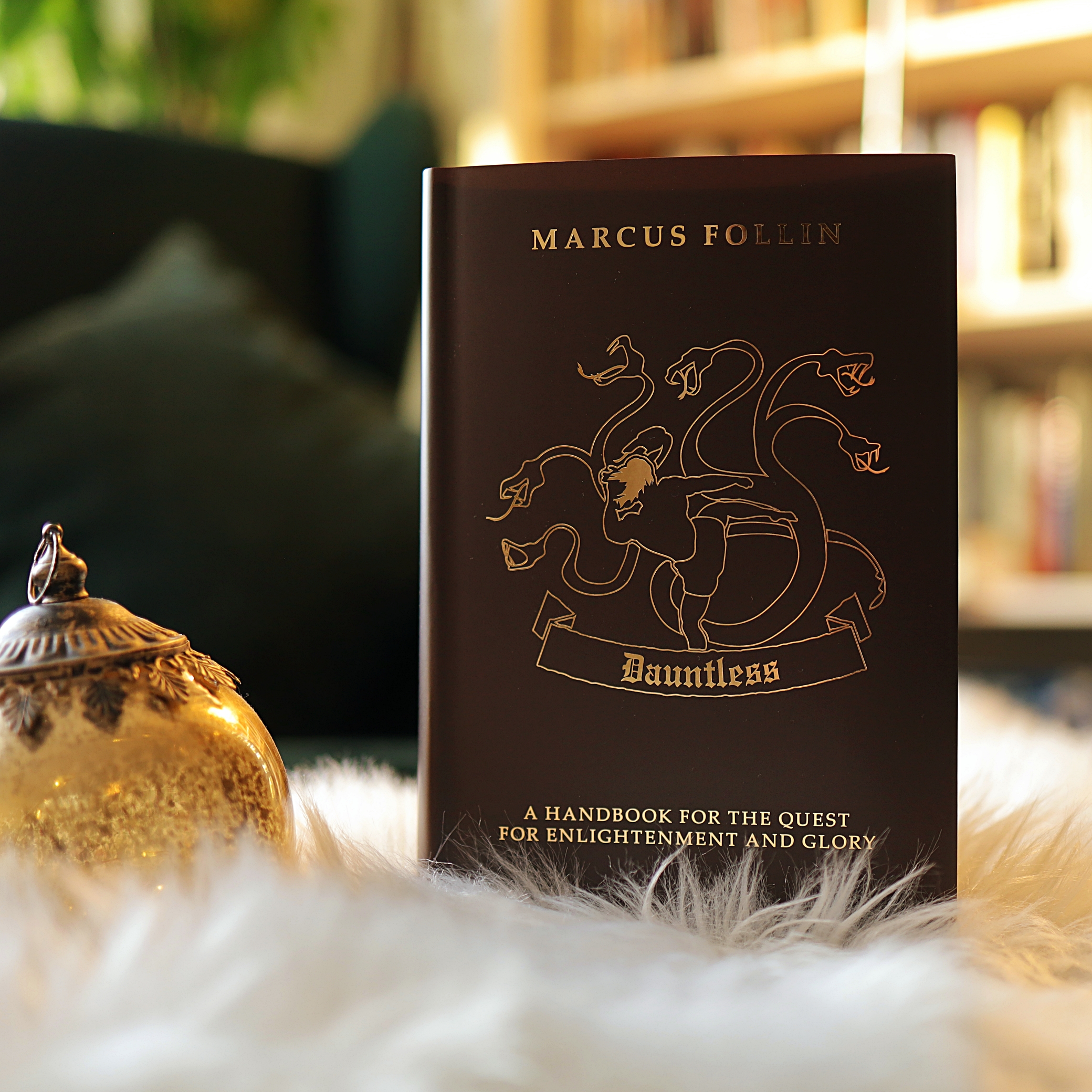
Note: I claimed the title of The Golden One in 2014 and not in relation to this passage by Evola. I will elaborate on this in my coming book.

Saint Bernard and Germanised Christianity
In the chapter titled The Greater and Lesser Holy War, the following beautiful quote appears:
‘Whether we live or die, we belong to the Lord. What a glory it is for you to emerge from the battle crowned with victory! But what a greater glory it is to win on the battlefield an immortal crown… What a truly blessed condition, when one can wait for death without any fear, yearning for it and welcoming it with a strong spirit!’
Saint Bernard – De laude novae militiae
This quote illustrates quite clearly the Germanisation of Christianity, something Evola discusses in several books. Many of the thoughts in the chapter are elaborated on in the book Metaphysics of War. I have not reviewed it, but I refer to it in Dauntless. In the quote above, it is clear that Saint Bernard is invoking a Pagan warrior-spirituality.

Overpopulation
In the chapter titled The Decline of Superior Races, Evola discusses the issue of overpopulation. The chapter begins thus:
‘The modern world is far from being threatened by the danger of underpopulation /…/ The truth is that we are facing an opposite danger: the constant and untrammeled increase of population in purely quantitative terms.’
Julius Evola – Revolt Against the Modern World. Page 167.
The topic is as relevant today as when Evola wrote the book. There is, of course, the issue of low European birth-rates. However, the focus must not be taken away from the real issue at hand – mass immigration into Europe from the Third World. When looking at humanity as a whole, it is hard to find a compelling argument as to why more humans would be desirable. A sound eco-system, clean rivers and oceans, a thriving wild-life; these are desirable – and an increasing human population stands in opposition to this.

Conclusion
As stated in above, Revolt Against the Modern World is Evola’s magnum opus, and makes for a great introduction and overview of his teachings. At 369 pages, it will take its time to read through but it is time well spent.
Men Among the Ruins by Julius Evola
Posted on July 6, 2022
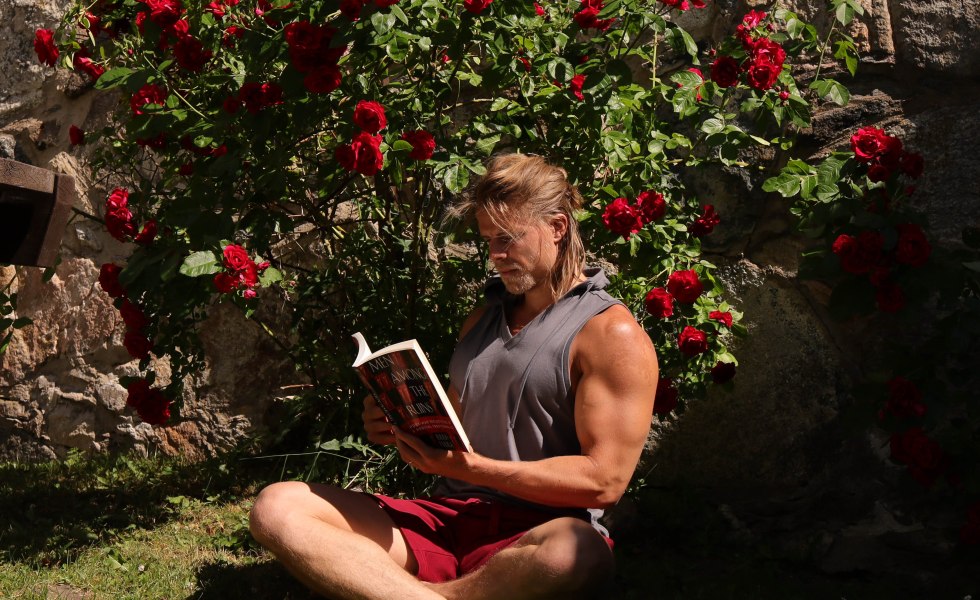
I have read Men Among the Ruins by Julius Evola. Written after the Second World War as a commentary on social, political, and historical matters, it contains many interesting insights. Some have labelled Evola’s post-war writings as ‘black-pilled’ (i.e. negative and defeatist); I did not get this impression upon reading it. Instead, I found it to be a reasonable and measured observation of the world at the time. Compared to Ride the Tiger, Men Among the Ruins is, in my opinion, much better. Below are but a few of the interesting insights found in the book.
My Critique of Evola
Since I have reviewed and referred to Evola quite many times over the last year, I deem it necessary to point out a few things. Firstly, I am mainly interested in his teachings that pertain to matters of the spirit. I believe that Evola as a spiritual seeker has few rivals. As for his social and political commentary, they do not necessarily align with my own. Therefore, it is good to point out that those who are sceptical of his social commentary would do themselves a great disservice by not reading his esoteric works because of said scepticism.
I sometimes see young men invoke Evola as a way to be ‘uniquely radical’ or as a way to side-step accusations of being a Fascist. Moreover, to my great lament, I often see said younger men refer to Evola or other thinkers of the Right (of the German Conservative Revolution, for example) as a way to ‘look down’ on the ‘Plebs’ (especially in regard to Nationalism). I find this unwarranted sense of superiority laughable. I also find the disdain for one’s own people to be incongruent with the sense of love for one’s own that should be a driving force for any champion of Mother Europa – or any Nationalist for that matter. I am certainly frustrated with Europeans in general and Swedes in particular from time to time, but I still love them (again, the Swedish people in particular).
Moreover, I am a man of the people (of the middle class* that Evola so despises) and a man for the people. I am, of course, also an Aristocrat of the Soul, and I aspire to become what I refer to in Dauntless as a man of a new Countryside Aristocracy. Furthermore, I am, as I have mentioned before, an aspiring Enlightened Despot. I point this out so that no one will mistake my enthusiasm for Evola’s teachings with a disdain for my own people or for Nationalism (note: I do not refer to myself as a Nationalist to the initiated, as explained in Podcast Episode 7. Europa).
*The middle class is very broad in Sweden, Swedish society also has a certain level of upward mobility – both of these factors are aspects that I view as beneficial for the well-being of the people.
There are, of course, other aspects of Evola’s teachings which I do not endorse. I understand that you, my dear reader, understand this – I am merely pointing it out should nefarious elements seek to misrepresent my own teachings. To give an example, Evola would classify boxing as a vulgar display of American degeneracy (I am paraphrasing him here – he writes about this in The Bow and the Club). Had he been alive to witness the rise of MMA, he would most likely have labelled it as even more barbaric! And I do, as you know, recommend MMA (including boxing) as a form of training.
Furthermore, I am not opposed to Bonapartism or Caesarism (although Rome saw its glory days during the Republic). I am not opposed to a strong monarch with the love and support of the people. For more information about this subject, I wrote a short review of Two Models of Government by Dr Michael Arnheim. Moreover, in Metaphysics of Power, Evola voices his reservations about France’s Philip the Fair – the critique is not only based on Philip’s attack on the Templars, but also because he centralised power (at the expense of the aristocracy). I see no issue in Philip centralising power in this manner – heroic king Gustav Vasa of Sweden did the same. Perhaps I will elaborate on this topic at length in a coming Podcast episode!
Powerful Women – the High Priestess
Although not necessarily related to Men Among the Ruins, a common theme in Evola’s books is the dichotomy of the chthonic Earth Mother and the celestial Olympian Father.
Perhaps some would interpret Evola’s teachings as being hostile to women. Although I would not necessarily agree with this, I would like to note that Evola (from what I have gathered thus far) does not highlight certain powerful feminine archetypes – such as the High Priestess or the Queen. Although this is a topic that lies beyond the scope of this book review, it is good to note that there are archetypes a woman can strive for within a Traditional setting. Traditional here denotes eternal metaphysical principles – and not ‘Trad’ (which has become a bit of a ridiculous meme at this point). In essence, a High Priestess or Queen can become powerful via the love and loyalty she inspires in the men of the tribe or nation. This love and loyalty can be based on many different factors – on a more local level, it can be based upon favours and kindness. To give an example (that is not necessarily related to the archetypes of the High Priestess or the Queen): the gentle grandmother who is kind to her grandson and his friends (inspiring love). When they are young men she will potentially have a Männerbund to call upon should she be in danger.
Modern culture has made a mockery of feminine power – portraying women as having masculine power is only obnoxious and can, in some cases, present a young woman with a false sense of security, and it will certainly deprive the woman of any true power (based on love) she could have.
A powerful woman is not a ‘girl-boss’ that no one likes (let alone loves), nor is it someone who tries to emulate masculine archetypes (i.e. a Warrior). A powerful woman is the beloved Queen, Mother, and Priestess that can call on the loyalty of men who feel love (non-sexual) for her.
Lastly, an obvious example is, of course, the Mother, who can count on the loyalty of her sons and daughters.
Note: Evola discusses the role and archetypes of women in Revolt Against the Modern World (which we will review at a later point).

Evola and Christianity
Since I have mentioned some disagreements above, I thought it would be reasonable to also share something in particular that I appreciate with Evola. His view of Christianity is very measured and reasonable – and matches my own to a large extent (my views have, it must be noted, been influenced by his in this matter). Although not strictly related to any chapter in Men Among the Ruins, I deemed it reasonable to elaborate on this here.
A superficial critique of Christianity is often accompanied by a view in which Christianity and Paganism are seen as two competing sport-teams. A person harbouring said such superficial view of the matter could ask:
‘How can you admire the Teutonic Order that fought against Pagan Lithuanians?‘
Those who harbour these sentiments fail to realise a historical truth – that Europeans have fought in countless wars against each other since time immemorial. Is it right or is it wrong? It is what it is. At the present moment, it is good to promote a sense of European unity. But it is not reasonable getting upset over medieval conflicts.
The Teutonic Order, the Templars, and the Hospitallers are worthy of admiration because of the heroic ideals they embodied. These orders expressed themselves in congruence with the Indo-European spirit – the spirit of the initiatory Männerbund. I admire these orders because of this. That they wore crosses does not bother me – the Swedish flag also has a cross on it; I still find it beautiful.
Thus, the superficial critique of the Teutonic Order, the Templars, or Hospitallers would be to point to their crosses and say that they were on ‘Team Christianity’ (i.e. as in the view of the aforementioned sport teams).
In the notes (page 306) of Men Among the Ruins, the following is noted: ‘Concerning the Knights Templar, they had their own initiation and esoteric doctrine, reserved to higher degrees, which were not reducible to the mere Christian religiosity fostered by the Church.’ This can explain why Evola liked the Templars, despite not liking Christianity.
Evola During WW2
In the introduction of the book, Dr. H. T. Hansen notes that Evola wanted to fight on the Eastern Front against Bolshevik Russia. However, since he was not a member of the Fascist party, his application was delayed again and again, and even upon declaring his willingness to join the party (to be able to join the war effort), he was declined. He had many enemies in the party – which is perhaps not so surprising given his rather confrontative nature and his critical view of Fascism. Evola fought as an officer during the First World War, and his status as belonging to the Kshatriya (Warrior caste) is beyond dispute. I mention this here to emphasise the fact that he was someone who lived in accord with his teachings. This is, in my humble opinion, an important aspect to look at when judging any philosopher.

Mana
In the chapter Personality – Freedom – Hierarchy, the following interesting passage appears:
‘Ancient primitive man essentially obeyed not the strongest members of society, but those in whom he perceived a saturation of mana (i.e., a sacred energy and life force) and who, for this reason, seemed to him best qualified to perform activities usually precluded to others.’
Julius Evola – Men Among the Ruins. Page 142.
I thought it would be interesting to share for my esteemed Podcast subscribers. In Episode 23. Beauty, I noted that Achilles must not be portrayed as a mere brute (as in Total War Saga: Troy) – but as a divinely blessed specimen with great martial prowess, but also full of charisma. Certain men have an ‘it’-factor; this ‘it’-factor can be explained as being saturated with mana, as mentioned in the quote above. This is a deep and interesting subject that we will return to in coming Podcast episodes as well as book reviews.
Nordic-Aryan – Indo-European
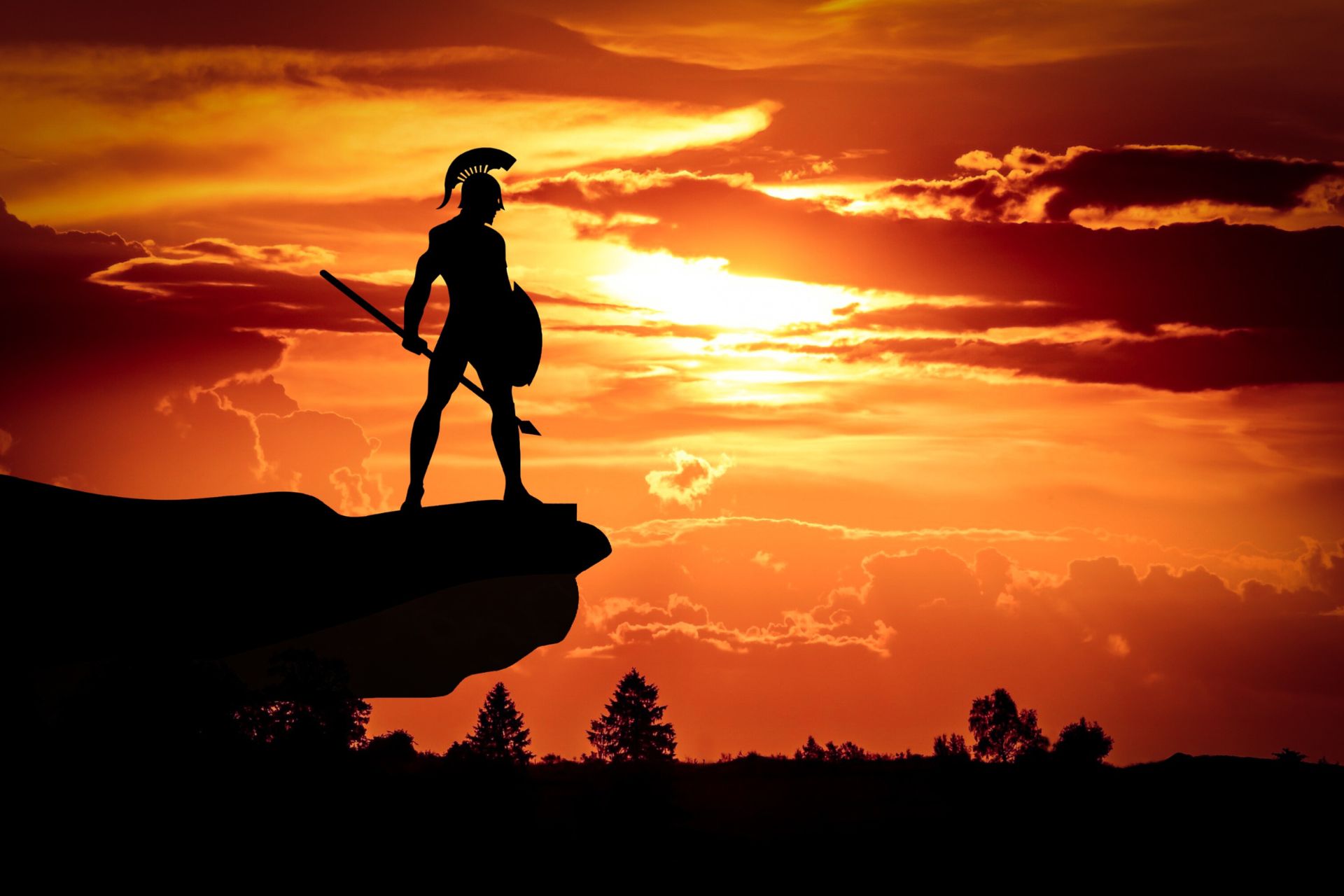
Evola often returns to the Aryans, which is the word he uses for Indo-European – the term I use (to avoid confusion). He defined the term thus:
‘It must be realized that in modern racial studies, “Aryan” and even “Nordic” do not in fact mean German; the term is synonymous with “Indo-European,” and is correctly applied to a primordial, pre-historic race from which were derived the first creators of the Indian, Persian, Greek, and Roman civilizations, and of which the Germans are only the final adventitious branches.’
Julius Evola’s Autodifensa (Self-Defense Statement in court during a trial in 1951 – found in the appendix of the book).
Evola expressed a wish for Italy to reaffirm the Roman (Aryan) spirit as opposed to the ‘degenerated’ (his word) Mediterranean (Pelasgian) spirit. This was, as one can imagine, a quite controversial statement in the biologically heterogenous Italy of the post-war period. This, in addition to his affinity for Germany, landed him in trouble after the war. In several of his books, Evola emphasises the Indo-European blood and spirit. As we saw in our review of The Doctrine of Awakening:
‘We have to remember that behind the various caprices of modern historical theories, and as a far more profound and primordial reality, there stands the unity of blood and spirit of the white races who created the greatest civilizations both of East and West, the Iranian and Hindu as well as the ancient Greek and Roman and the Germanic.’
Julius Evola – The Doctrine of Awakening. Page 14.
Moreover, some people associate the term Aryan with certain features (blond hair and light eyes for example). While it is true that many of the Indo-European tribes (the Dorian Greeks, for example) frequently had these features (as is evident in both DNA studies as well as in how the Ancient Greeks depicted their Gods and heroes), it is important to recognise that said features are not necessarily indicative of Indo-European-ness (Steppe ancestry, to be even more precise), and a lack of said features does not mean a lack of Indo-European blood.
Furthermore, it is reasonable to point out that the Indo-European (Aryan) origins of Roman and Hellenic greatness is a rather controversial topic, and it is not uncommon to see non-European Mediterraneans (i.e. individuals from the Near East) claim a closer kinship with ancient Greece and Rome than what Northern Europeans have. This video illustrates clearly that these claims are incorrect: JIVE TALK: Ancient DNA news: Greece and Italy. In regard to a metapolitical analysis as to why these faulty claims are made, one could say that it is both an attack on European Unity (in this case, north–south) and European (White) identity as a whole.

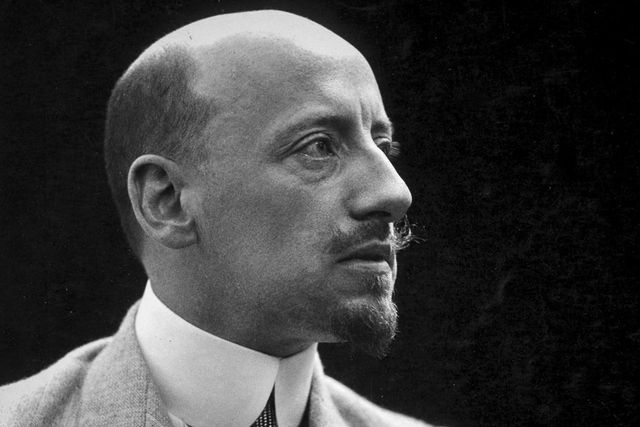
Gabriele D’Annunzio
On a personal note, I do not use the term ‘Mediterranean’ (since it is often misused), and I am not as critical of certain Mediterranean elements as Evola is – he goes quite hard against them in Men Among the Ruins. Evola notes the following:
‘In the Mediterranean man there is a splitting between an “I” that plays the role and an “I” that regards his part from the point of view of a possible observer or spectator, more or less as actors do.’
Julius Evola – Men Among the Ruins. Page 142.
Evola accompanies this passage with a footnote which reads as follows:
‘D’Annunzianism is one of the most characteristic phenomena of the “Mediterranean” style in regard to this particular trait. This is true when we consider not just an artistic component, but the overall style that Gabriele D’Annunzio exhibited in his life, even as a leader and a soldier.’
Julius Evola – Men Among the Ruins. Page. 310.
In my humble opinion, Gabriele D’Annunzio embodied an Indo-European (Faustian, Aryan) spirit of greatness. His character can also be explained by the fact that he was an artist. Moreover, I must admit that D’Annunzio is an inspiration of mine, and a man I hold in high regard. This is not to say that I endorse everything he did – this is, of course, obvious to any of my regular readers, but I thought to point it out anyway for good measure.
The following quote by Yukio Mishima comes to mind when contemplating the life of Gabriele D’Annunzio.
“Perfect purity is possible if you turn your life into a line of poetry written with a splash of blood.”
– Yukio Mishima,
Germany and Italy – The Holy Roman Empire
As we saw in our review of The Mystery of the Grail, a topic Evola often returns to is the medieval conflict between the Guelphs (the pro-Pope faction) and the Ghibellines (the pro-Emperor faction). Understanding Evola’s view of this conflict is the key to understanding his view of a great many other things – his positive view of Germany, for one.
Certain Italian Nationalists (contemporaries of Evola) viewed the Germans (during the Middle Ages) as foreign oppressors. Evola, on the other hand, viewed the Holy Roman Empire as the legitimate spiritual successor of Rome. He also viewed the Ghibelline Middle Ages as a spiritual high-point. The following quote illustrates this quite well:
‘Frederick I fought against the Communes not as a Teutonic prince but as “Roman” emperor, upholding the supernational and sacred principle of authority that was exclusively derived from his qualification and function.’
Julius Evola – Men Among the Ruins. Page 184.
I will elaborate on this at length in my coming book, but a short summary of my not-yet-complete analysis is the following: Primacy amongst Indo-Europeans has gone from culture to culture. At one stage Sparta had it, thereafter it went to Alexander’s Macedon, thereafter to Rome, thereafter the Goths gained it, thereafter it went to Charlemange’s empire, and so on. Our quest today is to reawaken the spirit.

Imperium Europa and Christianity
Evola discusses Imperium Europa in Men Among the Ruins. This is, of course, a topic that is as relevant for any European gentleman today as ever. I discussed it in Podcast Episode 7. Europa and will return to it in coming episodes as well.
Evola notes that Christianity cannot be the unifying factor for Europe. The reasons for this are, among others, that:
- Catholicism is the faith only in some European nations.
- Becauce of the desacralisation and secularisation that has occurred in Europe.
- Because of Christianity’s universal nature.
These are all valid points. Perhaps a return to Paganism is the most reasonable course of action. Not the superficial Paganism – i.e. the other ‘sport team’ that we mentioned above in regard to the attitudes of some anti-Christians – but rather a sincere and solid foundation based on shared Indo-European metaphysics and the wisdom of Plato. I am not yet wise enough to set a clear course in this matter, so these thoughts are still in development. Moreover, to elaborate fully on these factors lies beyond the scope of this review.
Male Initiation
Evola discusses the important concept of male initiation. We have encountered the topic before, most notably in our review of Kris Kershaw’s The One-eyed God and the (Indo)-Germanic Männerbünde. The following quote illustrates this quite well:
‘In fact, prior to this initiation, the member of the group, no matter what his age, was believed to belong to the same category that included women, children, and animals. Once the transformation occurred, the individual was incorporated into the Männerbund.’
Julius Evola – Men Among the Ruins. Page 125.
Conclusion
Men Among the Ruins is a great book to read for those who wish to get a good view of Evola’s Weltanschauung. The edition I read by Inner Traditions (published in 2002) is 310 pages and includes a 106 pages long preface by Dr. H.T. Hansen as well as Evola’s Autodifensa.



 The Golden One
You must be logged in to post a comment.