Rune Might by Edred Thorsson (Stephen E. Flowers)
Posted on May 18, 2022

I have read Rune Might by Edred Thorsson – which is the pen name of Stephen E. Flowers. I first encountered his writings a while back when reading Icelandic Magic (read my review of it here: Icelandic Magic by Stephen E. Flowers), which I found highly interesting. Therefore, I decided to continue along the same path by reading this book. Gaining more insights into the runes also comes at a good point since I am currently meditating upon the Elder Futhark (as discussed in this video: Esoteric Masters – Vital Elements Review).
Just as Icelandic Magic, Rune Might contains plenty of practical instructions, which is great. There is plenty of theory to be had, and I suppose that you, my dear reader, are more interested in the practical applications of magic. This is definitely true for me – I aim to increase my knowledge of esoteric matters in order to set a higher pace in my great quest.
The Elder Futhark
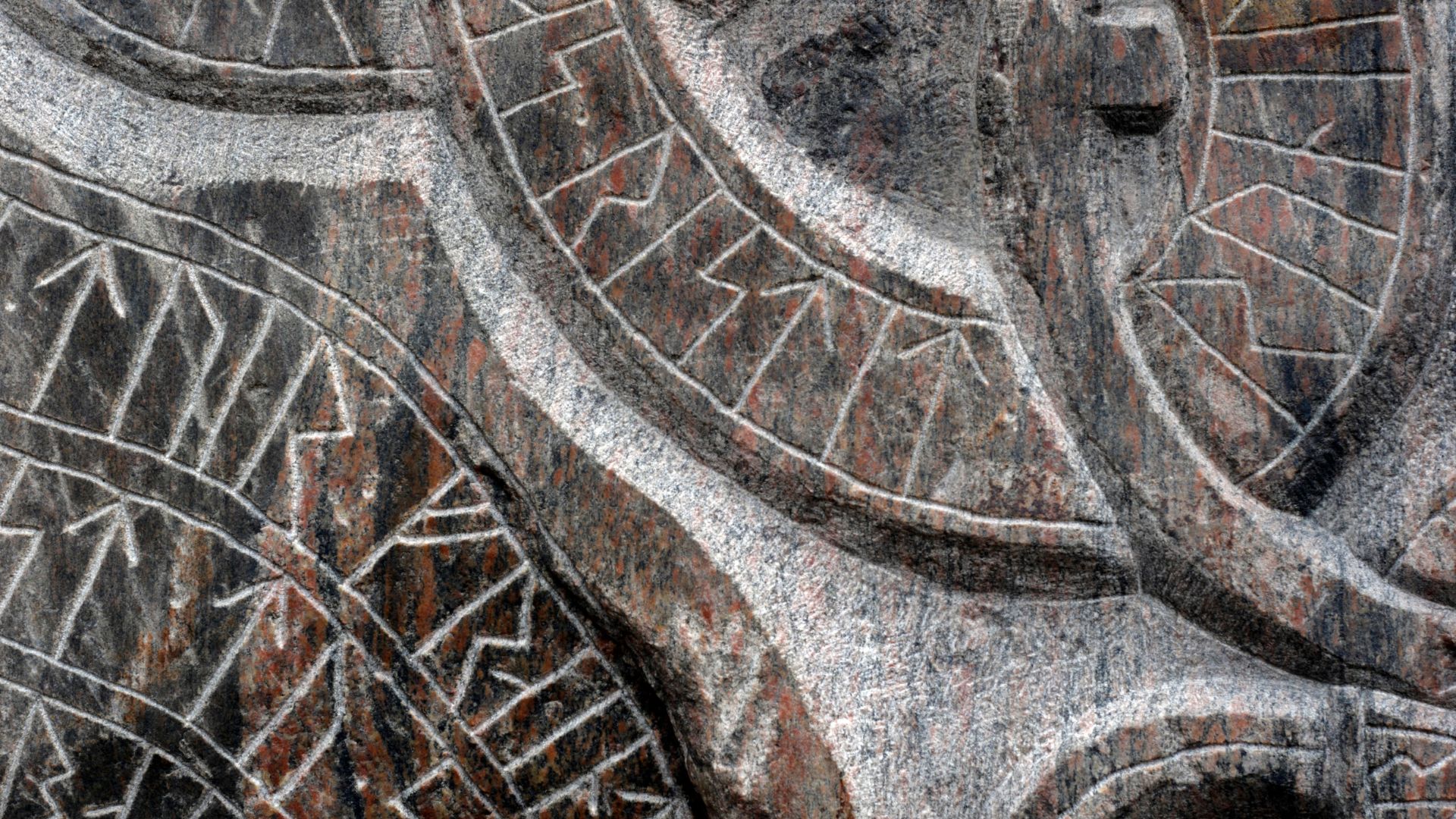
The author presents the traditional runic systems, which are the following: the Elder (Older) Futhark (pictured below), the Anglo-Frisian Futhorc, the Younger Futhark, and the Armanic Futhork. The name Futhark simply comes from the sounds of the first six runes in the rune row (of each system respectively), as presented below:
- Fehu (f)
- Uruz (u)
- Thurisaz (th)
- Ansuz (a)
- Raido (r)
- Kenaz (k)
The Frisian Futhorc (33 runes) and the Armanic Futhork (18 runes), although similar to the Elder Futhark, present some of the runes in a different way, in addition to not containing the same number of runes. The Younger Futhark (16 runes) is simply a shortened version of the Elder Futhark (24 runes) and came into use during the Viking Age (around 800-1100 CE). Much more can be said about this, but on a personal note, I will mention that it is the Elder Futhark that I am meditating upon (I will return to this topic once I have meditated upon all runes therein).

Gothicism
In the introduction, the author introduces the concept of Storgoticism – Megalogothicism (stor = grand in Swedish) which was a popular cultural movement during the zenith of Swedish power (mainly the 17th century). He erroneously states the following, however: ‘the esoteric doctrine that the Goths (wrongly assumed to be the same as Swedes) were the once and future master race.‘ I was surprised to find such an obvious fault in the work of an otherwise excellent scholar. The Goths did, in fact, originate in Sweden, more specifically from the region of Götaland. The sacred island of Gotland shares a similar name. Survive the Jive elaborates more on the origins of the Goths at the end of this video: JIVE TALK: Ancient DNA news: Greece and Italy.
It must be noted though, that during the Gothic migration down through Europe they absorbed the DNA (primarily maternal) from other tribes they encountered – in true Indo-European fashion! We will return to the topic of the Goths in coming reviews and Podcast episodes.

German Esoteric Masters
In the chapter titled The High Tide of Rune Magic, the author presents a cast of characters that were important to the runic renaissance that took place in Germany during the early 20th century. As I have noted before, it is always interesting to read about the lives of the men whose teachings live on. I found an inspiring passage about one them – namely, Rudolf von Sebottendorf, who ‘traveled in various dark corners of the world collecting arcane lore.‘ Just reading that sentence conjures up the life-affirming spirit that European man needs today. Reading that passage certainly increased my own motivation for pursuing my arcane studies!
The author also presents Arnold Krumm-Heller, one of the most unique rune-crafters of the runic resurgence. Krumm-Heller went to Latin America (Chile, Peru, and Mexico) on a secret military mission in 1894. In Mexico he began his studies of the occult. He would go on to have an adventure-filled career too long to cover here. I note this to emphasise the fact that the occult has attracted men of power (in case anyone believed it was reserved for low-thumos men). The book introduces several other interesting esoteric teachers – an important one of those was a man named Guido von List (whom we shall return to in coming reviews).
Rune Yoga
In chapter 7, the author introduces the concept of rune yoga, which I found interesting since I have, as you most likely know, practiced yoga (i.e. mobility exercises) and meditation for quite some time. A number of postures and exercises are presented (some of which I will endeavour to experiment with in the coming time) with accompanying sounds and purposes (esoteric purposes as opposed to the yoga used for mobility).
It is noted that the best results are attained when the practitioner does the postures on bare ground, with bare feet, and in open air. This ties in well with the concept of grounding – i.e. connecting with the earth’s energies by walking barefoot. One can debate the science of grounding, but what I can say for certain is that it does indeed feel great to walk around barefoot in a beautiful environment. It is also worth pointing out that one should not let science interfere with esoteric matters – I will elaborate on this at length at a later time.

In the same chapter, the author describes the orientation and structure of the postures as presented by the German esoteric masters. A northward orientation provides a greater magical will, for example. More instructions are given for each posture, and I thought that the following passage would be interesting to share:
‘These theories are virtually identical to those of Indian tantric cosmology, with which the Germanic cosmology ultimately shares a common Indo-European ancestry.’
Edred Thorsson – Rune Might
Various mantras connected to the rune-postures are also presented. For example: ‘Sing the rune-name KA and the formula KA-KE-KI-KO-KU while visualizing the influx of force from the solar and lunar coursing through the palms to the solar plexus and being grounded in the earth zone.’ I am unsure if I will try the mantra, but the visualisation sounds reasonable at least! I share this example as a way to illustrate roughly what these mantras entail.
Steads of Rune Might
Geomancy (earth magic) was a key component in the teachings of the German rune-magicians of the last century. Just as it is good to do the rune yoga in a certain way (as mentioned above), so does the place of the exercises matter. I am surrounded by these places of power – Steads of Rune Might – and, just as I noted above in terms of grounding, I can say for certain that some places have a special energy about them. This is a highly interesting topic that I will return to.

Conclusion
Rune Might by Edred Thorsson is a well-written and engaging book full of valuable insights. At 191 pages and with plenty of illustrations, it is not a big time-investment. I enjoyed Icelandic Magic greatly, and this book follows a similar style. For anyone interested in the esoteric side of the runes, I can definitely recommend it. My next review will be of Revival of the Runes by the same author (same topic but a different perspective).
Onwards and upwards!
The Great Linen Release
Posted on May 15, 2022
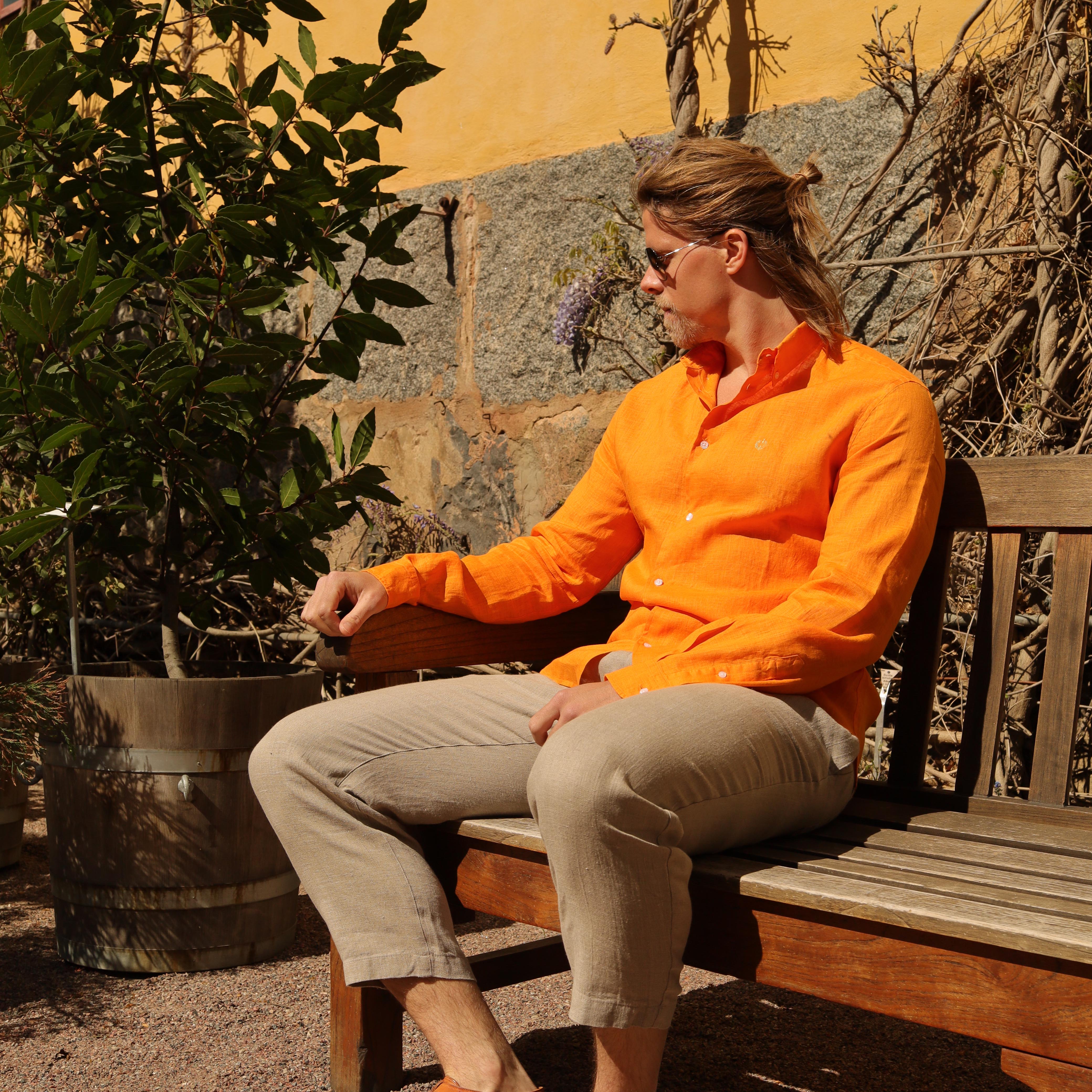
It is with great pride and joy that I present the latest linen garments. I always set a high standard; even so, every once in a while, I am additionally happy with a release. This is one of those moments. I am the the first customer of the clothing, which means that the clothes must meet my own expectations and desires – I basically only wear Legio Gloria these days. A lot goes into a garment – look, feel, and material to just name a few aspects.

Ever since our first linen shirt (released in 2019), I have been a fan of linen – a fan on many levels! Linen looks good and feels good. It has a long and illustrious history, especially in Europe. Moreover, since we have delved into the esoteric as of late (with the book reviews), I can also note that linen is a sacred garment. I am not yet knowledgeable enough to point out exactly how, but I just know it on a deeper level – I feel in a similar way about wool. Perhaps I will return to the topic at a later time.
‘Legio Gloria products are high quality, smart and comfy. Linen is the best fabric for summer, wool the best for winter. Cotton acceptable. Polyester blasphemous.’
Survive the Jive (via Telegram)
The statement above is a great endorsement from my favourite YouTube (and Odysee) channel. Feels great!
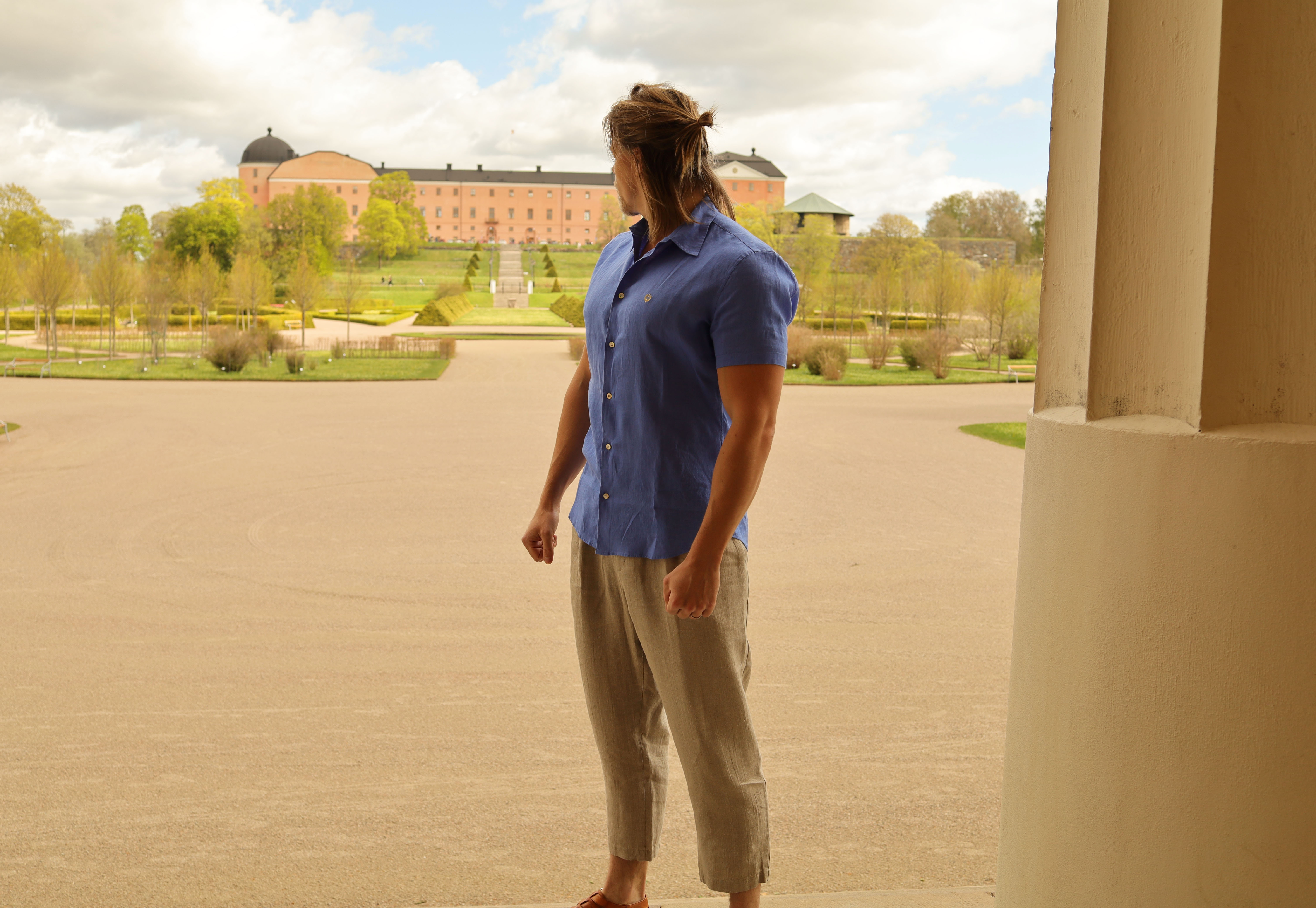
I posted the following to Telegram and Instagram, and deemed it reasonable to share here as well:
I, an artist, seek to imbue all my works (be it sculpting my physique or developing clothing) with as much beauty as possible. In order to do so, I endeavour to surround myself with beauty. The beauty I absorb can then be used for creative purposes. Architecture is a main source of beauty. People living in architecturally beautiful environments = happier. It is an easy concept. Upon regime change, a priority is thus to beautify cities (where possible) by replacing unaesthetic buildings with ones in classical style. The pictures above are taken in Uppsala, which, despite being populated by all manner of questionable characters, is a truly beautiful and sacred place.

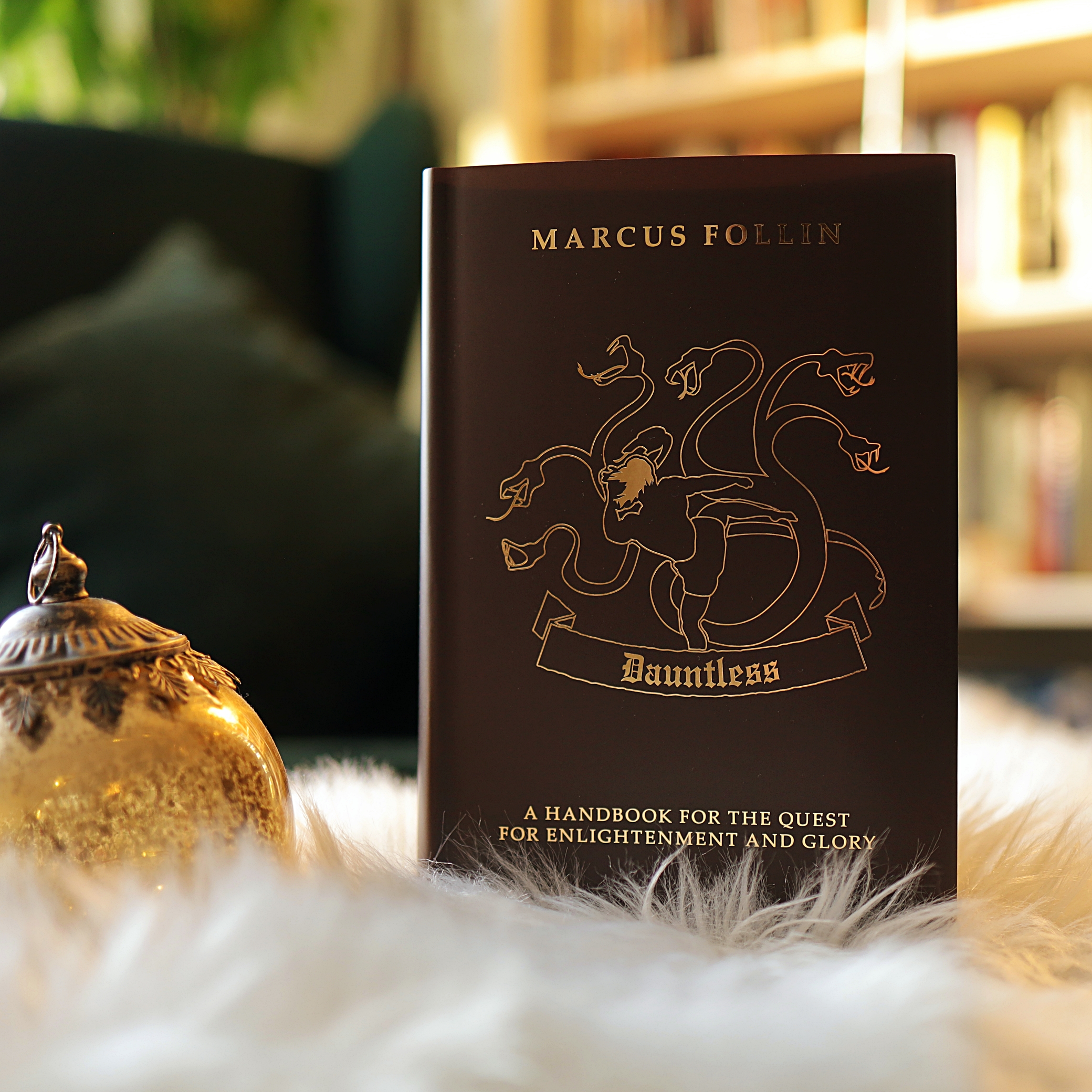
Check out the new releases here: LegioGloria.com (you can also order Dauntless – The Wild Hunt Edition from the same webshop if you have not already read it).
The Mystery of the Grail by Julius Evola
Posted on April 23, 2022

I have read The Mystery of the Grail by Julius Evola. This book was at first just an appendix to Revolt Against the Modern World, but three years after its release Evola published The Mystery of the Grail as a book of its own – which is fortunate for us. On a personal note, I have always had a great affinity for the Grail legend, so perhaps I am biased in this regard, but I would say that this is one of Evola’s most interesting books. Something to be noted is that many of the perspectives presented in the book are elaborated on in other books as well, so being familiar with Evola beforehand may make the insights easier to understand.
Generally speaking, the more of Evola you read, the more sense his other works will make. As I mentioned in this video (Momentum Is King – Bombard Your Mind To Learn – Train Everyday), the more pieces of a puzzle you put down, the better grasp of the full picture you will get. Below are, as always, just a few insights I thought would be particularly interesting to share.
Guelphs and Ghibellines
A reoccurring theme in Evola’s work is the medieval conflict between the Guelphs (supporters of the Pope) and the Ghibellines (supporters of the Holy Roman Emperor). Understanding this conflict and Evola’s views on it is instrumental in understanding many of his other teachings. This is especially true for his disagreement with René Guénon, which we have discussed in many other reviews.
Evola, as we have noted before, viewed the Emperor – whether in the Roman Empire or the Holy Roman Empire – as the (rightful) highest spiritual authority, as opposed to the Pope. Therefore, Evola viewed the Middle Ages from a pro-Ghibelline perspective. Much more can be said about the historical context surrounding the Guelphs and Ghibellines, and we are bound to return to the topic at a later stage.

The Three Elements of Medieval Civilisation
In a very insightful chapter titled The Grail as a Ghibelline Mystery, Evola notes that medieval civilisation was shaped by three elements: Northern-Pagan, Christian, Roman. A certain segment in this chapter is so interesting that I found it reasonable to share most of it here. He states that the Northern-Pagan component played a decisive role in many aspects of social life, and perhaps more importantly for the topic at hand, that:
‘The feudal regime, the knightly morals, the civilisation of the courts, the original substance that engendered the crusading spirit are inconceivable without a reference to Nordic-Pagan blood and spirit.’
Julius Evola – The Mystery of the Grail. Page 121.
And, in regard to the Goths and other Germanic tribes (i.e. Nordic-Pagan blood), he states that:
‘But while the races that descended upon Rome from the North should not be considered “barbarian” from this perspective (since it seems to me that they carried along values that were superior to those of a civilisation that was already decayed in its principles and in its people), we can still talk of a certain barbarism, which does not mean primitivity but rather involution, in specific regard to their spiritual traditions. I have already mentioned the existence of a primordial Nordic-Hyperborean tradition. In the peoples living at the time of the invasions we can find only fragmentary echoes and obscure memories of such a tradition, which leave a wide margin to popular legends and to superstition.’
Julius Evola – The Mystery of the Grail. Page 121.
This is similar to what I have said in regard to the Goths as being the true heirs of the Roman spirit. As I noted in a recent article: The Rome that Alaric sacked in 410 was a far cry from the glorious city it had once been, and the spirit that led the Romans to glory had been long gone by this stage. I will meditate further upon this, but even at this stage one could argue that the spirit of Rome – which was founded by invading Indo-Europeans from the north – would have had more in common with the Goths than the people of the Roman empire during its waning years. I will return to this topic at a later stage, but what we can say now is that Rome during the early 400s was not the same Rome (bio-spiritually) as it was during its Golden Age (for more information on ancient Roman DNA, read this article: Ancient Roman DNA).

‘In any event, these memories were such that forms of a tough, warlike, and rough-hewn life prevailed over everything spiritual. The Nordic-Germanic traditions of the time, which were largely constituted by the Eddas, retained slight residues whose vital possibilities appear to have been exhausted and in which little was left of the wide scope and metaphysical tension that were proper to the great cycles of the primordial tradition. Thus we may speak of a state of involutive latency of the Nordic tradition. But as soon as contact with Christianity and with the symbol of Rome occurred, a different condition ensued; this contact had a galvanising effect. In spite of everything, Christianity revived the generic sense of a supernatural transcendence. The Roman symbol offered the idea of a universal regnum, of an aeternitas carried by an imperial power.’
Julius Evola – The Mystery of the Grail. Page 121.
Thus, one interpretation could be that the spirit of Eternal Rome – Imperial Europa – was inherited by the Goths (and other Germanic tribes – the Franks in France for example) upon their invasion of Western Roman territories. This spirit would then give raise to the Middle Ages (which was a spiritual high-point for Evola, as he discusses elsewhere). One could envision the passing of a flame in terms of this spirit – the Imperial spirit going from Rome to the Holy Roman Empire, with Charlemagne being a particularly bright flame in this regard.
‘All this integrated the Nordic substance and provided superior reference points to its warrior ethos, so much as to gradually usher in one of those cycles of restoration that I have labelled “heroic” in a special sense. And so, from the type of the mere warrior the figure of the knight arose; the ancient Germanic traditions of war waged in function of Valhalla developed into the supranational epic of the “holy war” or crusade’.
Julius Evola – The Mystery of the Grail. Page 121.
In inheriting this spirit, the Germanic peoples could elevate themselves – i.e. the lower warrior could transcend into the higher knight. Evola discusses the concept of holy war further in Metaphysics of War. I also elaborate on the ‘inner’ and ‘outer’ crusade and jihad in Dauntless. There is an important lesson to be learned here – namely, that a high-thumos man guided by higher principles can elevate himself above his current state. Therefore, it can be said that adding a spiritual dimension to one’s life is a good decision.

‘A shift occurred from the type of the prince of a particular race to the type of the sacred and ecumenical emperor, who claimed that the principle of his power had a character and an origin no less supernatural and transcendent than that of the Church. This true renaissance, however, this grandiose development and wonderful transformation of forces, required an ultimate reference point, a supreme centre of crystallisation higher than the Christian though Romanised ideal, and higher than the external and merely political idea of the Empire. This supreme point of integration was manifested precisely in the myth of the Grail’s regality, according to the intimate relation it had with the several variations of the “imperial saga.” The silent problem of the Ghibelline Middle Ages was expressed in the fundamental theme of that cycle of legends: the need for a hero of the two swords, who overcomes natural and supernatural tests, to really ask the question: the question that avenges and heals, the question that restores power to its regality.’
Julius Evola – The Mystery of the Grail. Page 121.
The question he refers to is a common theme in the Grail legend (i.e. that the hero must ask an appropriate question at a certain stage). The quote continues:
‘The Middle Ages awaited the hero of the Grail, so that the head of the Holy Roman Empire could become an image or a manifestation of the Universal Ruler; so that all the forces could receive a new power; so that the Dry Tree could blossom again; so that an absolute driving force could arise to overcome any usurpation, antagonism, laceration; so that a real solar order could be formed; so that the invisible emperor could also be the manifest one.’
Julius Evola – The Mystery of the Grail. Page 122.
In conclusion it can be said that (as we have noted before) Evola viewed the Emperor (in this case the Holy Roman Emperor) as the rightful spiritual authority, just as the Pontifex in Rome had been, as opposed to the Papacy. It is worth pointing out that the rivalry between Emperor and Pope during the Middle Ages was not only in regard to spiritual authority, but also in terms of political power. As noted above, this is a deep and interesting topic which we will return to in other contexts.
Ancient Wisdom in Constantinople
Just as the imperial spirit went from Rome to its Germanic inheritors, so did another spirit of the classical world go to Constantinople. This spirit, in the form of classical knowledge and art, returned to Renaissance Italy during the final years of the Byzantine Empire (to save the treasures from the Ottoman conquest). This is not something Evola elaborates on in the book – it is merely a note of my own for the sake of clarity. We will return to this discussion at a later stage.

The Templars and the Crusade Against the Grail
Evola refers to Otto Rahn, whom we have discussed in these reviews: Lucifer’s Court – Book Review and Inspiring Quotes and Crusade Against the Grail by Otto Rahn as well as in Podcast Episode 9. The Pinnacle of Civilisation – France. In his discussion about the Cathars he notes that, in his view, the spirit of Catharism had little to do with the spirit of the Grail’s Templarism. From my understanding of Cathar doctrine, I am inclined to agree with this assessment. If one were to view the Templars, and other similar organisations such as the Teutonic Order and the Hospitallers, as spiritual descendants of the Indo-European Männerbund, then they are indeed quite different from the less militaristic Cathars. The life-denying attitudes of the Cathars are in sharp contrast to the heroic (in the Evolian sense) spirit of the Templars. The quote below ties in well with previous discussions regarding the Magna Mater (for example here: The Yoga of Power by Julius Evola).
‘But while in the Grail cycle the positive and virile aspect of an ancient, pre-Christian Nordic-Celtic legacy was resurrected, in Catharism what apparently reemerged was the negative, feminine, gynecocratic aspect, belonging to a different pre-Christian legacy, which I have characterised elsewhere as “Atlantic-Southern” and which should be considered as an alteration of the primordial tradition in the sense of the “cycle of the Mother.”’
Julius Evola – The Mystery of the Grail. Page 139.
He goes on to note that the Cathars viewed the Catholic Church as ‘too Roman’ to be the Cathar ‘Church of Love’. To use modern political terms, one could say that the Cathars were ‘to the left’ of the Catholic Church. This is quite similar to how the discourse regarding Christianity looks today – plenty of criticism comes from ‘the left’ (in the form of atheists and anti-Europeans, etc.) as well as from ‘the right’ (i.e. Pagans).
In pointing this out Evola shows that the crusade against the Cathars and the attacks on the Templars (in the fateful year of 1307) were quite different in their nature.
I thought to add something that relates to this. On a personal note, I usually defend the Church and Christianity when attacks come from the ‘Left’ (i.e. from liberals and atheists etc.), but am receptive to criticism from the ‘Right’ (i.e. from Right-Wing Pagans) if voiced in a respectful and mature manner.

Philip the Fair and the Templars
In Metaphysics of Power (I wrote a shorter review of it), Evola elaborates on France’s Philip the Fair. Evola mentions Philip in this book as well. He does not have much good to say about him – he labels him a ‘secularised, profane, and despotic king who hated the aristocracy.’ I am not yet knowledgeable enough about medieval French history to comment upon whether Philip the Fair was a good king or not. His elimination of the Templars and opposition to the aristocracy can simply be seen as a way to solidify state power – which is natural and understandable.
Thunderweapons and the Axis Mundi
The concept of the World Axis – Axis Mundi – will be familiar for those who read my review of The Serpent Symbol in Tradition by Dr. Charles William Dailey. Evola mentions it in chapter 18, which is titled The Mystery of the Lance and of Revenge, in which he notes that the lance (like the scepter) often interferes with the symbolism of the Axis Mundi. He does not elaborate extensively upon the concept, but I thought it would be interesting to point it out since we encountered thunderweapons and the Axis Mundi in the aforementioned book.

René Guénon and the Freemasons
In the epilogue, Evola expresses his lament over the fact that Guénon views Freemasonry in a positive light. Although the discussion on Freemasonry is brief and not central to the book, I deemed it reasonable to share this here since we are bound to return to the topic in later reviews or Podcast episodes.
‘It is surprising to find in a very qualified expert in traditional studies, such as Guénon, the claim that together with Compagnionaggio, Freemasonry is almost the only organization in the West that currently may claim, despite its degeneration, “an authentic traditional origins and a regular initiatory transmission” (Apercus sur l’initiation [Paris, 1946], 40, 103.) Guénon apparently rejects the correct diagnosis of Freemasonry as a pseudoinitiatory syncretism promoted by underground forces of counterinitiation, a diagnosis that could be established even on the basis of his own views. How Guénon’s view of Freemasonry as a traditional organization could possibly be reconciled with his positive assessment of Catholicism, a sworn enemy of modern Freemasonry, still needs to be clarified.’
Julius Evola – The Mystery of the Grail. Page 172.
Evola goes on to say that he has friends who are Freemasons, including Reghini – whose articles are included in Introduction to Magic (reviews here and here). He also mentions that he has some good things to say about the lodges that refrain from socio-political engagement.
Conclusion
As noted above, this is perhaps the most interesting book by Evola I have read thus far. The book is also helpful when it comes to understanding his view of the imperial spirit, and this, in turn, makes many of his other teachings more understandable. If you are interested in Evola’s writings, I can highly recommend the book.
The Serpent Symbol in Tradition by Dr. Charles William Dailey
Posted on April 10, 2022 1 Comment
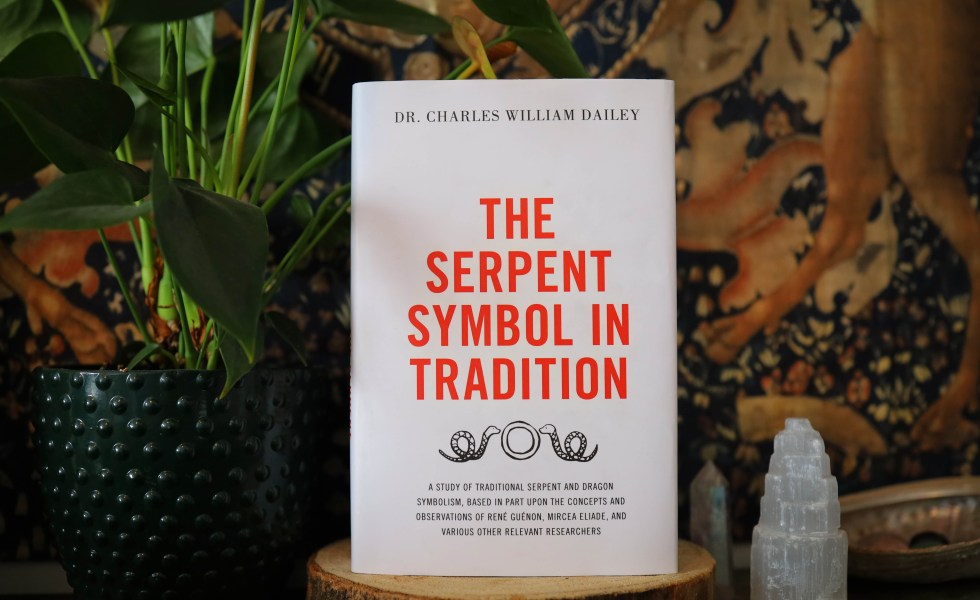
I have read Dr. Charles William Daily’s excellent book The Serpent Symbol in Tradition – A Study of Traditional Serpent and Dragon Symbolism, Based in Part Upon the Concepts and Observations of René Guénon, Mircea Eliade, and Various Other Relevant Researchers. At 572 pages, with quite technical language, reading the book is a bit of a time investment. The author himself states, in the dedications, that his writing style is ‘stodgy’. I would not necessarily say it is stodgy, but rather, again, technical, and perhaps not as free-flowing as other works I have read. However, this is not a negative aspect in this context, as the style of writing makes the sometimes complex insights easier to understand. Another way in which the author emphasises certain points is to repeat insights in different contexts, which makes the Perennial aspects of various symbols clearer. The book contains a wealth of valuable insights. Below are just a few (among many) topics I thought to share.
René Guénon and Mircea Eliade
As stated in the subtitle of the book, the author draws upon the teachings of France’s René Guénon (1886–1951) and Romania’s Mircea Eliade (1907–1986). In the introduction of the book, the author gives a good background to each gentleman. Knowing a bit more about an author is good to better understand his worldview. For example, Guénon was fragile of health as a child, which might have caused him to view the contemplation of the Priest/Brahman as higher than the action of the Warrior/Kshatriya (which we have discussed in previous reviews). Guénon, alongside Julius Evola, is an authority on matters of Tradition and spirituality. He wrote numerous works which we are bound to return to as we continue on our esoteric journey.
Eliade, as described in the introduction of the book was a highly productive writer – celebrating with his friends his one-hundreth published article at the age of eighteen. He wrote many influential works, including Patterns in Comparative Religion (which is referenced in Taliesin’s Map, which I wrote a review of: Taliesin’s Map: The Comparative Guide to Celtic Mythology). He also wrote articles and book-length treatments on alchemy, approaching the subject as a spiritual doctrine (in a similar fashion to Evola). Reading about the productivity of men like this is inspiring and makes me want to set an even higher pace for myself – in this case to commence the writing of my second book (which I will talk more about at a later stage). Just as we will return to Guénon, we will return to Eliade in coming articles.
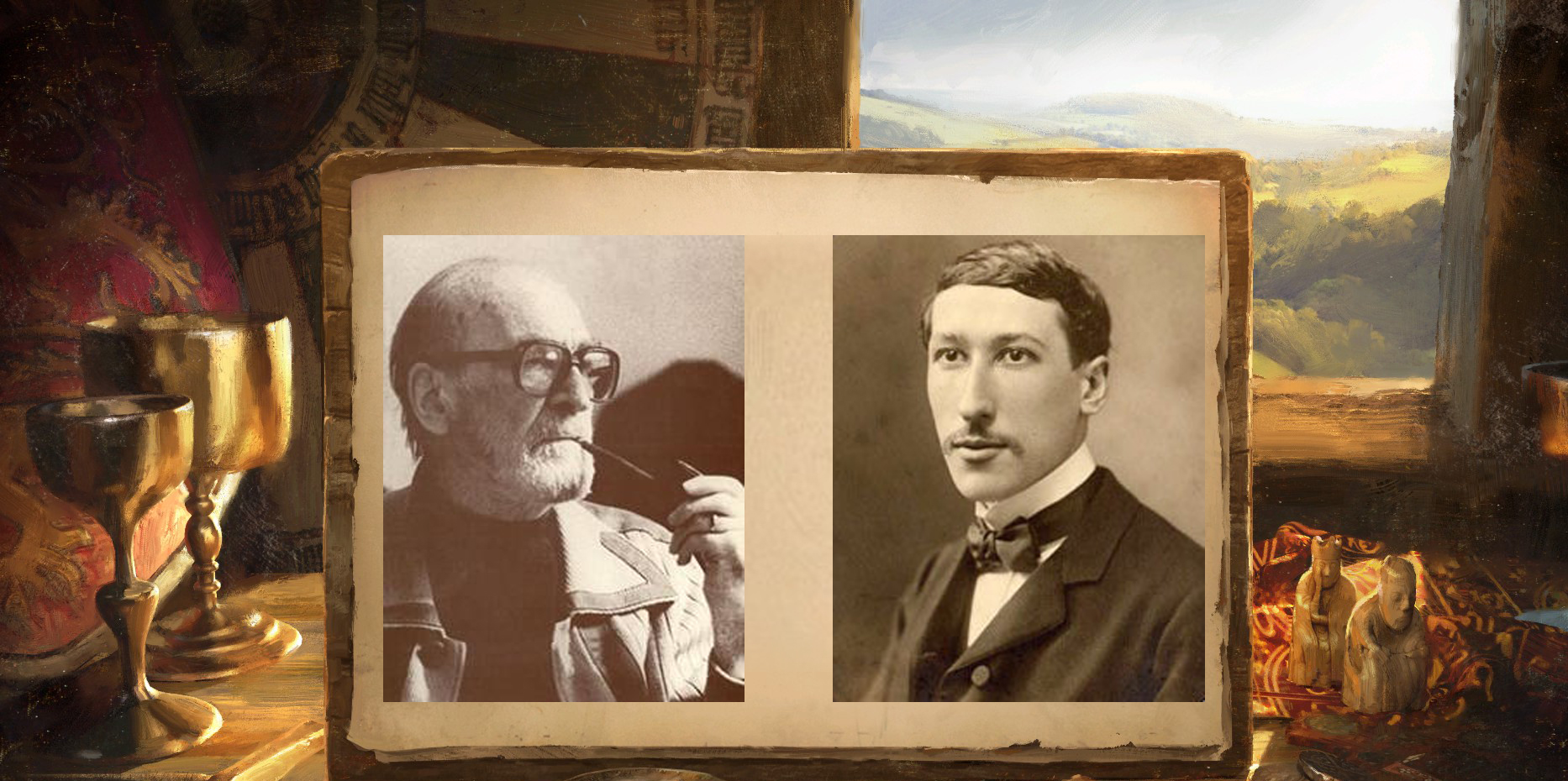
Pictured below: Mircea Eliade (left) and René Guénon (right).
Metaphysics and the Neoplatonic One
The author notes that for Guénon, metaphysics ‘is essentially knowledge of the Universal’, and that he makes a distinction between the Universal (Platonic Forms) and the Particulars. He also points out that Eliade views Platonic metaphysics as an expression of Tradition.
For Guénon, all religions are merely particular manifestations of the one metaphysical doctrine (Tradition*) that mingled with heterogenous elements – Particulars (thus creating differences). The author gives an example from Guénon’s Introduction to the Study of the Hindu Doctrines, where Guénon notes that Bhakti Yoga is not in itself a metaphysical doctrine, but merely one expression of Tradition. According to Guénon, the serpent or dragon in Tradition symbolises ‘the indefinite series of cycles of manifestation.’
Note: when Tradition is spelled with a capital T, it denotes this view (also known as Perennialism), as opposed to a specific tradition that is not Universal.
The author contends that the metaphysical Principle (a reoccurring concept) of Guénon can be seen as the equivalent of the Neoplatonic One. The author shares the following quote from the Neoplatonic philosopher Plotinus (204–270 CE):
‘The Intellectual-Principle stands as the image of The One, firstly because there is a certain necessity that the first should have its offspring, carrying onward much of its quality, in other words that there be something in its likeness as the sun’s rays tell of the sun. Yet The One is not an Intellectual-Principle.’
Plotinus – The Six Enneads
The Serpent Guardian of Enlightenment
In chapter 14, the author notes that in certain myths (Herakles and the Golden Apples, for example) the serpent or dragon symbolises something that may be two opposing alternatives:
1. Achieving enlightenment/immortality/moksha (moksha is a Hindu concept of enlightenment or liberation).
2. An obstacle to (or a guardian of) enlightenment/immortality/moksha.
As we have noted in previous reviews, a hero with the power to subjugate the Dragon (Living Fire, ύλη (matter), Green Dragon, Quintessence, First Substance, Great Magical Agent) can use its powers to fuel his ascent to greatness.
The Caduceus
A symbol that may be familiar is the Caduceus, the Rod of Hermes (in Roman: Mercury). The author states the following in regard to its meaning:
‘I suggest that Hermes’/Mercury’s rod represents the ‘unity’ of the metaphysical ‘Principle’ that is ‘surrounded by’ its ‘polarization’ into two forces, one of which ‘ascends’ toward its unifying Source and the other of which ‘descends’ into the realm of ‘duality’ (‘chaos’).’
Dr. Charles William Daily – The Serpent Symbol in Tradition

Aryan Patriarchy and the Earth Mother
The Magna Mater, the Great Mother, the Earth Goddess, whom we have discussed before (for example here: The Yoga of Power by Julius Evola), appears in this book as well. The author notes that one interpretation (subscribed to by Joseph Cambell among others) of certain combat myths is the struggle between Indo-Europeans and the peoples they conquered. The celestial, patriarchal Indo-Europeans representing Order versus the chthonic, matriarchal natives representing Chaos. In Greece the Aryan (Hellenic) Zeus defeats a monster to establish a new social order. In India the Aryan (Vedic) god Indra does the same.
‘Every god has his enemy, whom he must vanquish and destroy. Zeus and Baal, Coyote and Ahura Mazda, Thor and the Lord of Hosts, are alike in this: that each must face a dreadful antagonist. Apollo’s enemy was the great dragon Python, whom he had to fight and kill before he could establish his temple and oracle at Delphi.’
Joseph Fontenrose – Python: A Study of Delphic Myth and Its Origins
Guénon and Eliade do not view the use of symbolic weapons (such as the thunderbolt) and the vanquishing of serpentine antagonists in these socio-political terms, but rather as a manifestation of the metaphysical Principle in the physical world. I am not yet wise enough to give a definitive statement upon this, but it is reasonable to say that certain myths may pertain to a struggle between peoples and other similar myths regard the struggle of the individual for immortality or enlightenment (subjugating the dragon) – as mentioned above.
Thunderweapons and the Axis Mundi
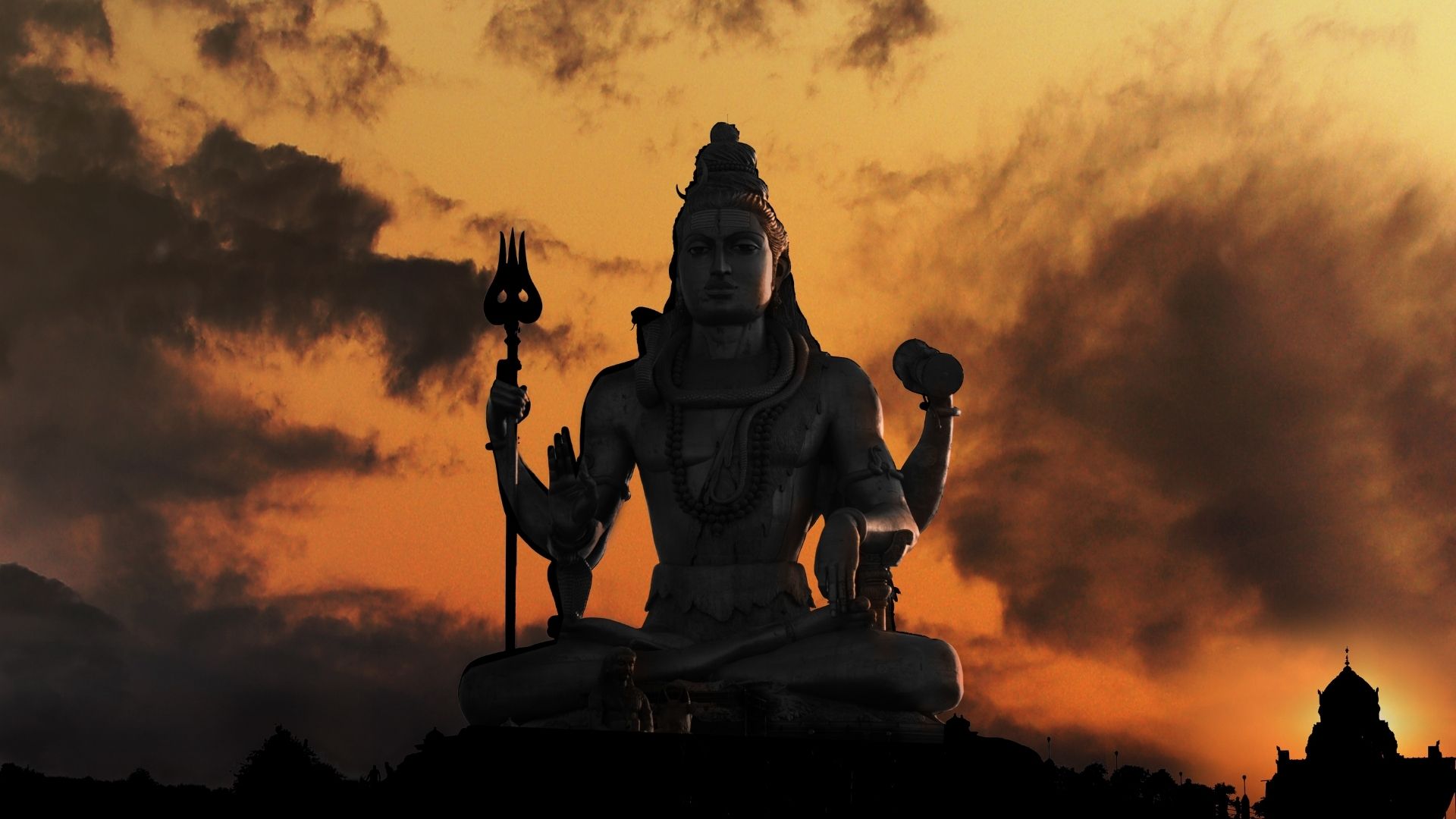
Thor, Apollo, Zeus, Indra, and Marduk amongst other gods and heroes are often depicted as wielding thunderweapons (or variations thereof) in their battles against their monstrous (serpent or dragon) adversaries. The use of these weapons can be seen as harnessing of the power of Heaven. According to both Guénon and Eliade, these weapons can be representative of the Axis Mundi (the World Axis). The World Axis can be described as the metaphysical (transcendent) Reality at the centre of the universe.
Pictured below: Thor wielding the thunderweapon Mjölner.

Chinese Dragon-Emperor and the Axis Mundi
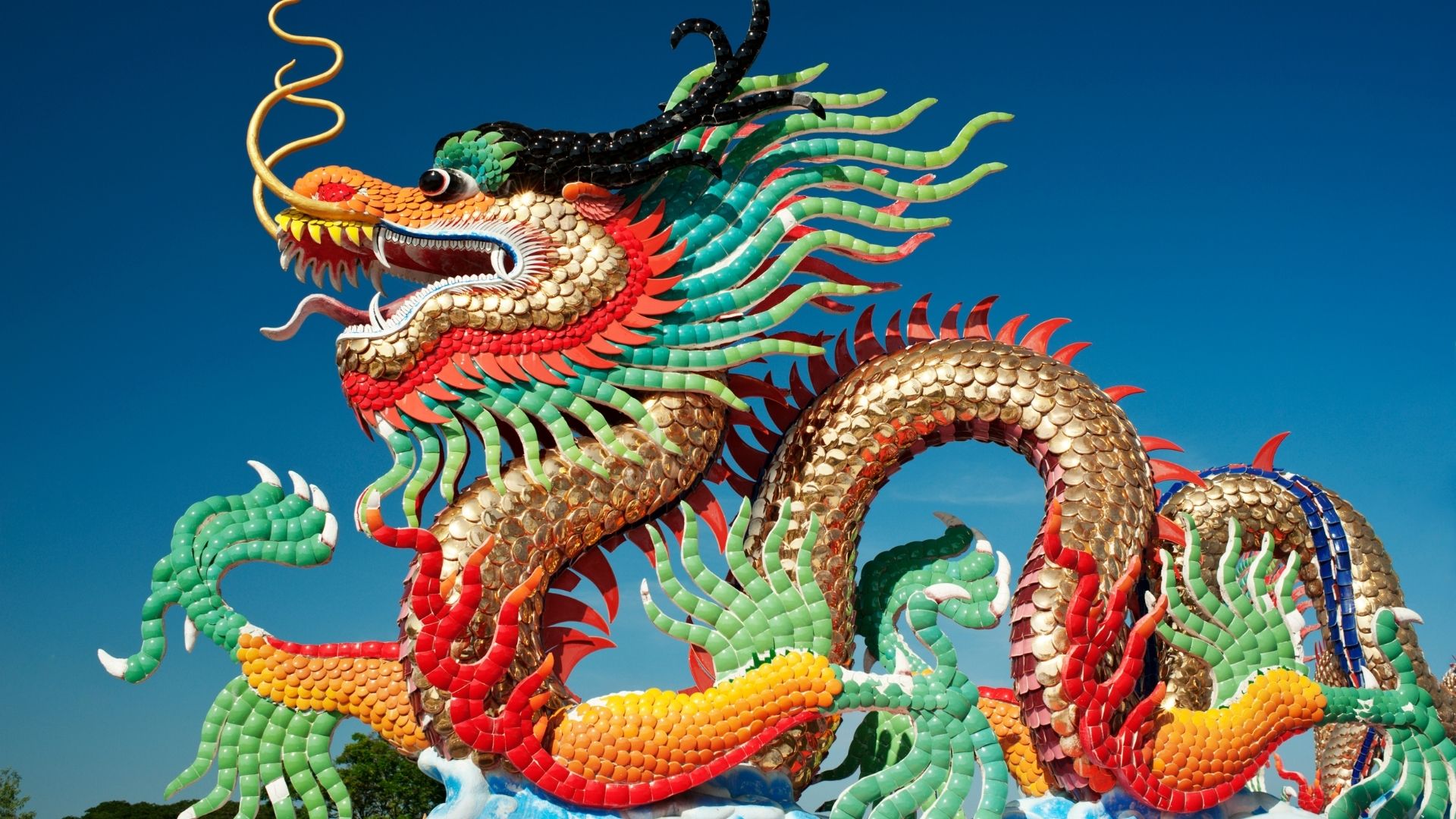
The author elaborates on the sacred symbolism of the dragon in Chinese tradition. He argues that the Far-Eastern Dragon did not symbolise the Chinese Emperor himself, but rather represented that which the Emperor controlled. The Emperor was a mediator between Heaven and Earth (a bridge between them), a controller of the Water – which is symbolically synonymous with the Dragon (for more regarding the Water, read this review: Julius Evola and the UR Group – Introduction to Magic: Volume 1 under the heading Knowledge of the Waters).
Guénon noted that for the Chinese people, traditionally, the Emperor symbolised the Axis Mundi.
Ouroboros – Anima Mundi – The Soul of the World
In chapter 9 of the book, the author refers to, amongst other works, Julius Evola’s The Hermetic Tradition (read my book review here: The Hermetic Tradition by Julius Evola). He elaborates on the Ouroboros, which may be a familiar symbol to many, and connects it to the Anima Mundi – the Soul of the World. Carl Gustav Jung defined the Anima Mundi as ‘the oneness and essence of the physical world’ and, moreover, stated that:
‘the Anima Mundi was conceived as that part of God which formed the quintessence and real substance of Physis [nature].’
Carl Gustav Jung – Mysterium Coniunctionis
Guénon noted that:
‘as symbol of the Anima Mundi, the serpent is most commonly depicted in the circular form of the Ouroboros.’
René Guénon – The Great Triad
Evola noted the following:
‘the alchemical ideogram of “One the All,” is O, the circle: a line or movement that encloses within itself and contains in itself both its end and beginning. In Hermeticism this symbol expresses the universe and, at the same time, The Great Work [of alchemy]. In the Chrysopoeia it takes the form of a serpent – Ouroboros – biting its own tail.’
Julius Evola – The Hermetic Tradition

I asked Styxhexenhammer666 (the free-speech champion) about his having the Ourobos as an avatar, whereupon he responded: ‘I use the Ouroboros as a symbol of completion and whole-ness. The snake is a cycle, which completes, winding and undulating and changing but always whole.’
Note: in the book, the author writes ourobos and anima mundi. I use my poetic powers to rewrite them as Ourobos and Amina Mundi – I capitalise them for aesthetic reasons.
Sacred Mountains
In chapter 13, under the title The Serpent, the Mountain, the Omphalos, and Sacred Stones, the author continues the discussion on the Axis Mundi. He notes that for Guénon, the ‘Tree in the Midst’ (or the ‘Polar Mountain’) is a common variant of the World Axis – Axis Mundi – that symbolises the metaphysical Principle in the art and myth of various cultures. The Yggdrasil of Norse myth comes to mind here. Guénon listed Montsalvat as such a Polar Mountain. Montsalvat features in the work of Otto Rahn and his quest for the Grail (read my review here: Crusade Against the Grail by Otto Rahn). Mircea Eliade said the following:
‘Mountains are often looked on as the place where sky and earth meet, a “central point” therefore, the point through which the Axis Mundi goes, a region impregnated with the sacred, a spot where one can pass from one cosmic zone to another.’
Mircea Eliade – Patterns in Comparative Religion
Pictured below: The ruins of a Cathar castle – Château de Peyrepertuse – in France, near the Pyrenees, where the semi-mythical Montsalvat is said to be (which exact mountain Montsalvat is remains unknown).
Epic Quotes
Below are two quotes I found particularly appealing. Whenever I share certain quotes – which I titled as epic – I do so not only to provide a deeper understanding of the subject at hand, but more so to invoke a feeling. The quotes below should be felt rather than read. This will, hopefully, inspire a hunger for life that will fuel your quest for excellence.
‘Muchalinda, a prodigious cobra, dwelt amongst the roots. He perceived, as soon as the Buddha had passed into the state of bliss, that a great storm cloud had begun to gather, out of season. Thereupon he issued quietly from the black abode [of the hole that he dwelt in] and with the coils of his body enveloped seven times the blessed body of the Enlightened One; with the expanse of his giant snake-hood he sheltered as an umbrella the blessed head. Seven days it rained, the wind blew cold, the Buddha remained in meditation. But on the seventh, the unseasonable storm dispersed; Muchalinda unloosed his coils, transformed himself into a gentle youth, and with joined hands to his forehead bowed in worship of the saviour of the world.’
Heinrich Zimmer – Myths and Symbols in Indian Art and Civilization
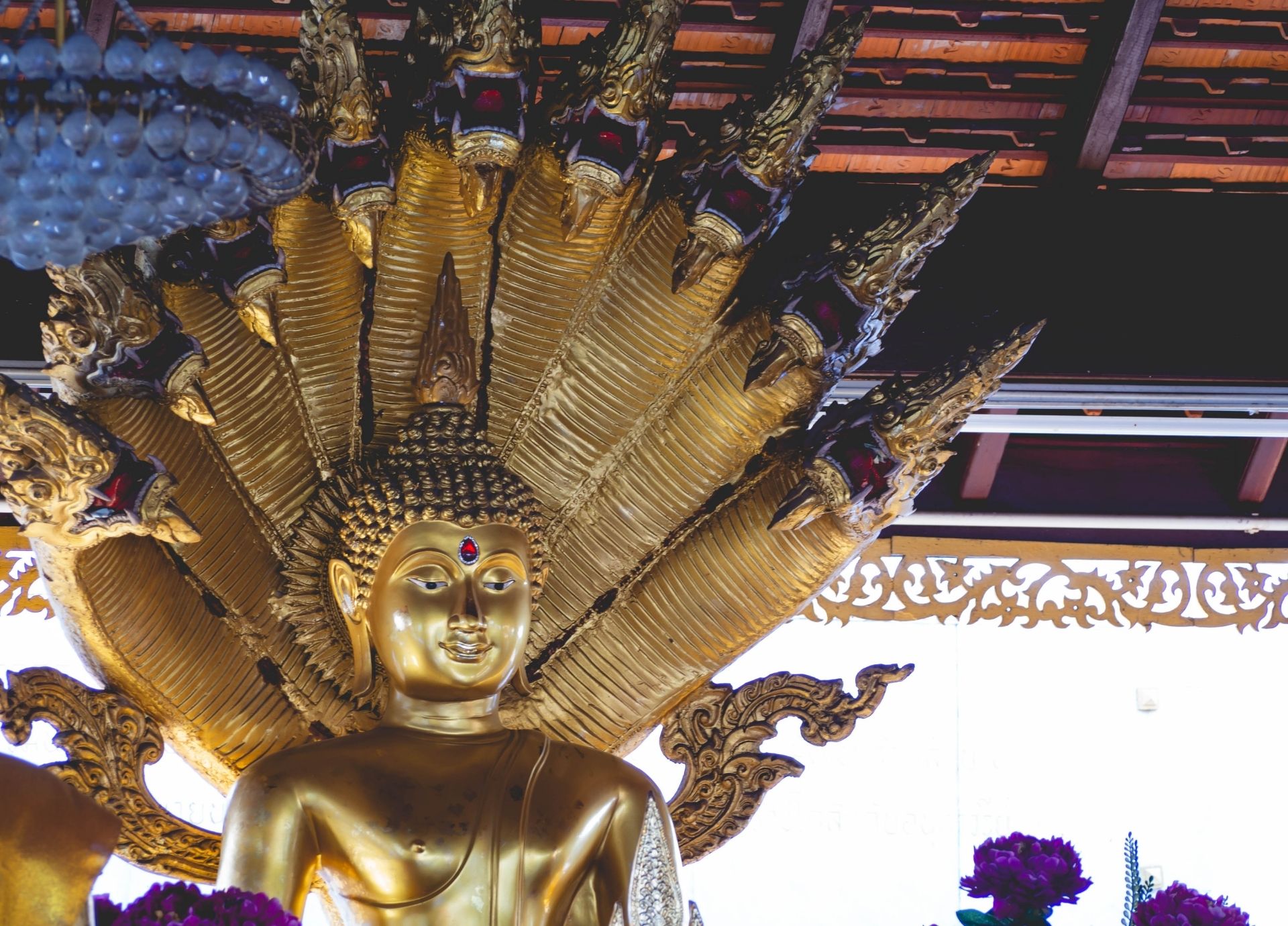
‘Nagas are genii superior to man. They inhabit subaquatic paradises, dwelling at the bottom of rivers, lakes, and seas, in resplendent palaces studded with gems and pearls. They are keepers of the life-energy that is stored in the earthly waters of springs, wells, and ponds. They are the guardians, also, of the riches of the deep sea – corals, shells, and pearls. They are supposed to carry a precious jewel in their heads.’
Heinrich Zimmer – Myths and Symbols in Indian Art and Civilization

Quetzalcóatl
Quetzalcóatl – the Plumed Serpent – is mentioned in the book. Mesoamerican lore portrays Quetzalcóatl as a great educator and civiliser. In the Encyclopedia of Ancient Mesoamerica, Quetzalcóatl is said to have ‘revolutionised Toltec society, banning human sacrifices, corruption and cruelty.‘ Perhaps some Aryan adventurers landed in Central America in ancient times and established themselves as a ruling caste. I will not speculate further on the matter at this stage, but for those who are interested, I recommend watching the following video by Asha Logos: Conspiracy? Our Subverted History, Part 5.3 – The Oera Linda Book. Note, I do not personally subscribe to the legitimacy of the Oera Linda Book, but the video linked is worth watching.
Conclusion
As stated in the introduction, The Serpent Symbol in Tradition contains a wealth of insights and is well worth the time investment. On a personal note, reading it now fitted perfectly in relation to the other books I have read (and written book reviews on) as of late. For anyone interested in metaphysics and myth, I can highly recommend the book!



 The Golden One
You must be logged in to post a comment.